
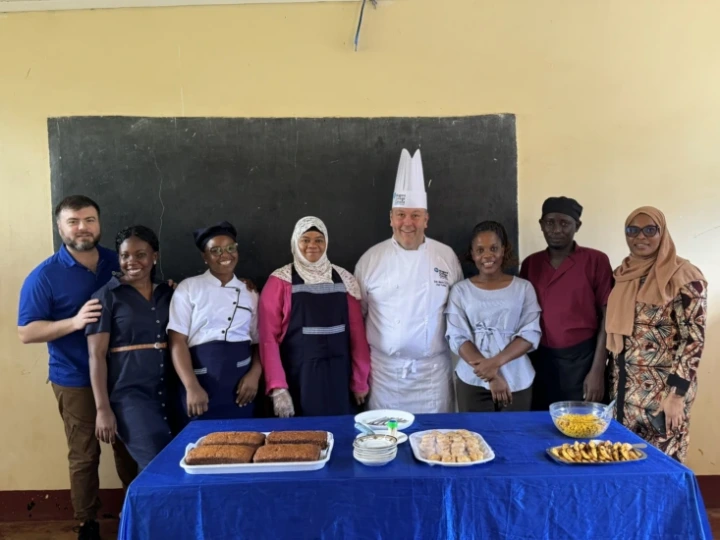
Niagara College brought its expertise in Culinary Arts, Marketing, and Gender Equality to Tanzania, supporting new pathways to learning, skills development, and opportunity through the Empowerment Through Skills Program (ESP-05).
From May 4 to 15, a Niagara College Institute for Global Education and Training team worked alongside local partners in Tanzania to deliver specialized training and strengthen collaboration across key areas, creating two weeks of impactful activities.
Workshop on Marketing
The first week of the collaboration was dedicated to a series of workshops in Dodoma, bringing together partners including Tanzanian Folk Development Colleges (FDCs) in Bigwa and Munguri, and Community-Based Organizations (CBOs) such as Justice in the Society for Transformative Change (JUST) and the Young Strong Mothers Foundation (YSMF).
Led by Esteban Navarro, NC’s Global Education Projects, Project Manager, and Mary Bantug, Seneca’s International Partnerships, Manager, the workshops focused on strengthening institutional capacity in areas such as stakeholder engagement, recruitment, community event planning, and social media marketing strategies.
“Together with our partners, we continue supporting sustainable growth and learner success through applied education and collaboration,” said Navarro. “We also learn from their experience and perspectives, and that shared learning strengthens our work at Niagara College.”
Train-the-Trainer Culinary Sessions
At Bigwa FDC, NC’s Culinary Subject Matter Expert Chef Erik Mauke delivered Train-the-Trainer culinary sessions focused on adapting recipes to the Tanzanian context, exploring recipe costing, and sharing culinary techniques and ingredient substitution strategies.
The five-day training program brought together Bigwa FDC cookery instructors to build on lesson plans developed in 2024 by Chef Isa Mottiar, when NC became the first Canadian college under the ESP umbrella to conduct Train-the-Trainer sessions in the region, strengthening local expertise and instructional capacity. These efforts also contributed to the development of two short courses designed for local colleges: Vegetarian and Vegan Food and Baking Essentials.
The experience was marked by a strong collaborative approach, with participants working collectively to address challenges such as equipment and infrastructure limitations through locally available solutions.
“Personally, this experience pushed me to grow as an educator, as it strengthened my adaptability, patience, and ability to deliver high-level training in unfamiliar environments,” said Mauke. “The warmth and openness of our Tanzanian partners also reminded me that food is a universal language–it brought us together. The impact of this initiative extends well beyond my time there, as the instructors are now equipped to transfer that knowledge to their students and continue building capacity within their institutions and communities. I return to my classroom in Canada with a broader perspective, new stories to share, and a renewed appreciation for the role education plays in building strong, connected communities.”
Lasting change
One participant who reflects the impact of ESP-05 is Monica Faustine, a student at Bigwa FDC. She joined one of the short courses after learning about the free opportunity through ESP-05, as she was unable to continue her studies due to financial challenges.
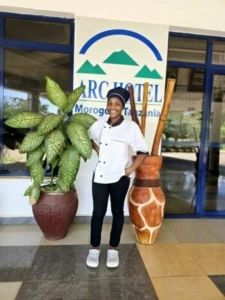
Monica Faustine gained cooking skills through ESP-05 and secured employment at a hotel.
At Bigwa FDC, Monica gained hands-on cooking skills and learned about baking, food preparation, hygiene, and teamwork. She later completed her placement at Arc Hotel in Morogoro, where she applied her training in a professional kitchen.
Her performance led to a job offer at the hotel, where she is now employed in the cookery department. This opportunity has transformed Monica’s life and her family’s.
“I always loved seeing chefs in their uniforms, and it was always my dream to become like them,” said Monica. “When you hear of an opportunity like the one from ESP, don’t be afraid: believe in yourself and show up.”
Monica’s journey reflects the purpose of ESP-05: turning potential into opportunity, and opportunity into lasting change.
About the Empowerment Through Skills Program (ESP-05)
Funded by the Government of Canada through Global Affairs Canada (GAC), ESP-05 is implemented by Colleges and Institutes Canada (CICan). This four-year initiative (2022-2026) is focused on providing alternative pathways to education, employment, and entrepreneurship for students and marginalized groups, particularly women.
In collaboration with Tanzania’s Ministry of Education, Science, and Technology, Niagara College and Seneca Polytechnic work closely with local FDCs and CBOs.
Through these collaborative efforts, Niagara College is taking important steps to support the advancement of sustainable education and drive positive change. This initiative also allows NC to continue supporting the SDGs, specifically SDG 4 (Quality Education), SDG 5 (Gender Equality) and SDG 8 (Decent Work and Economic Growth), and SDG 17 (Partnership for the Goal).
