
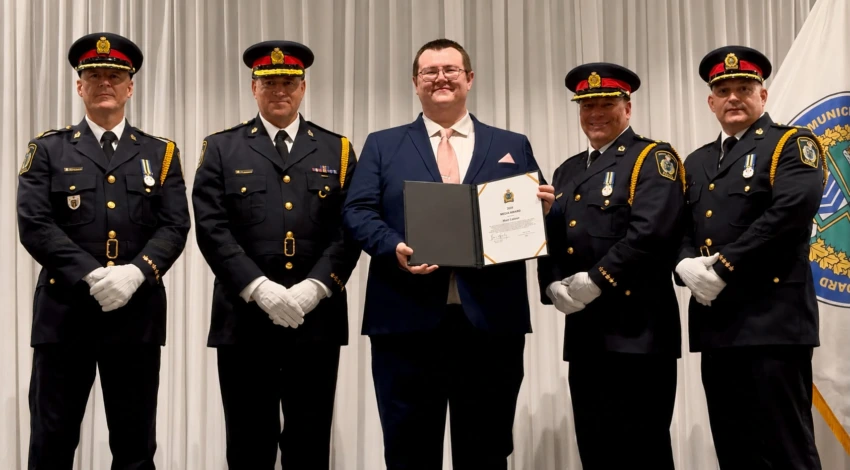
Matt Latour, alumnus of NC’s Broadcasting – Radio, Television and Film (BRTF) program, has been recognized with the Niagara Regional Police Service (NRPS) Media Award, an annual honour presented to local journalists and media personalities who actively and fairly report on police activity and community safety stories.
For Latour, the recognition reflects years of work in radio news built on the foundation he developed at NC.
“Winning the award was a very special feeling,” said Latour. “I know that I do good work and honest reporting, values that were instilled in me from my time at Niagara College, but being recognized for it validates that feeling. I don’t do my radio news work for any sort of recognition; the most important thing is that the audience is kept in the know about issues that matter to them.”
Born in St. Catharines, Latour moved to Oshawa at a young age and grew up in the Durham Region. In his final years of high school, he volunteered with the Rogers TV crew covering games, an experience that first sparked his interest in broadcasting. As he began exploring post-secondary options, NC quickly stood out. After visiting the Welland Campus, he knew it was the right fit, ultimately choosing the BRTF program that would launch his career.
Current role and career path
ML: Currently, I am the Morning News Anchor and Reporter for both 91.7 Giant FM and Niagara’s New Country 89.1, where I’ve been since January 2024. I cover a wide range of stories across the Niagara Region, from politics and sports to crime and community news. My day starts around 5 a.m. in the studio, with newscasts airing between 6 a.m. and 9 a.m., followed by writing stories and interviewing local newsmakers.
I began my radio career in 2017, receiving my first job offer during my Niagara College convocation. My first role was in Barry’s Bay, where I worked as a news reporter and morning show host. I later moved to Peterborough, working with Oldies 96.7 and EXTRA 90.5 (now FREQ 90.5), primarily as a news reporter and occasional fill-in host.
Both those stations and my current roles are with My Broadcasting Corporation, where I’ve worked across two stints over the past eight years. With MBC operating more than 20 stations across Ontario, my work is also heard in regions from the Upper Ottawa Valley through to the London area.
Influences and inspiration
ML: I originally came to Niagara College wanting to become a sports cameraman, and that was the plan I was set on. I spent a lot of time volunteering on Oshawa Generals broadcasts, often as the main follow camera, and it felt like the direction I was meant to go in. That changed on September 16, 2014 – a date I remember clearly because it was my best friend’s birthday, I got a traffic ticket on the way home from campus, and it was my first radio class.
At first, I didn’t think radio was for me. I was outgoing, but the idea of being on air was outside my comfort zone. To ease into it, I volunteered to read sports, and I was immediately hooked. Growing up, I was always talking about whatever I was interested in, hockey, wrestling, anything, and the idea of sharing that with an audience felt natural and exciting.
After my first radio lab, I was faced with a choice between continuing down the camera path or pursuing radio. It wasn’t a decision I made quickly, but after a lot of thought, I’m glad I chose radio.
The BRTF experience
ML: When we started doing full assignments and in-class radio labs, it really felt like I was already in the working world. Coming from someone who admittedly coasted through high school, the BRTF program was a reality check. Meeting deadlines is one thing, but being accurate to the second is something I feel only BRTF can truly teach.
I struggled in my first semester and my grades weren’t good. After a difficult conversation with my mom following mid-term marks, I realized I had a choice: leave the program or learn to manage the pressure and push through. I chose to stay and adapt to the demands of a fast-paced, high-pressure field. That program is not for the faint-of-heart; it will test you. That’s what makes it so good and prepare you well for the your career outside of College.
I’ve had days covering major news, whether it’s a 24-hour standoff or the start of a global pandemic, where the pressure would have been overwhelming without the foundation NC provided. The BRTF program prepared me for those moments and taught me how to handle pressure in a productive way.
Standout NC moments
ML: Anyone who knew me during my time at Niagara College can confirm I was a huge sports fan. It didn’t matter if it was hockey, basketball, volleyball, or football, I wanted to be involved. I don’t know the exact number, but I did well over 100 games as a play-by-play commentator while I was a student.
I was also fortunate to be at NC during a time when the college covered major events like the 2016 IIHF U18 Women’s Championships in St. Catharines and the 2016 OCAA Women’s Basketball Championships in Welland. While not directly tied to my current role, those experiences gave me the confidence that I could build a career as a broadcaster.
Those opportunities ultimately led to me becoming the first-ever play-by-play commentator for the Niagara River Lions, a role I held for the franchise’s first two seasons. Even while still in school, I was already working in professional sports, which was a direct result of how well the BRTF program prepared me.
NC mentors
ML:
- Bruce Gilbert is one of the most influential professors I had at Niagara College. Working with him throughout my second and third years was incredibly impactful. I learned a great deal from him, not only about radio, but about how to treat people. In broadcasting, how you treat people is just as important as your skill set — d something Bruce consistently reinforced and that I’ve carried with me throughout my career and life.
- The first radio professor I ever had was Chris Jeanneret, who made it clear early on that my work ethic needed to improve if I wanted to reach my potential. His first-year class was a wake-up call. I wasn’t performing well academically because I was trying to coast through college the way I had in high school. I had a difficult but important conversation with Chris in my first semester that pushed me to change course and take the program seriously.
- Peter “Dutch” VandenBerg is another professor who had a lasting impact on me, even though I was never formally in his classes. Through remote broadcasts with NC’s production team, I worked closely with him and often spoke with him more than some of my instructors. Even now, when I return to campus, I make a point of stopping by to reconnect and reflect on those experiences.
- Another professor I’d like to acknowledge is Dave Lostracco. While I only had him for two classes, I saw him frequently at mobile sports broadcasts. We had many conversations about the industry, navigating it as a newcomer, and the importance of understanding roles within a production. A good broadcast, he emphasized, only works when everyone does their part well.
Preparing for industry challenges
ML: The radio industry is a tough one. From the outside looking in, it’s easy to assume it’s shrinking, which is true in a sense. There are fewer jobs, especially in my area of news, and more stations are seemingly being sold. The most important part is being versatile, and being someone that cannot be replaced. My entire career, I’ve made it a point to be the guy someone can come to for a news story, hosting an on-location show, whipping up a graphic for social media. If you’ve got that many tools at your disposal, it’s going to be very tough for any company to get rid of you. In fact, you’ll be the broadcaster that they ask to stay when you say you’re going somewhere else.
Niagara College helped me become this versatile broadcaster I am today. From radio and television labs doing sports, news, weather and hosting, to graphic design courses that you may think you’ll never need, every little bit matters and is what made me the broadcaster I am today.
Words of wisdom
ML: If you’re on the fence about which school to choose, I can make it simple: go to Niagara College.
I graduated from the BRTF program in 2017, and I’ve been speaking highly of it ever since convocation. The program will challenge you, but you’ll also have strong support when you need it from your professors. At Niagara College, I never felt like just another student, they genuinely cared about both the quality of your work and the person behind it. They understood the pressure students were under and consistently made an effort to support your wellbeing so you could succeed.
As post-secondary broadcasting programs across Canada continue to close or scale back, I’m not surprised to see BRTF still standing strong. It’s the best there is.
Out in the industry, the transition is straightforward: apply what you were taught in BRTF. Whenever I meet a fellow graduate in radio, there’s a noticeable level of professionalism and work ethic that sets them apart. The program equips graduates with everything they need to succeed in whatever workplace they enter.
