
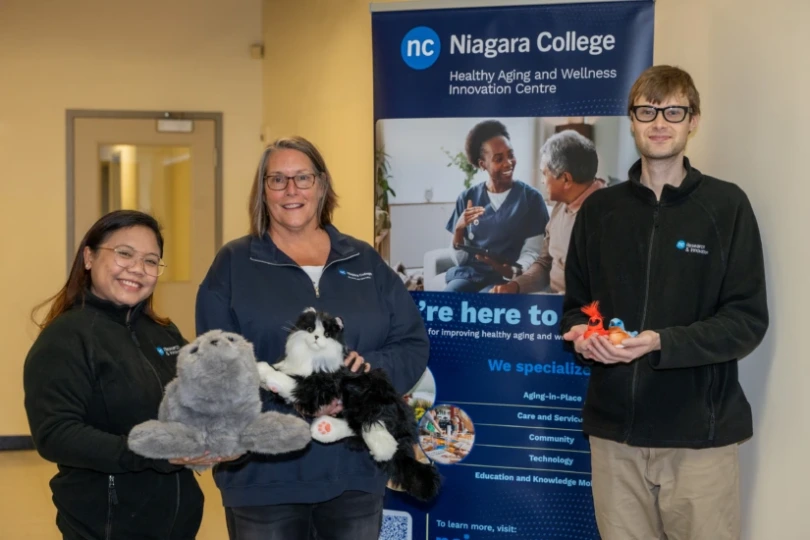
Coco the seal, Charlie the cardinal, and Sam the bluebird may be robotic, but their positive therapeutic benefits could not be more real – and research underway at Niagara College is helping to harness their full potential.
The heartwarming breakthroughs that robotic animals offer seniors with dementia are the driving force behind NC’s “Fins, Feathers and Fur” project. This initiative has become the cornerstone for the College’s new Healthy Aging and Wellness Innovation Centre (HAWIC), the latest focus for its trailblazing Research and Innovation division.
Research Lead Christine Wilkinson, a longtime Recreation Therapy Professor with expertise in dementia care, began her initial study on robotic animals two years ago. Her longtime interest in robotic animals led to the purchase of NC’s first robotic seal for the Recreation Therapy program in 2018. While the therapeutic benefits of these devices were well documented, Wilkinson observed a critical gap: despite their high cost – a single robotic seal can run $9,000 – they arrive without clinical guidance. She noted that staff often lacked the instructions or information needed to achieve the greatest therapeutic outcomes.
“What I kept seeing over and over again, was that staff members didn’t necessarily know how to use the robotic animals in the most effective way with the residents,” said Wilkinson. “The manual explains how to charge them, clean their fur and troubleshoot the technology, but it doesn’t explain how to use the robotic animal to engage with the residents.”
In January 2025, Wilkinson transitioned from recently retired faculty to HAWIC Research Lead. Supported by an investment by the federal government, she set out to bridge this training gap. Her team, with the help of students and staff from local long-term care residences, developed and piloted a three-hour Fins and Feathers training program and custom toolkits, which include intervention planning tools, large-print fact books about the animals, conversation prompts, activity resources, and visual memory supports to help residents remember their robotic visitors.
The project has now entered its “Fins, Feathers and Fur” phase, as the College recently acquired a suite of yet-to-be named robotic cats and dogs to add to its collection of robotic animals. She noted that the robotic cats and dogs offer a lower-priced, more familiar alternative to the AI-driven seals and singing birds and they are often used as pet replacements, triggering deep-seated instincts among former pet owners. The team will soon be enhancing the toolkits and training to include robotic cats and dogs.
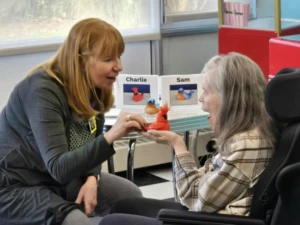
Christine Maleta, Responsive Behaviour Therapeutic Advisor for Niagara Region Senior Servicesn uses Charlie the cardinal to interact with a resident at Linhaven.
While it’s a departure after decades in the classroom, Wilkinson is finding fulfillment in her new research role poised to have an impact on the long-term care sector. Her project offers students firsthand experience with implementing the robotic animals at long-term care homes, as well as valuable applied research experience along the way.
“It’s so rewarding. I’ve seen staff members moved to tears because they’ve heard more words from a resident in one session with a robotic animal than they had in the previous month,” said Wilkinson. “This reinforces the belief that the work we’re doing at NC can have a broad, positive impact not only here in Niagara but across the country and perhaps around the world.”
She is excited that the project is gaining national momentum. She has presented her findings at industry conferences from Halifax to Montreal to Vancouver – including the International Society for Gerontechnology Conference in March.
In the weeks ahead, Wilkinson and her team will be taking new and older models of robotic cats and dogs to severa
l long-term care homes across Niagara to gather feedback from residents and staff. They will be asking questions about the features and functionality of the different animals, while also observing resident responses. They hope to generate some name ideas for the animals during the process.
HAWIC has also applied for a new funding grant to continue the study nationally, with an interest in expanding its scope to more geographically and culturally diverse populations.
Involvement in the project has been rewarding for students involved.
Amanda Reid, who recently completed the Recreation Therapy program late last year, has been applying her Fins and Feathers training as a part-time Recreation Therapist at Heidehof in St. Catharines. She recalled participating in Fins and Feathers training at Linhaven as a student, witnessing how robotic birds singing recognizable tunes such as “Take Me Out to the Ball Game” could transform an environment.
“As a student, this training program opened up a door to a whole new therapeutic world that I can bring with me for when I create my own programs as a recreation therapist,” said Reid. “I believe that this research is valuable to both seniors and staff a
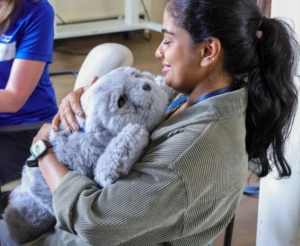
Lakshmi Sivan Pillai, Recreationist at Linhaven and an NC Recreation Therapy grad, participates in a Fins and Feathers training session.
s it offers additional therapeutic tools that can be incorporated into daily care and programming.”
Matthew Bosnich, who completed the Recreation Therapy program late last year, has since joined HAWIC staff as a full-time Research Associate. He recently accompanied Wilkinson to the 2026 International Gerontechnology Conference in Vancouver to promote the project. Bosnich has been instrumental in developing the toolkits and supporting the filming of training videos that capture the heartwarming reactions of residents.
“It’s incredibly rewarding knowing that what I am working on goes back to actually making a difference in people’s lives. That motivates me to put my best work forward,” said Bosnich. “With these tools, the robotic animals become more than just a cute, and comfortable distraction. They can now be used as a way to stir deep conversations with residents, such as reminiscing about a beloved pet from their childhood, which helps fulfill that soci
al and emotional need that is so important for older adults in long-term care.”
Staff at long-term care residences are applauding the project. Jeannette Beauregard, Behaviour Supports Program Manager, Niagara Region Senior Services, noted that the training has been valuable for staff at Linhaven where experienced recreation staff gained valuable hands-on learning and practical strategies they could use right away. She said it helped strengthen their understanding of how robotic animals can support meaningful engagement with residents, especially those living with dementia.
“We saw the impact almost immediately. Residents connected with the robotic animals in ways that were comforting, calming, and emotionally meaningful. These interactions often opened the door to greater connection between residents and staff, helping staff engage in a more personal and responsive way,” said Beauregard. “The tools and strategies learned through HAWIC have strengthened our team’s ability to create positive therapeutic experiences for residents and has shown the value of bringing innovative tools into dementia care.”
Heather Vokey, Director of Life Enrichment at Heidehof, sees the broader impact of the collaboration as the Fins, Feathers and Fur project prepares to visit their facility in May. “Overall, I see that this research plays an important role in improving seniors’ overall well-being, advancing scientific knowledge, and creating a tool that helps staff connect more purposefully and effectively with residents through meaningful therapeutic visits with robotic animals,” said Vokey.
HAWIC’s applied research projects are made possible by an investment from the Natural Sciences and Engineering Research Council of Canada (NSERC) through the Mobilize program.
“The Fins, Feathers and Fur project embodies HAWIC’s mandate perfectly. By developing toolkits and training to maximize the therapeutic potential of robotic animals, we ensure that innovation is actively improving the lives of older adults, while creating opportunities for our students,” said Rachel Brown, Acting Program Manager, HAWIC. “We look forward to continuing to partner with community and industry as we address the complex challenges of aging through applied research.”
NC’s Healthy Aging and Wellness Innovation Centre is dedicated to applied research that improves the quality of life for Niagara’s older adults. Beyond robotic companions, HAWIC leads projects ranging from driving simulators for memory clinic patients to identifying programming gaps for the fifty-plus population.
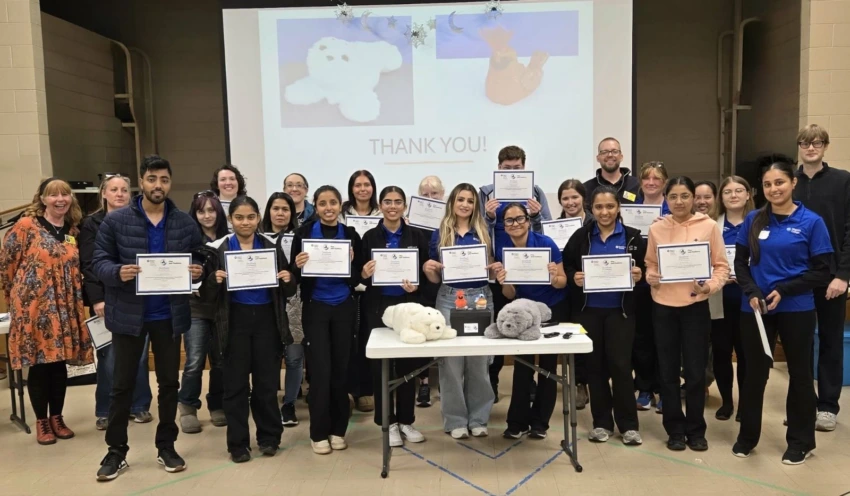
NC Recreation Therapy students stand with Niagara Region recreation staff stand after completing the training in Fall 2025, along with Niagara Region Responsive Therapeutic Advisors who helped facilitate the training.
