
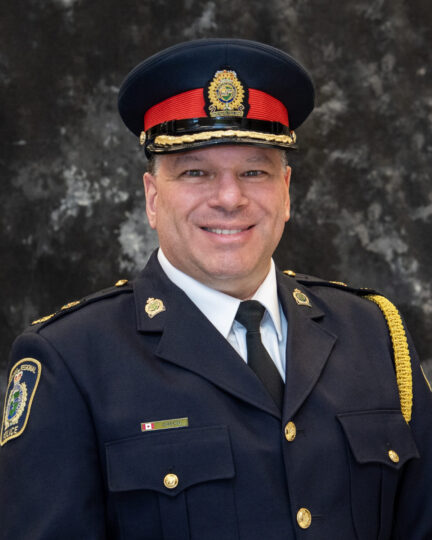
From a young co-op student at Niagara Regional Police Service to Deputy Chief of Police, Luigi Greco has spent more than two decades shaping policing in the Niagara Region. A 1993 graduate of Niagara College’s Law & Security Administration program, Greco has built a career defined by dedication, integrity, and a commitment to his community. In every operational and leadership role, he has used his education and experience to support a resilient police service that the community trusts.
Current role and career path
As Deputy Chief of Support Services, I lead a broad portfolio of Corporate Services functions, supported by two Superintendents and three civilian Directors. Together, we are responsible for the systems and structures that keep the Service running day in and day out.
My focus is making sure the operational backbone of the Service is strong; that our governance is sound, our support services are aligned, and our people have what they need to do their jobs well. Behind every frontline response is a network of professionals ensuring the organization is positioned to deliver adequate and effective policing across the Niagara Region.
My responsibilities span several key areas:
-
Operational Support and Projects:
Including Court Services and Prisoner Management (Courts, Quality Assurance, and Prisoner Detention), as well as Records and Information Management, Evidence Management, and Digital Evidence. -
Information & Communication Technology:
Overseeing Technology and Application Services, Client Services, Infrastructure and Telecommunications, and both Business and Operations Systems to ensure our technology environment supports frontline and investigative needs. -
Executive Services:
Including Professional Standards, the Member Support Unit, Policy and Risk Management, and Professional Development. -
Finance and Assets Management:
Overseeing Finance, Materials Management, Facilities, Quartermaster functions, and Fleet Services to ensure responsible stewardship of resources. -
Human Resources:
Directing Member Health and Wellness, Talent Acquisition and Development, Total Rewards, and Human Resources Systems to support our members throughout their careers.
Throughout my career, I have had the privilege of serving in both operational and leadership roles across the organization. I began as an Auxiliary member in 1996, followed by service as a Special Constable, before being sworn in as a Constable in 1998. Over the years, I progressed through Uniform Patrol, Street Crime, Guns and Gangs, and Criminal Investigations, ultimately serving in supervisory and investigative leadership roles including Detective Sergeant in the Guns, Gangs, and Grows Unit, Staff Sergeant in Major Crime, Communications, and District Detective Services.
I later moved into executive leadership roles as Inspector overseeing Professional Standards, Operational Support, and Professional Development, followed by Superintendent of Executive Services. Each role has provided a deeper understanding of both frontline operations and organizational governance, culminating in my current position as Deputy Chief of Support Services.
Influences and inspiration
Policing was a career aspiration for me from a young age. My positive interactions with police officers that visited my elementary and secondary schools for presentations and career fairs sparked that interest. In High school, I completed a co-op placement in the #22 Division Court Office of the NRPS which exposed me to the many great people that worked for the NRPS. That experience guided me towards the Law and Security program at NC. The education and experiential learning through the police co-op placement and other volunteer security activities assisted me on my path and assisted me with gaining positions for an armoured car company, a casino security position and eventually a role as a Special Constable.
Looking back, it is that combination of diverse experience, relevant education, strong work ethic, and a genuine commitment to teamwork and community that has formed the foundation of my career.
Preparing for industry challenges
Niagara College played a significant role in shaping my foundation for policing. The courses in criminal and provincial law, report writing, rules of evidence, computers and psychology were practical and directly applicable to the work. I could see the connection between what I was learning and what I would eventually face on the road.
The physical fitness component was just as important. It helped me build not only strength and endurance, but confidence. Knowing that I could meet, and exceed, the fitness standards gave me practical reassurance that I was prepared for the demands of policing.
Policing, though, goes beyond education and meeting requirements. Success in this profession depends on who you are as much as what you know. It’s a career grounded in community trust and problem-solving. Enforcement is only one aspect. At its heart, policing is about relationships and a commitment to continuous growth.
To thrive, you need a blend of character and commitment. Strong communication skills matter. So does emotional maturity, physical and mental resilience, and the ability to exercise sound judgement under pressure. Honesty, integrity, empathy, leadership and plain common sense aren’t optional; they’re essential. Those qualities are what allow an officer not just to do the job, but to do it well.
Standout NC experience
The overall learning environment made a real difference for me. The curriculum was well-structured and relevant, but what truly set it apart was the hands-on learning and the instructors who brought lived policing experience into the classroom. They didn’t just teach theory, they shared practical insight with real scenarios and lessons learned from the field. That combination helped me build a strong, practical foundation and made my eventual transition to the Ontario Police College (OPC) feel smooth and manageable.
The police co-op placement was another pivotal experience. It exposed me to a wider range of policing functions within the Niagara Regional Police Service, from shifts in uniform patrol to time spent observing Forensics and Investigations. Being immersed in the day-to-day work gave me a clearer understanding of the profession, including the responsibility and the teamwork required. I also had the opportunity to meet many dedicated officers during that time, several of whom later became colleagues and supervisors. That early connection to the Service made the experience even more meaningful and reinforced that I was choosing the right path.
There were many great staff members but the one who had the greatest influence on me was Fred Bassi. Fred was a great instructor and assisted me in developing a commitment to fitness. His no-nonsense approach to teaching and his wonderful sense of humour made him a favourite for many.
The police co-op placement exposed me to many aspects of policing within the NRPS and mirrored their selection process, which was very beneficial.
Words of wisdom
Once you have identified your career path, do everything you can to align your education and experiences to achieving that goal. Don’t be afraid to take chances and don’t give up on achieving that goal.
