
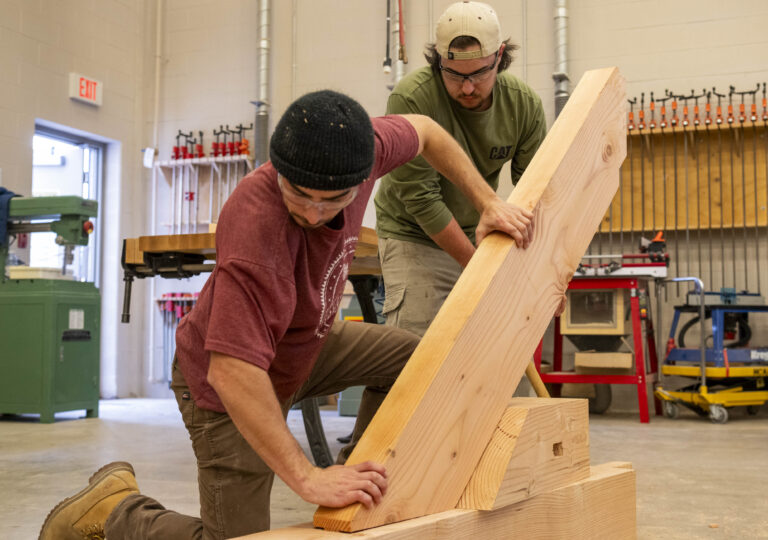
From deep roots in medieval Europe to modern restoration projects, hammer bent timber frame construction is an important skill in a carpenter’s toolkit.
Nine students in Niagara College’s General Carpenter Apprenticeship program tried their hands at the construction method in October, under the tutelage of instructor James Paroschy.


“I chose the hammer-bent design for our curriculum because it embodies the spirit of teaching and learning that defines Niagara College,” said program coordinator Alex Lukacs, who says the process – both traditional and highly specialized – is not currently being facilitated at any other college in Ontario.
“We challenge our students to take on complex projects that hone their skills, preparing them for the challenges that await them in industry,” said Lukacs. “By engaging with this type of construction, our students gain valuable, hands-on experience that enhances their craftsmanship, particularly in heritage restoration, where a deep understanding of traditional building methods is essential.”


Timber framing emerged in the 12th century, during a period when wood was the primary building material. Among its various techniques, the hammer-bent style – considered the most complex – offered a practical solution for constructing tall spaces such as halls, barns, and churches. This method allows for vast, open interiors without the need for interior walls to support the roof.
The name comes from the resemblance to a hammer shape, with the posts as the handle and the top beam as the head.
Westminster Hall in London, commissioned for Richard II in 1393 and built by the royal carpenter, Hugh Herland, is one of the most notable landmarks that features this style of carpentry work.
These strong and durable structures are not just from the past but have various uses today. The aesthetic construction is popular for lodges, hotels and high-end homes.

The skill – which combines structural engineering and joinery – is also important for restoration projects, such as preserving barns and churches.
The benefit to timber framing, in a modern context, is the use of natural, sustainable and environmentally-friendly building materials – moreso than steel or concrete.
“This project is a remarkable showcase of the advanced, hands-on learning opportunities we’re providing to our apprentices at Niagara College,” said Julie Niemiec, NC’s Manager, Apprenticeships.
As students prepare for their careers as General Carpenters, this unique-to-NC project will help set them apart in Ontario’s growing construction sector.
