
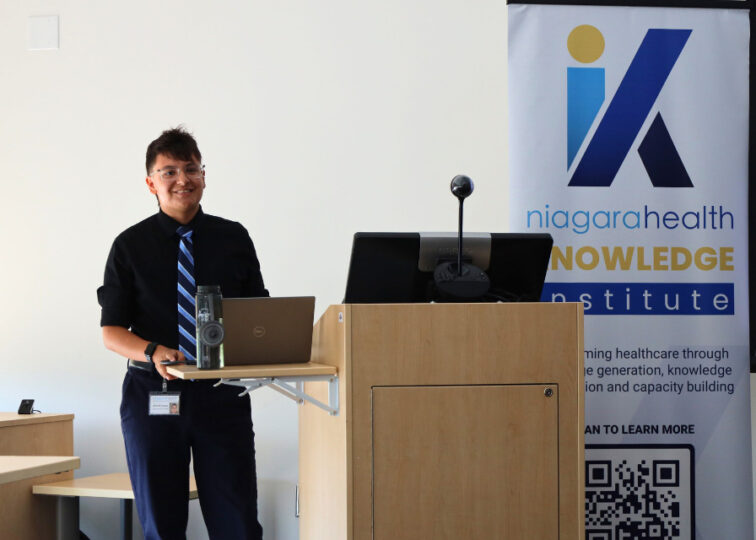
Niagara College student Sebastien Duguay gained valuable experience for his future career in paramedicine during a research opportunity with the Niagara Health Knowledge Institute (NHKI) this past summer.
The second year Paramedic student was one of four recipients of the 2025 NHKI Summer Student Research Scholarship. The scholarship program offers a paid research-focused placement from May to August to selected students in health-related programs from NC, Brock University, McMaster University’s Thrombosis and Atherosclerosis Research Institute (TaARI) and the University of Niagara Falls Canada. Over four months, students gain hands-on experience working with Niagara Health researchers and staff on projects that can improve patient care.
Duguay, a Tillsonburg native and member of the Chippewan First Nation, applied for the scholarship hoping his past research experience would stand out among applicants. After being selected, he leveraged his research skills to support a project to improve the documentation of hospital-acquired delirium in older adults, part of the provincial Delirium Aware Safer Healthcare (DASH) initiative. Through extensive chart reviews, he uncovered significant gaps in delirium screening and recording, which can directly affect follow-up care.
Working with NHKI gave Duguay a deep understanding of how hospital-based research can directly improve patient care, experience he will bring to his role as a paramedic.
“I know this experience will help me approach my future career as a paramedic with a stronger foundation and a broader understanding of the system I’ll be working within.”
Duguay provides a glimpse into his experience below.
Q and A with Sebastien Duguay
Q: Why did you apply for the NHKI Summer Student Research Scholarship program?
A: I have previous research experience in physics, and when the opportunity arose to apply my research skills in a healthcare setting, I knew it was something I wanted to be part of. The chance to explore research in a completely new field while connecting it to my current studies in paramedicine was exciting and felt like a natural next step.
Q: How did it feel to be named a scholarship recipient and to participate in research in a community hospital setting?
A: It was an incredible honour to be selected. Honestly, when I first found out, I was shocked. I didn’t expect to be chosen and wasn’t sure I had enough experience or skills to stand out among other applicants. Being recognized as someone who could contribute to research gave me a huge confidence boost. Working in a community hospital setting was inspiring, and it gave me a new appreciation for all the work that goes on behind the scenes to improve patient care.
Q: Tell us about the research project you worked on and what you learned.
A: My project revolved around conducting chart reviews to help determine the true rate of delirium across Niagara. Delirium often goes unrecognized in hospital settings, and understanding how often it occurs is especially important given Niagara’s aging population, who are at higher risk. Accurately capturing this data is a key first step toward improving screening, prevention, and patient outcomes.
Through this work, I had the opportunity to contribute to the larger DASH (Delirium Aware Safer Healthcare) movement. In addition to the chart reviews, I attended delirium education huddles and shadowed several members of the geriatrics team at Niagara Health. This gave me valuable insight into how different professionals collaborate to care for older adults and how education and awareness can lead to better care practices.
I also gained experience in data collection and analysis, learned how to apply research ethics in a clinical setting, and developed a much deeper understanding of how hospital-based research can directly improve patient care.
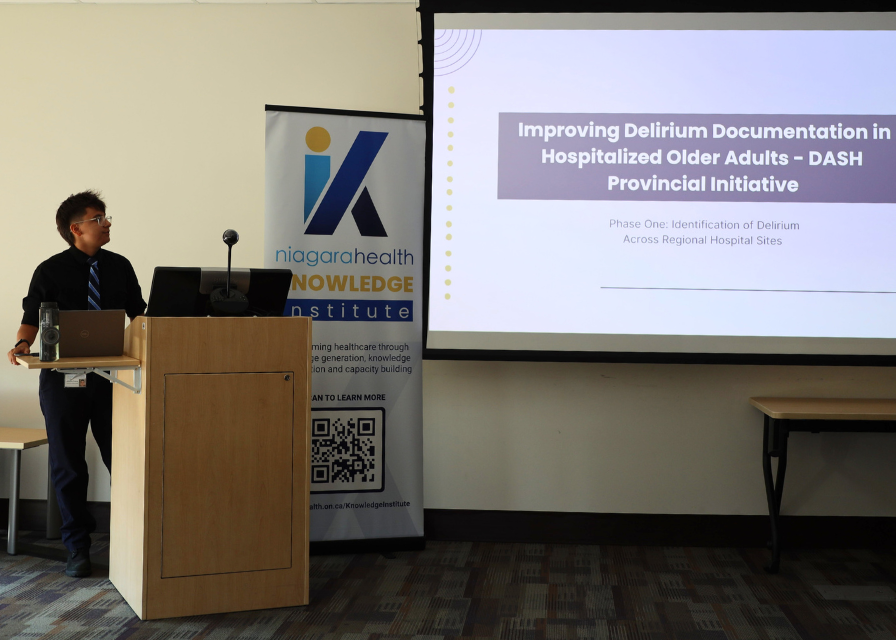
NHKI Summer Student Research Scholarship recipient Sebastien Duguay. (Niagara Health photo)
Q: How will the opportunity with NHKI enhance your NC program experience and future career as a paramedic?
A: This experience gave me a completely new perspective on healthcare. As a paramedic student, I’m used to focusing on immediate patient care, but being part of research showed me how much thought, data, and collaboration go into shaping the protocols we use in the field. It helped me build practical skills like data analysis, critical thinking, and understanding research ethics, but also strengthened my soft skills… especially communication, teamwork, and adaptability.
Working alongside experienced researchers and clinicians gave me confidence in my ability to contribute to healthcare in different ways, and it showed me how evidence-based practice drives better patient outcomes. I know this experience will help me approach my future career as a paramedic with a stronger foundation and a broader understanding of the system I’ll be working within.
Q: Would you participate in health research again or recommend the experience to other students?
A: Absolutely. I think research is such an important part of improving healthcare, and I would love to continue contributing to it throughout my career. This experience showed me how research directly shapes the care patients receive and how much collaboration and innovation go into making the system better. I would definitely recommend it to other students because it helps build valuable skills, broadens your perspective, and shows you just how much of an impact you can make beyond the classroom or clinical setting.
