
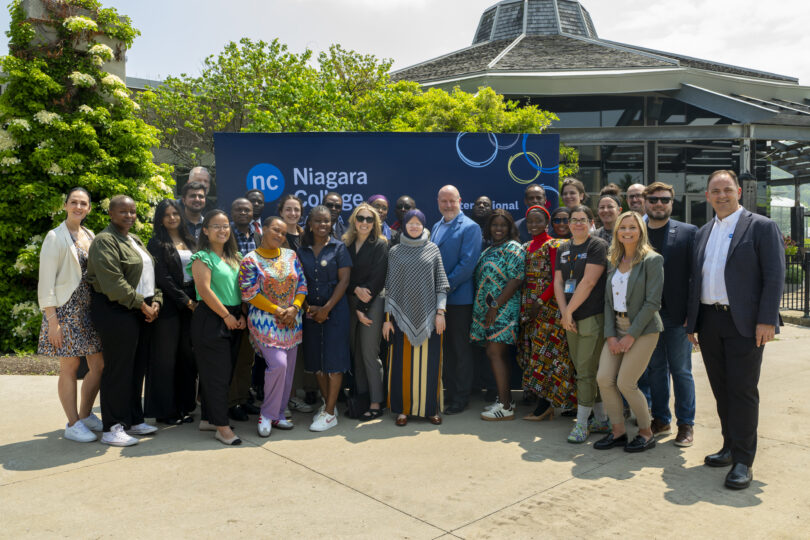
This spring, Niagara College welcomed 12 partners from Tanzania, united by a shared vision to strengthen communities and expand education’s impact through global collaboration.
From June 2 to 6, the group, representing Folk Development Colleges (FDCs) and Community-Based Organizations (CBOs) in the Morogoro and Kondoa regions of Tanzania, participated in an Experiential Learning Study Tour at Niagara College as part of the Empowerment through Skills Program (ESP-05).
Coordinated by NC’s Institute for Global Education & Training, the visit marked the delegation’s first time in Canada and offered a meaningful week of cultural exchange, experiential learning, and strengthened collaboration between institutions.
ESP-05 (Empowerment through Skills Program) is a four-year initiative (2022-2026) funded by the Government of Canada through Global Affairs Canada (GAC) and administered by Colleges and Institutes Canada (CICan). Through this program, Niagara College, in collaboration with Seneca Polytechnic and Tanzania’s Ministry of Education, Science, and Technology, works closely with Tanzanian FDCs and CBOs to create alternative pathways to education, employment, and entrepreneurship for students and marginalized groups, particularly women.
Throughout the week at NC, the group engaged in a variety of workshops and hands-on learning activities led by NC faculty and subject matter experts at both the Daniel J. Patterson Campus in Niagara-on-the-Lake and the Welland Campus.
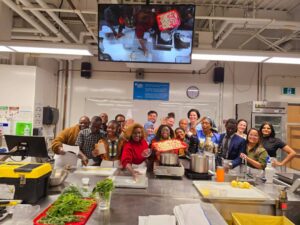
The group engaged in a variety of hands-on learning activities, such as a gnocchi-making workshop.
One of the tour highlights was a gnocchi-making workshop focused on adult learning and how to engage students by providing opportunities to explore and develop new skills.
“It was wonderful to reconnect with our partners and continue our collaboration,” said Chef Isa Mottiar, Professor in the School of Food & Wine Sciences who was in Tanzania last year and developed two Culinary short courses to be launched at Bigwa FDC this year. “I am thrilled to have been part of this successful pilot program and look forward to visiting them again–hopefully even purchasing some of the in-house products the students are now making at Bigwa.”
Another highlight was capacity-building sessions for both CBOs and FDCs with Dr. Dawit Eshetu, Professor in the School of Business & Management Studies.
“It has been rewarding to work alongside them, as equal partners, to adapt those practices to their local realities”, said Eshetu. “Whether through workshops, consultations, or study visits, I hope the knowledge and connections built will continue to resonate on both sides long after the project ends.”

The campus tour offered the delegation a closer look at Indigenous cultural traditions and sustainability initiatives.
The Tour also included sessions on leadership and experiential learning activities in the classroom with Dr. Holly Catalfamo, NC Workshop Facilitator; a resource mobilization workshop led by Krasna Baotic, Professor in the School of Liberal Studies; Equity, Diversity, and Inclusion (EDI) in the classroom, and gender-responsive curriculum sessions delivered by Taylor Venneri, English as a Second Language Facilitator; and a sustainability tour and discussion hosted by Katie Bristow, Program & Outreach Coordinator in the Sustainability Office.
“All activities led by our subject matter experts were a strong demonstration of the project’s work plan in action, bridging practical skills development with pedagogical approaches,” said Esteban Navarro, Project Manager at Global Education Projects. “It also reinforced the alignment between project outcomes and the short courses developed, ensuring the training is both relevant and sustainable within the local context.”
NC’s engagement in ESP-05 exemplifies the institution’s commitment to advancing the United Nations Sustainable Development Goals (SDGs) through global education and capacity-building partnerships. By working on this international project, NC is contributing to inclusive, quality education (SDG 4), gender equality (SDG 5), decent work and economic growth (SDG 8), and reduced inequalities (SDG 10). Through meaningful engagement and knowledge exchange, the project supports long-term impact for communities in both Tanzania and Canada.
Niagara College’s Institute for Global Education and Training
Bringing together the expertise of a highly skilled NC team with partner organizations worldwide, Niagara College’s Institute for Global Education and Training proudly provides educational solutions designed to inspire sustainable global change. For over 20 years, NC has collaborated with global institutions to develop and deliver customized education and training programs as well as capacity building projects, empowering learners and global partners to achieve their goals. Building on this expertise, NC launched its official global education hub in May 2024. This resource leverages NC’s world-renowned education and training programs while also offering newly developed modularized global programs. Aligned with the United Nations’ Sustainable Development Goals (SDGs), the Institute is committed to fostering impactful partnerships and advancing sustainable development through education.
