
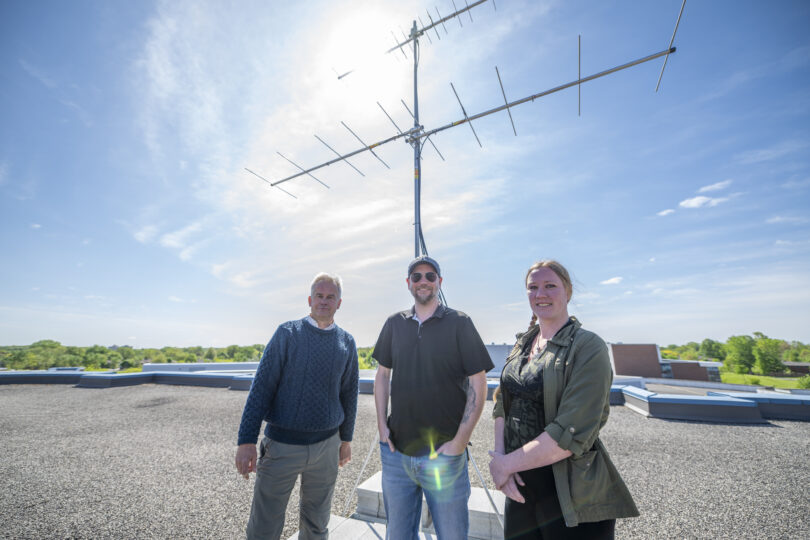
A new Motus tower at Niagara College’s Welland Campus is tracking at-risk birds and other migratory species moving through the region.
Installed on the roof of the Simcoe building, chosen for its accessible high point on campus, the tower was positioned to pick up radio transmitters from tagged birds which broadcast unique identifiers as they fly overhead.
“Each tower collects data that are like pieces of a puzzle, and all those puzzle pieces are put together through the network of hundreds of towers,” said Martin Smith, Professor in NC’s School of Environment and Horticulture. “It’s the collective of the different data points which makes the system informative.
“We can use the data to see where birds were flying, how long it took them to go from station to station, whether they stopped to rest, and how many disappeared or got lost.”
This data feeds into the Motus Wildlife Tracking System, an international collaborative research network connected to hundreds of other towers across North and South America, as well as Europe. Managed by Birds Canada, Motus uses coordinated automated radio telemetry to facilitate research and education on the ecology and conservation of migratory animals, including birds, bats and insects.
The Motus tower at the Welland Campus was installed just two years after the College’s first Motus tower made its debut at the Daniel J. Patterson Campus in Niagara-on-the-Lake. While the Niagara-on-the-Lake tower tracks birds migrating through North Niagara, the Welland Campus tower detects those flying along the south shore of the region, benefitting both the international network and student learning opportunities.
The two towers on NC’s campuses expand the Motus network. Currently, there are only three Motus receiver locations in the Niagara region – two on NC campuses and one in Thorold. The next closest stations are in Grimsby and Port Maitland, and across the U.S. border in North Tonawanda, New York.
“The Niagara College Motus towers are integral to this large-scale collaborative effort by helping fill a crucial gap in the Niagara region, which is an area where many animals migrate through if they are unable to cross over Lake Ontario or Lake Erie,” said Matt Fuirst, PhD, Research Ecologist and Observatory Manager, Birds Canada.
Fuirst noted that Motus is a collaborative research network that makes use of new and existing infrastructure to enable anyone to play a part in tracking migratory birds, bats, and insects, and contributing to their conservation. Motus is rapidly expanding and there are over 2,000 stations worldwide.
Students in NC’s environmental programs gain direct experience with monitoring techniques, hands-on training with the equipment and how to navigate the sophisticated monitoring system, enhancing their employability.
“The Motus tower at our Welland Campus is another outstanding example of how Niagara College blends experiential learning with meaningful community partnerships. It not only enhances the hands-on training our students receive, but also contributes to vital conservation efforts across the region,” said Evan DiValentino, Dean of Business and Environment. “Projects like this are why our graduates are so well-prepared to meet the demands of today’s environmental sector.”
Even before the tower became operational, different classes of Ecosystem Restoration students learned the nuts and bolts of the initial installation process, including figuring out costs and applying for funding. Students were involved with equipment purchase and assembly, linking the tower to computer and internet systems, troubleshooting technical issues, and more.
Smith noted that Ecosystem Restoration students use the Motus data in an animal monitoring project for their Species Management course. They also write formal proposals for funding grants as part of their Ecological Engineering course – an essential skill for many Ecosystem Restoration graduates as they pursue their careers.
Through written proposals, different classes of Ecosystem Restoration students over the past few years have successfully gained funding to support both of NC’s Motus tower projects.
Funding and community support
The tower at the Daniel J. Patterson Campus in Niagara-on-the-Lake was supported by an RBC Foundation grant of $4,000, and a student-led Go Fund Me campaign that raised $2,800 to cover purchase and installation of the Motus tower, as well as a $2,531.69 donation from the Niagara Falls Nature Club and $1,000 from the World Wildlife Fund.
The Welland Campus project was supported by funds raised by students in 2023-2024, including $13,000 from the Niagara Community Foundation (NCF) and $6,000 from RBC Foundation.
“The Motus Wildlife Tracking Tower Project is an excellent example of an innovative project that is addressing the ever-changing environmental concerns of our region,” said Bryan Rose, NCF Executive Director.
Rose noted that the NC project exemplifies a successful initiative addressing a priority of NCF’s Environmental Grants program, supported by the Dorothea Thomas Fund.
“We know that Niagara has a unique natural habitat that is in constant threat by climate change, and human impact of development and growth within our region. We need to work together to protect it. But the first step in any environmental protection, is knowledge,” said Rose. “Gaining a better understanding of the migratory corridors, with the help of the Tracking Tower, will equip Niagara College and other community partners with the data and information they need to better understand how to protect and preserve our environment for migratory birds and animals.”
“Protecting Canada’s biodiversity and investing in solutions that fight biodiversity loss will be important for generations to come,” said Jaye Toulouse, Regional Vice President, Niagara Region, RBC. “That’s why we are proud to support Niagara College’s Motus Wildlife Tracking Tower Project, that leverages technology and helps unlock the data needed to inform how to protect and restore our natural ecosystems.”
Hands-on experience for students

Professor Martin Smith and Environmental Technician graduate Tyler Warmbold examine equipment on the Welland Campus Motus tower.
In addition to supporting the Welland Campus tower, funds raised enabled 12 selected students from NC’s School of Environment and Horticulture to attend a three-day advanced ornithology micro-credential course, which focused on the Motus system, at Birds Canada’s Port Rowen Observatory in March.
Graduating Environmental Technician student Tyler Warmbold (Port Colborne), who will continue his studies in the Ecosystem Restoration post-graduate program in September, valued the experience he gained with Motus towers on campus and the opportunity to attend the Birds Canada course. He was in his early twenties when he enrolled in the program, pursuing a career change to a field he was passionate about.
“The Motus initiative was an unexpected pleasure … I was able to use the experience installing the new tower on the Welland campus rooftop and finding out the way the towers work to create a proper thesis and complete the term long project,” he said.
Warmbold noted that the experience students are gaining may be beneficial for their future environmental careers.
“If I were to pursue a career in birds, there is potential to install Motus towers in other countries; for example, South America has very few towers and it is where a lot of our bird species end up migrating to,” said Warmbold. “If we are to better understand and track these species, many more towers are going to need to be installed and maintained.”
