
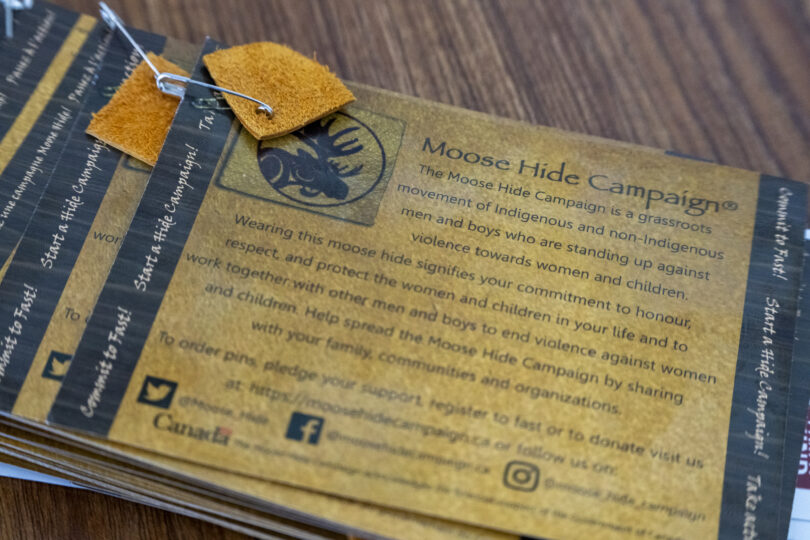
On May 16, Niagara College’s Indigenous Education department invited people from across the College to join them as they recognized and honoured the Moose Hide Campaign, an Indigenous-led grassroots movement aimed at ending violence against women and children.
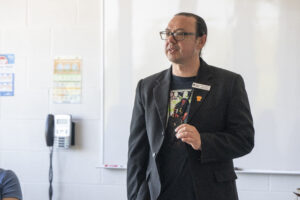
Indigenous Education’s Cultural Advisor Karl Dockstader welcomes guests to the Moose Hide Campaign event.
The Moose Hide Campaign began in British Columbia over 10 years ago along the Highway of Tears and has since become a nationwide movement supported by both Indigenous and non-Indigenous Canadians.
NC’s Moose Hide event took place at the Welland Campus and was facilitated by Indigenous Education’s Cultural Advisor Karl Dockstader.
Dockstader welcomed employees and students to the event and shared the importance and significance of the Moose Hide Campaign and how it came to be.
“I had the great honour of speaking to Sage Lacerte (one of the founders of the Moose Hide Campaign) and she shared the importance of creating dialogue around this issue and how men across Canada need to take a leading role as change makers,” said Dockstader.
“As an Indigenous man I have a responsibility to talk about Missing and Murdered Indigenous Women and Girls (MMIWG) and Two Spirit, Lesbian, Gay, Bisexual, Transgender, Queer, Questioning, Intersex and Asexual (2SLGBTQQIA+) people as often as possible and I look to the other men in this room to join me in pledging to give a voice to these people by initiating conversations and bringing awareness to this epidemic.”
During the event guest speakers Dylan Ritchie, Bear Clan from Saugeen First Nation and Chris Shawanoo, Turtle Clan from Stony Point First Nation shared personal stories about their upbringings and the importance of preserving culture and how they are working to teach Indigenous men about their role in ending gender-based violence.
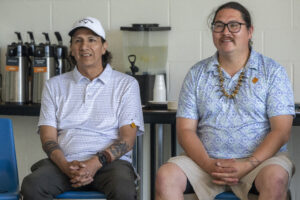
Special guests Chris Shawanoo (left) and Dylan Ritchie spoke to the group about the importance of ending gender-based violence.
“Our ceremonies are a way of healing and creating good energy, and this gathering today is a type of ceremony,” said Ritchie. “Wearing the Moose Hide pin is a great honour and the vision for the Moose Hide Campaign is to create a day of prayer across Canada that brings energy and awareness to Missing and Murdered Indigenous Women and Girls and to help people (both Indigenous and non-Indigenous) heal.”
“I am a father, uncle, grandfather and son,” said Shawanoo. “My grandparents and parents are residential school survivors, and I have seen first-hand the impact of institutionalization and colonialism and how it has affected my people. Today’s Moose Hide Campaign allows us to reflect on the past while working towards a brighter future.”
Shawanoo, Ritchie and Dockstader also spoke about the Kizhaay Anishinaabe Niin program which translates to I am a Kind Man. It is a culturally relevant program offered at Indigenous Friendship Centres throughout Ontario to help Indigenous men heal while offering Indigenous men a safe place to understand their roles and responsibilities in ending violence.
“Everywhere I go I am a conduit of change,” said Shawanoo. “Within my lifetime I’ve seen the impacts of colonialization and how many of our Indigenous men have forgotten their way, and it is our job to help them reconnect with themselves so they too can be conduits of change.”
Part of NC’s Moose Hide event included the distribution of Moose Hide pins – a symbol of one’s commitment to honouring, respecting and protecting women and children. Those who took the pledge made a commitment to respecting and protecting the women and children in their life, supporting truth and reconciliation and reversing the harm done by residential schools.
NC’s Moose Hide Campaign event follows the College’s observance of Red Dress Day on May 5, when flags were lowered and red dresses were hung at both campuses to honour MMIWG2SLGBTQQIA+.
To learn more about the role you can take to help end violence against women and children, visit the Moose Hide Campaign website.
