
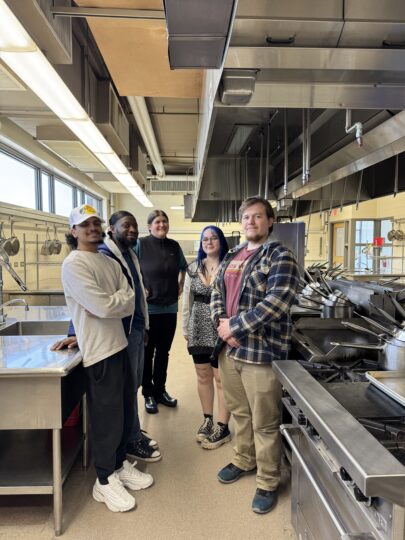
This spring, students in the Culinary Innovation and Food Technology (Co-op) program put their unique expertise to good use to find ways to save energy in kitchens and labs at Niagara College.
The assignment? Ensure food preparation is not just safe and delicious, but also sustainable.
With food safety inspections and audits being standard practice for students in the program, professor Amy Proulx sought to diversify their experiences and set them up to be leaders in their industry.
“When you look at agriculture and the food industry, they contribute one third of greenhouse gas emissions,” said Proulx. “Sustainability, energy conservation and waste management are going to be vitally important skills our next generation of food manufacturing professionals.”
Students conducted energy audits of teaching kitchens at the Daniel J. Patterson Campus in Niagara-on-the-Lake to broaden their understanding of food safety inspection, considering the realities of energy conservation and sustainability.
“The food industry is very concerned with energy conservation and waste management. Likewise, the College is prioritizing these core themes right now through energy audits and waste diversion strategies,” said Proulx. “We need leadership in this space, and we’re hoping to equip graduates of our program to with the capabilities for leadership in sustainability.”
The catalyst for the assignment was a presentation from NC’s Energy Team, Danielle Notarianni, Manager, Energy & Assets, and Mae Lannan, Energy Analyst. Students interviewed Notarianni and Lannan, drawing comparisons between ‘opportunity hunts’ for energy saving and ‘Gemba walks’ for premise inspections.
Students in the program learn to perform Gemba walks for food safety audits where they walk through spaces using skills of observation to gather information and identify areas for improvement.
Proulx asks students to consider how to prevent or reduce waste from occurring within food production systems, and how it can be repurposed. They also examine process controls that can be applied to equipment or human behavior.
Second-year students in Proulx’s Food Process Engineering class included Travis Pearsall from North Bay, Julie Norris from Milton, Robert Brian Bueh from Cameroon, and Jonathan Ali from Trinidad.
“Safety audits and energy audits, they go hand in hand with observation skills,” explained Pearsall, an aspiring chef with an interest in science.
During his Gemba walk in the kitchen, Pearsall identified the need for timers or motion sensors on lights. Speaking with Chef LeBlanc, he identified some minor repairs on equipment that would help save energy.
“This helps me for my career because I work at a restaurant as part of the health and safety committee and we do monthly audits,” said Pearsall.
On choosing the Culinary Innovation program, Pearsall wanted to blend his education in science with his passion for cooking.
“I want to be a Chef and I want to do a better job. I want it to be cleaner and safer. I want to do my own thing but still innovate.”
Bueh, who has an engineering background, noticed cameras and projectors left idle well after class ended, suggesting timers or motion-sensors.
“My passion for this program came when I was watching a food science show,” said Bueh. “Everything we’re talking about, explaining all the processes, I fell in love with it and felt I needed to do this.”
Norris learned about the Culinary Innovation program while in the Baking and Pastry Arts program as a way to blend her interests in cooking with science.
“Now I like the idea of doing auditing,” said Norris. “It’s cool to find things that need to be fixed.”
Proulx says the College’s emphasis on work-integrated-learning and course-based research like the energy audit is an effective way for students to gain work-ready skills.
“Through a work-integrated learning exercise like this, we’re benefiting the College by validating the findings of the internal audit team,” explained Proulx. “Student practitioners bring fresh perspectives and unique ideas of what goes on in the kitchens. They’ve spent countless hours in all of those classrooms seeing the behaviors on the front lines and they know how the equipment works.”
“They are student leaders in the community, and this exercise heightens their own personal awareness of energy conservation which is often shared in conversations with other students,” said Proulx.
Ideas generated by students through the audit will be put into action.
“Energy audits are excellent student projects that provide participants with technical experience,” said Lannan. “Student-led audits offer unique insights into space usage, capturing diverse perspectives. We compile all energy-saving opportunities in our opportunity register and work with the Energy Team to implement initiatives whenever feasible, fostering a more efficient and sustainable campus.”
Book an energy hunt
Energy hunts are group-based activities that do not require prior knowledge of energy consumption. Involving various groups in these activities enhances college-wide energy management. Any group interested in finding energy-saving opportunities can reach out to [email protected].
