
It was a ‘pool party’ unlike any other.
On March 27, past and present students from NC’s Ecosystem Restoration program gathered with faculty, staff and guests to celebrate the new vernal pools on campus.
Located in a natural wetland at the Daniel J. Patterson Campus in Niagara-on-the-Lake, the vernal pools are the culmination of a project six years in the making for Ecosystem Restoration faculty and students. Their goal: to support the local population of Escarpment Mole salamanders.
Ecosystem Restoration Professor Martin Smith noted that the vernal pools play an important role in supporting the Escarpment Mole salamanders on campus who live underground for 11 months of the year, and surface to spawn during the spring.
“They only come up to the surface for one month of the year. You only see them in March or April when they come up to the surface to spawn in the shallow ponds called vernal pools,” he said. “Vernal pools are special because they are temporary ponds … they don’t have any fish in them. The salamanders only choose pools without fish to lay their eggs.”
Six cohorts of Ecosystem Restoration students have worked towards creating the vernal pools on campus since 2019 – from concept to design, to completing required permits.
The project took years to organize and get approved. Smith noted that the permit process was more complex than the installation. Students gained valuable experience dealing with regulatory agencies.
“It doesn’t take much physical work to install a vernal pool, but it has such a large impact on the salamander population,” said Smith.
Students gained approval to build the pools last spring and installation took place last fall. Since then, they have been monitoring them.
Their work is already paying off. The day before the Vernal Pool Party, the first eggs were spotted.
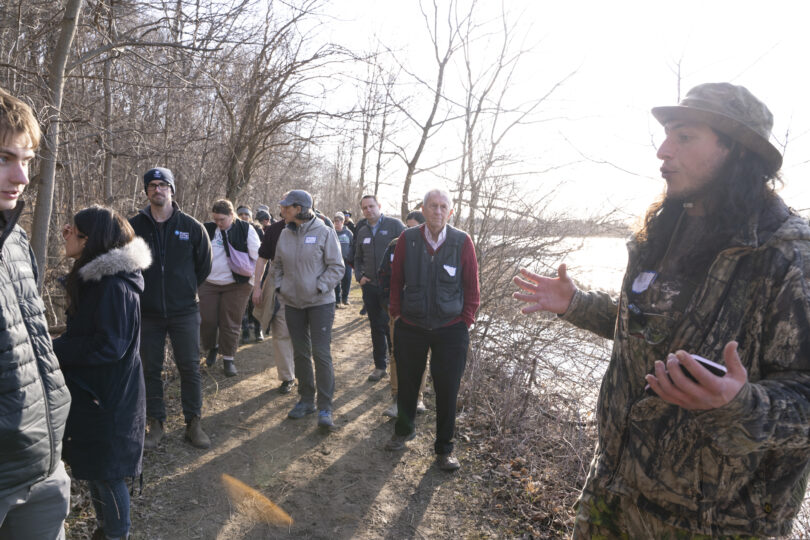
The March 27 event drew faculty, students, alumni and guests to the Teaching Greenhouse (classroom) to celebrate the project’s completion. Guests had an opportunity to participate in student led tours along the Wetland Ridge Trail to get an up-close look at the vernal pools – and view the eggs that had just become visible in the shallow waters.
Ecosystem Restoration student Nick Stefani, who led tours at the event, is passionate about nature and the project. He was among a group of students who worked on the installation last fall – from digging pools to moving a 600-pound rock strategically into place to hold the water and overflow as a weir.
Since then, they have been monitoring the vernal pools to ensure the water quality is suitable for salamanders.
“I really do care about this. We spend hours up there over the course of the week monitoring them,” said Stefani, who noted he once noticed a leak in the weir – which was placed to help prevent water overflow – and was determined to find a solution, which was ultimately resolved by adding more clay, plantings and netting.
“Literally, I would wake up at 3 a.m. thinking about it. We put in a lot of time,” said Stefani. “In order to improve habitat and ecosystems in the world, you first have to simply care.”
Ecosystem Restoration student Cassidy Wilson enjoyed her involvement with the initiative. She was among students to help move the large rock into place to install the pools, and monitoring them since.
“It’s nice to see how, after all that heavy work, it came together at the end, see the habitat created and the animals come in, and how the ecosystem and nature take over,” she said. “You can see how nature has adopted it as its own and it’s very inspiring.”
Ready to graduate this spring, she values the experience she gained in the Ecosystem Restoration program, which she began after completing an undergraduate degree in Environmental Science, following her long-time interest in the environment and love for the outdoors.
“There’s a lot of field -based application in this program. We’re able to connect what we’ve learned in our undergrad, hands-on, outside, so it’s a nice full circle moment.”
Durning the event, Smith gave a presentation about the salamanders and a brief o overview of the Vernal Pools project. He recognized several key people from the College and the community who have been involved in the project over the years including:
- Wayne Weller (OPG), Andrea Sinclair (School of Environment Professor) who identified species on campus (2009) and participated in early monitoring (2001);
- Kylie Rogg and Melad Razouk who worked on the original concept with (2020);
- Katie Church and Jenn Roloson who worked on early design details (2021);
- Lindsay Taylor and Megan Roulston who worked on design details for the initial NEC application (2023);
- Emmett Vanson who worked on design drawings for NEC, and follow-up information requests (2024);
- Nick Stefani and Cassidy Wilson who worked on construction (2024), and Trinity Synard who worked on initial monitoring (2025);
- Taryn Wilkinson (NC Sustainability Manager) who assisted with NEC applications;
- Cheryl Tansony. Niagara Escarpment Commission; and
- Kerry Royer and Katy Sokoloski from the NPCA.
The project was supported by the Niagara Community Foundation, Niagara Peninsula Conservation, RBC Tech for Nature, and Invasive Species Centre/ Invasive Species Action Fund.
-

- Guests gather for a group photo at the Teaching Greenhouse.
-
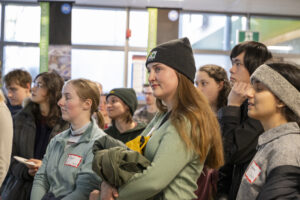
- Students, alumni and guests gather in the Teaching Greenhouse.
-
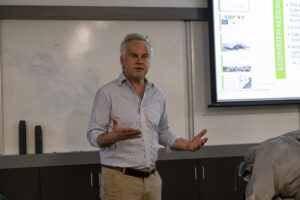
- Professor Martin Smith provides an overview of the project at the Vernal Pool Party.
-

- Dean of Business and Environment Evan DiValentino addresses the crowd.
-

- Salamander eggs are spotted in the new vernal pools.
-
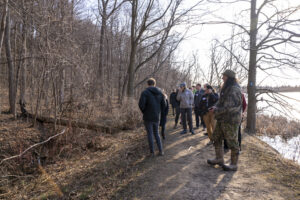
- Students, staff and guests take a student-led tour to view the vernal pools.
Stay tuned
Professor Smith and Dean of Business and Environment Evan DiValentino will be in the YourTV Niagara studio on April 7 to highlight NC’s Vernal Pool project. The interview is expected to air that week.
