
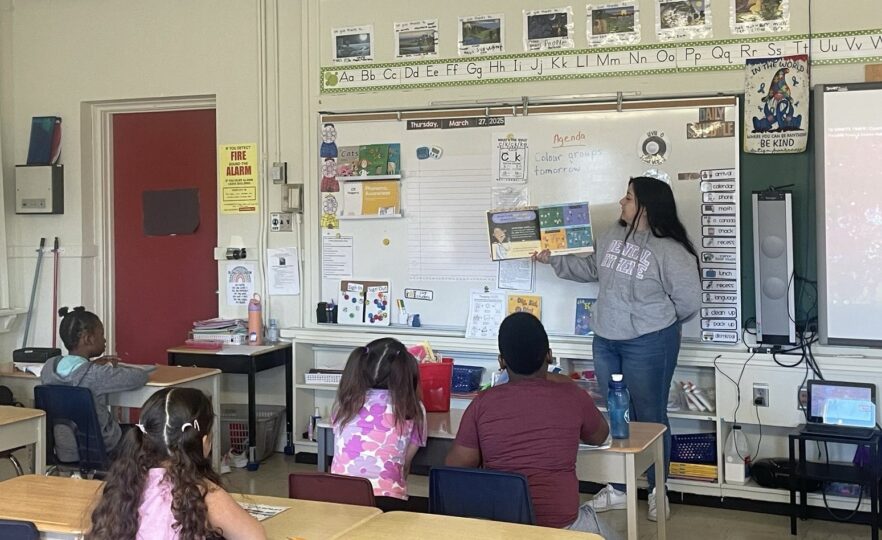
A group of senior Dental Hygiene students gained experience in front of the class at four elementary schools in Welland, delivering lessons on oral health care to more than 1,500 local children.
As part of their Community Health course, 52 senior Dental Hygiene students participated in a one-day dental blitz on March 27, ushering in National Dental Hygienie Week. Working in pairs – one taught while the other supported – they visited classrooms from Junior Kindergarten to Grade 8 at Ross Public, Plymouth Public, Glendale Public and St. Mary Catholic schools.
Linda Da Silva was among those who visited Ross school, where she delivered a lesson on tooth decay to a Grade 2 class. She selected a storybook from her own childhood, Open Wide, Tooth School Inside, by Laurie Keller – the same book which, years ago, sparked her interest in the field. The book follows a class of teeth learning about themselves, exploring the types of teeth, structure of a tooth, importance of baby teeth, how decay and cavities form, what can be done to prevent it and more. She also showed them an age-appropriate way to brush, with big circles touching teeth and gums.
“I really think that education on the why is the crucial first step to understanding anything. You can show a child how to brush, but until you explain why they need to brush, they won’t be able to make the connection that it’s good for them,” said Da Silva. “The kids were very engaged; they were excited I brought my childhood book.”
She was asked some very thoughtful questions for their age group, like, ‘what’s a toothache’ and ‘why can’t I eat after the dentist.’
“They seemed genuinely interested in what I had to say,” said Da Silva. “If I made a connection with one kid to encourage them to take care of their teeth, I’m satisfied.”
She was excited to participate in the dental blitz and build on her experience with children.
“I believe that this education blitz will teach a lot of people who haven’t necessarily had experiences with kids how to interact with them. For me personally, it will help me test how to explain big oral hygiene concepts without confusing the kids,” she said. “This will help prepare me for the field, especially if I decide to specialize in pediatrics.”
Dental Programs Professor Jeannette Kulik noted that students have spent many hours preparing a lesson plan and have gained an appreciation for how much work goes into lesson planning. They researched behavioural characteristics of the age group they were teaching, created and delivered lessons on various oral health topics with 20-30 minute presentations, as well as age-appropriate activities for the children to work on in class and take home.
“Community health is a really big part of dental hygiene, involving outreach and advocacy. Whether not they may choose to work in public health at some point, there’s always going to be a level of social responsibility to fulfill,” said Kulik. “There are well over 40 Entry-to-Practice Canadian Competencies for Dental Hygienists that are being fulfilled through the community engagement initiatives in our Community Health class.”
Improving oral health in the community
In addition to the dental blitz, students also worked with various local groups and organizations throughout Winter term on a Needs Assessment Health Promotion project. Their mission: to help improve oral health in the community and bridge gaps in knowledge, skills and behaviours among the populations the groups serve.
It was a major assignment for their Community Health Class. Professor Kulik organized the list of participating organizations and lined them up for the students to begin their projects in January. Working with the groups, students collected data through questionnaires, analyzed it, identified gaps in knowledge and skill, and presented information to help close the gaps and improve oral health of the target populations.
Groups they worked with included Segue Clinic (four locations in the Niagara region), Wellspring Niagara. Seasonal Agricultural Workers, EarlyON Child and Family Center Welland, Clarity Pregnancy, Bridge Niagara Immigrant and Refugee Services (formerly Niagara Folk Arts), Welland Heritage Council and Multicultural Centre, Indigenous Diabetes Health Circle, and Bridges Community Health Centre Diabetes Education Program.
“It’s so inspiring. It’s great to see students out in the community, engaging with populations in need, and helping them propel behavioural changes in populations that may not typically reach out for dental care,” said Kulik. “It’s been great to see the level of involvement and outreach between our students and the populations that we work with They make us proud.”
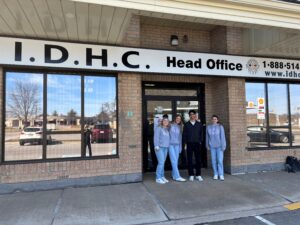
A group of students visit the Indigenous Diabetes Health Circle to discuss the impact of diabetes on oral health (supplied photo).
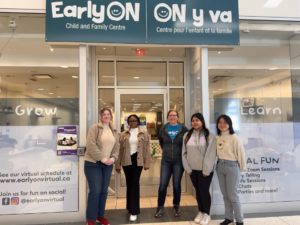
A group of Dental Hygiene students visit EarlyON Child and Family Centre in Welland to present findings from their Needs Assessment Health Promotion project to parents of young children in late March (supplied photo).
