
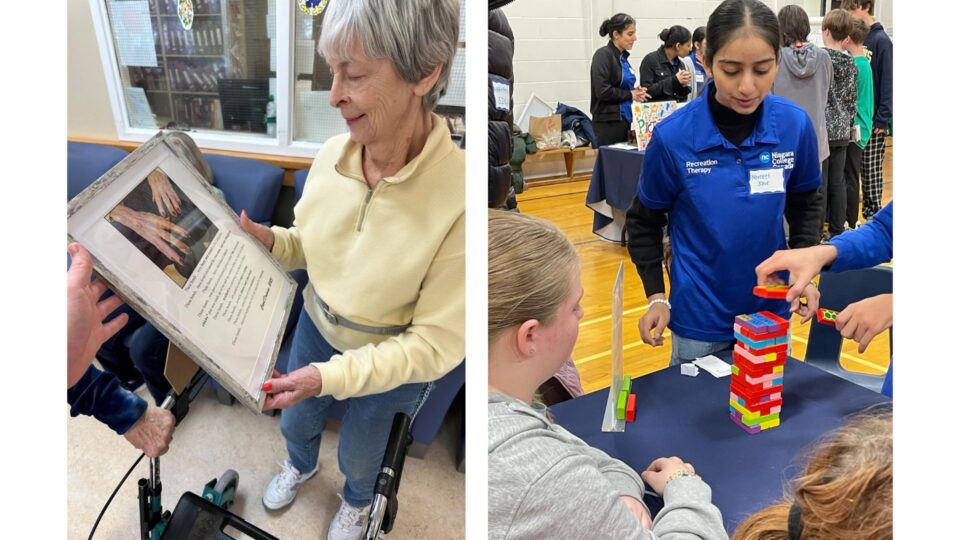
Niagara College’s School of Community Services continues to offer students enriching opportunities to apply their academic learning in real-world settings, ensuring they are equipped for the diverse demographics they will encounter in their future careers. Recently, two impactful initiatives helped Recreation Therapy (RT) students gain invaluable hands-on experience with both aging and youth populations, allowing them to develop essential skills for their studies and future work in the field.
These Hands Project: Connecting with Long-Term Care residents

In December 2024, a group of first-year RT students participated in a volunteer initiative called the These Hands Project, partnering with local long-term care homes. The project aimed to promote self-expression through creative writing, focusing on the residents’ life stories.
The students conducted interviews with 12 residents at a Niagara-on-the-Lake long-term care home and 10 at a Niagara Falls home, including some diagnosed with dementia, to gather personal stories. These stories were then transformed into commemorative art pieces, designed to celebrate each resident’s life. The final artworks were presented as heartfelt holiday gifts around Christmas, providing the residents with meaningful, personal reflections.
For students, this experience offered more than just a chance to make a difference–it was an introduction to working with older adults, particularly those with dementia. By reducing anxieties around working with this demographic, it prepared them for their second-year course in dementia care and gave them a deep understanding of the importance of legacy-building and reminiscence therapy.

“Opportunities like These Hands give our students invaluable hands-on experience that bridges the gap between theory and practice,” said Debbie Ann Fender, Professor in the School of Community Services. “Engaging directly with aging populations allows them to develop essential skills in communication, empathy, and adaptability–qualities that are crucial in recreation therapy. Seeing the impact of their work, whether through a resident’s emotional reaction to a meaningful art piece or the connections they build through these experiences, reinforces why real-world learning is so important in their journey.”
Leisure Education Collaboration: Engaging youth at Fitch St. Public School
Recognizing a gap in experiential learning opportunities with youth populations, the RT program introduced a new collaboration with Fitch St. Public School in November 2024. This initiative marked the first time that RT was brought into a school setting in person–previously, school-based activities had only been conducted virtually during the pandemic.

The project began in September 2024, when students in the Leisure Education course started developing activity booths designed to address social, cognitive, physical, and emotional aspects of youth development. These activities aimed to foster teamwork, communication, critical thinking, and physical activity among students. In November 2024, RT students delivered their activities to all grade 6-8 students at Fitch St. Public School, marking the culmination of their term-long projects.
The experience offered valuable insights into how to adapt to the unpredictable nature of working with youth and highlighted the importance of flexibility and engaging, high-quality program delivery. Many students expressed their gratitude for the opportunity to take their academic knowledge and apply it in a real-world setting, which will be a highlight in their professional portfolios.

“The partnership significantly enhanced student learning by providing them with real-world, hands-on experience that bridged the gap between academic theory and practical application,” said Erin Wilkie, Recreation Therapy Professor and Program Coordinator. “Working directly with youth populations allowed Recreation Therapy students to develop practical skills, gain authentic feedback, enhance adaptability, build confidence, and strengthen community connections.”
Preparing for future careers
These two initiatives not only provided students with practical skills but also enhanced their ability to work with diverse populations–a key component of their training in RT. From creating meaningful connections with older adults to delivering fun and engaging activities for youth, the experiences enriched their learning, built confidence, and prepared them for successful careers in RT.
