
Story submitted by the Student Rights and Responsibilities Office:
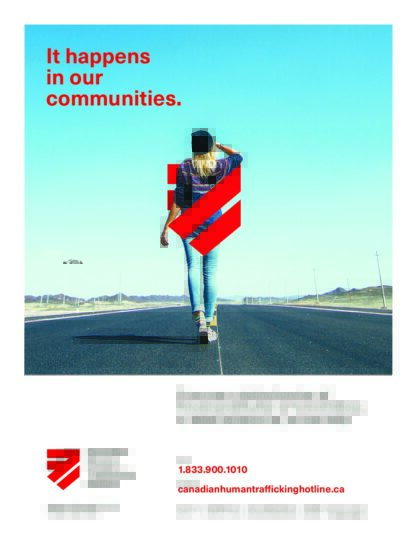
February 22 marks the National Human Trafficking Awareness Day in Canada. Take this time to understand and help support those who may be impacted. Learn more at the Canadian Centre to End Human Trafficking and Canadian Human Trafficking Hotline.
What is Human Trafficking?
Human trafficking is the exploitation of human beings to benefit from their work or service, typically in the form of forced labour and sexual exploitation. Trafficking can exist in many forms and usually entails victims being forced to provide sexual services or labour through force, coercion, deception and/or abuse of trust, power or authority. Human trafficking therefore results in substantial physical, psychological, and emotional trauma to the victims.
Despite common myths, human trafficking does not require that victims’ cross national borders. It can be perpetrated by a single individual, by a gang, or through organized criminal networks. It can also be committed by a company or employer.
Types of Human Trafficking:
Sex trafficking, also known as commercial sexual exploitation, is forcing someone to provide commercial sexual services through manipulation, lies, threats, or violence for personal gain or in exchange for something of value like food, shelter, money, drugs or transportation. In other words, sex trafficking is when someone is being exploited in the commercial sex industry for another person’s personal profit or gain. It can be hard to detect because it does not usually involve being kidnapped, smuggled, or physically restrained. Traffickers are often someone that a victim knows and has built trust with. Sex trafficking situations often look like intimate partner violence. The stereotypical images of criminals and “pimps” are not always the case.
Sex trafficking can happen to anyone and occurs in communities across Canada. In Canada, the majority of victims/survivors are Canadian. Sex trafficking does not require movement across provincial or international borders; someone can be trafficked without ever leaving their community.
Indigenous people, women, 2SLGBTQIA+ individuals, children, and youth are at higher risk of being trafficked. 90% of victims/survivors identified by the Hotline identified as female.
Traffickers often target people who are marginalized, including people experiencing:
- Unsafe housing or homelessness.
- Drug and alcohol dependency.
- Poverty.
- Physical or learning disabilities.
- Mental health or other emotional challenges.
- History of domestic violence or sexual abuse/assault.
- Being in the child welfare system.
- Problems with peers, family, and/or community.
- Systemic racism and discrimination.
There is no single indicator of sex trafficking; instead, it is often a combination of signs and behaviours considered within the context of the situation. The following signs may indicate that sex trafficking is occurring:
- Withdrawing from friends and family and/or being secretive about a new friend/boyfriend.
- Frequent absences from the home, work, and/or school.
- Having unexplained gifts or expensive items and/or sudden changes in appearance (clothing, accessories, make-up, nails, etc.).
- Giving scripted or ‘canned’ answers to casual questions.
- Showing fear and intimidation through facial expressions or body language (e.g. not making eye contact, acting on edge, afraid).
- Tattoos of the trafficker’s name or symbol.
- Not having any money even if they say they are working consistently.
- Not having possession of their identification documents.
- Visible signs of abuse (cuts, bruises, burns, etc.) and fatigue.
- Intoxication or substance use.
Labour trafficking (also known as forced labour and labour exploitation) is when someone uses violence, threats and/or lies to force someone to work. It usually includes poor and unsafe working conditions, abuse, discrimination, being made to work extremely long hours, and receiving illegal pay deductions or being paid less than your contract says or the minimum wage.
Labour trafficking can happen to anyone, but in Canada, low wage Temporary Foreign Workers, persons with precarious immigration status and/or without immigration status are at the greatest risk of abusive labour practices because they are often geographically isolated, are not aware of their labour rights in Canada, have limited access to community support and services, and may experience language barriers.
Labour trafficking can be hard to detect because multiple forms of labour abuse can take place over time. There is no single indicator of labour trafficking; instead, it is often a combination of labour rights violations and abuses. The following signs may indicate that labour trafficking is occurring:
- You were promised a job, and when you came to Canada, you found out that it did not exist or were told to do a different job.
- You are working very long and/or unusual hours or are forced to be available to work all the time.
- You are restricted on what you can do, where you can go, or who you may talk to.
- You receive very little or no pay for your work.
- Your passport and other identity documents have been taken away from you.
- Your employer or recruiter has threatened you or your family.
- You owe a large or increasing debt to recruiters or your employer.
- You are denied access to medical services.
- You have experienced physical, verbal or sexual abuse at work or from someone you work with.
Learn about Ontario’s plan to build safer communities by combatting human trafficking and child sexual exploitation.
Support
- The Canadian Human Trafficking Hotline operates 24 hours, 7 days a week.
If you are a victim/survivor of forced sex work or forced labour, or believe someone else might be, call the hotline at 1-833-900-1010. The Hotline Response Advocates will connect callers to support and services and will also take tips, answer questions and forward information, when appropriate, to law enforcement. - The Ontario Native Women’s Association and Niagara Chapter – Native Women Indigenous Anti-Human Trafficking Liaison Program supports Indigenous communities in providing survivor focused and localized responses to Human Trafficking.
Niagara College is committed to supporting those who have been impacted by sexual and gender-based violence. NC has a dedicated Sexual Violence Prevention & Response Coordinator, Kaytee Smith, who employs a trauma informed and survivor centered approach to supporting students impacted by sexual and gender-based violence.
Please contact Kaytee at [email protected] to learn more about services and access supports.
Follow @consentiskeync on Instagram, join the Consent is Key group in the NC Engage App and check out NC’s Consent is Key Campaign for content on sexual and gender-based violence and information on events.
