

Norfolk County Oct. 6-11
It was a “hands-on, boots-on” experience for a group of almost 50 Ecosystem Restoration students who had a chance to put their skills to work in Norfolk Country.
The week-long field camp equipped students with more than 40 hours of field work experience. After they rolled up their sleeves to work on essential restoration tasks during the day, they spent their evenings soaking up information at expert-led training sessions.

Ecosystem Restoration students attended the week-long trip at no additional cost, thanks to funding from CEWIL Canada.
CEWIL Canada grants full funding
Students were able to attend the trip at no additional cost – beyond tuition – thanks to full funding from Co-operative Education and Work-Integrated Learning Canada (CEWIL Canada) which granted more than $51,697 to cover the costs of travel, food, and accommodations as well as a stipend of $100 each for field equipment, materials, and an honorarium for guest instructors. The trip marked the second year that CEWIL Canada has fully supported this experiential learning opportunity for NC Ecosystem Restoration students.
“CEWIL’s financial support of this project lowers financial barriers to work-integrated learning. It reduces student costs of travel while providing a small stipend to recover potential lost wages from part-time work not done while taking part in the field experience,” said Dean, Business and Environment, Evan DiValentino.
For DiValentino, the week-long work-integrated learning experience is an example of what makes NC’s Ecosystem program so special.
“The time of year is crucial for environmental students who benefit from practical experience prior to winter weather setting in,” said DiValentino. “The funding provided by CEWIL allows for students to compress about seven weeks’ worth of training into one week prior to winter.”
DiValentino noted that in collaboration with community partners, such as the Long Point Basin Land Trust, St. Williams Conservation Reserve Community Council, ALUS Norfolk, and the Nature Conservancy of Canada, the work-integrated learning experience offered students invaluable practical “hands-on, boots-on” experience.
“This initiative not only aims to meet and exceed our program learning outcomes but also fosters meaningful partnerships and a deeper understanding of ecological restoration, traditional ecological knowledge, and modern data collection technologies,” he said. “We are especially honored to engage with the Mississauga of the Credit First Nations community, ensuring a respectful and reciprocal learning environment.”
Sowing seeds of experience

Ecosystem Restoration students gain hands-on experience in Norfolk County.
School of Environment and Horticulture Professor Martin Smith noted that students and professors completed multiple ecosystem services for regional NGOs on the trip. They participated in plantation aftercare and conifer girdling at the Alton Family Land Trust (which was recently purchased by the Long Point Basin Land Trust), and a forest health survey of the Hemlock Ravine at Arthur Langford. They conducted vegetation sampling as part of long-term monitoring of an old growth deciduous forest (Nature Conservancy of Canada), as well as raspberry removal and seeding in an oak woodland, (St. Williams Conservation Reserve Community Council).
Students mapped invasive species at a mixed tallgrass prairie, and collected native seeds at a tall grass prairie for Alternative Land Use Services. The field trip also included a site tour of the St. Williams Native Plant Nursery and Ecology Centre.
Evening seminars included presentations from Darin Weybenga, a heritage interpreter from the Mississaugas of the Credit First Nations, and Ian Fife (LPBLT) which described their organization’s mission. They also attended an owl banding night session at Birds Canada’s Long Point station.
“By its very nature, employment in restoration centres on field work across many locations, ecosystems and economic sectors,” said Smith. “Experiences beyond Niagara, including dry woodlands, prairies and agriculture overlying different soil textures, terrains and usages all increase graduates’ capacities to efficiently assess and operate in new environments as they arise.”
Smith noted that teamwork during the week-long camp in Norfolk County helped cement life-long bonds among this cohort of ecosystem restoration practitioners.
“These work-integrated learning opportunities not only provide our students the opportunity to examine, up close, successful restoration projects across a range of scenarios, but also provide practical, labour intense services to our NGO partners, where students can make face-to-face impressions and contacts with these prospective employers,” said Smith.
For students, the trip was an essential component of the Plant Material Management course. Activities on the trip were tied to curricular elements of the course and three course evaluations are specifically tied to field activities and collections of data.
‘Unforgettable experience’
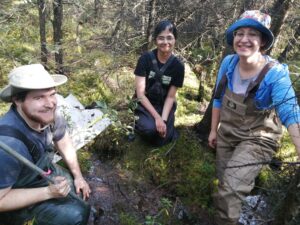
Students not only enhanced their learning on the field trip but forged connections with their classmates.
“The Norfolk Country trip was an unforgettable experience and believe it was very beneficial to myself and the rest of the Ecoysystem Restoratio students,” said student Chloe Krouse. “It combined learning with fun, hands-on experiences and allowed all the students to connect with each other.”
She appreciated the opportunity to gain real work experience while visiting sites in multiple stages of the restoration process and to participate in a wide range of activities, from collecting baseline data, to implementing management strategies, and completing long term monitoring on previously restored or protected sites.
“This hands-on experience allowed me to connect what I have learned in lectures to the real world,” said Krouse. “These site visits also allowed us to connect and learn from workers in the environmental and restoration field.”
Krouse valued the opportunity to work with Ian Fife from the Long Point Basin Land Trust when they visited a new LPBLT-acquired site to remove invasive species, girdle conifers and collect baseline biodiversity data. Her favourite activity was girdling, which involved removing a ring of bark from unwanted trees.
“I thought this was a very interesting technique to remove trees that is more beneficial to the environment than just chopping them down,” said Krouse. “Restoration often involves many complex solutions and being able to remove trees, while also protecting native species, was a great example of this.”
Student Shanze Yoell found it fascinating to participate in long-term monitoring at various sites they visited and to compare their samples to previous data.
“We could see with our eyes what had changed and how, how the trees had grown since,” said Yoell. “I love getting to feel like I’m contributing to something, and I love being able to be working on projects that will have impacts years and years and decades, hopefully centuries down the line.”
Student Jayna Wrightson noted how field trips help students gain outdoor experience and to get an idea of what a week in the life of a work camp could be like.
“[It’s] getting to know people, but also knowing what the workload might be like, what an average day would be like, so there’s no surprises later on,” said Wrightson. “It’s also exciting just to see what else there is out there that we haven’t seen before … new experiences, making new friendships too. It’s been a lot of fun.”
Copetown Oct. 3
The Norfolk Country experience was on the heels of a shorter field trip for Ecosystem Restoration students earlier this month. A group of almost 50 students had a rare opportunity to classify plants and soils not normally found in Southern Ontario during a visit to a rural area of Hamilton.
On October 3, they visited Summit Bog – an ecologically significant natural reserve in the Copetown area of Hamilton – on a joint field trip for their Soils and Flora Identification courses.
Summit Bog is the only bog that is known to occur in Hamilton-Wentworth County.
“This is very unusual in Southern Ontario, as bogs are generally associated with northern areas, but sometimes you find them in the south, left over as remnants from glaciation,” said School of Environment and Horticulture Professor Andrea Sinclair.
Sinclair noted that Summit Bog was formed when a very big chunk of ice melted and the water in that spot could not flow anywhere.
“It is filled with sphagnum moss, that forms peat/organic soil when it dies and is associated with plants that like acidic condition – so, basically like being in Algonquin Park but in the south,” said Sinclair. “The intent is that the students learn to identify and classify organic soils and the plant communities associated with it.”
-
- Students learn about peat at Summit Bog. (Supplied photo)
-
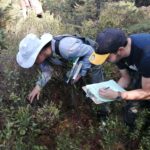
- Students practice plant identification at Summit Bog. (Supplied photo)
-
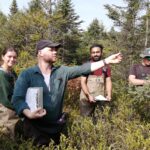
- Ecosystem Restoration students go prism sweeping among the leatherleaf at Summit Bog, (Supplied photo)
“
