

This fall, Niagara College’s Sustainability team – in partnership with NCSAC – gave over 950 NC students at both campuses a nutritious start to their day through the Rise and Shine Breakfast Program to help raise awareness about the College’s sustainability pledge.
The kick-off events on October 11 and 12 aligned with the College’s recent commitment to the UN’s Sustainable Development Goals (SDG’s) through the signing of the SDG Accord in late March.
The event sponsorship aligned with five of the 17 SDG’s, including no poverty, zero hunger, good health and well-being, responsible consumption and production, and partnerships for the goals.


“Collaborations like these are the College’s commitment to the SDG Accord and environmental stewardship in action,” said Pam Skinner, Senior Vice-President, College Operations who attended the breakfast at the Daniel J. Patterson Campus.
The goal of the event? Sustainability’s Katie Bristow says they hope to help students see College events and initiatives through a sustainability lens.
“A few conversations I’ve had surrounding the event were connecting things people may not have thought of or viewed as ‘sustainability’ and their connections to each other,” explained Bristow. “It’s hard to get people to care about greenhouse gas emissions when they are hungry. This helps build that knowledge not only into students, but also into staff members as well, to recognize all the great work they are already doing in making our Niagara College community more sustainable.”
Through partnership, the Sustainability team is not only elevating the work of other departments, but building awareness among students about the many different facets of sustainability, including many of the SDG’s that, on the surface, don’t have as clear a connection to the work.

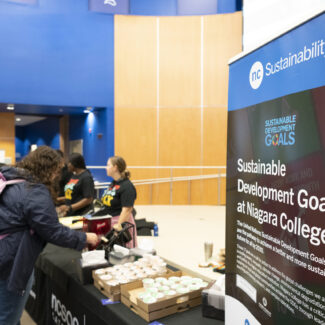
The ‘zero hunger’ goal aims to address global hunger and food insecurity which have been exacerbated by pandemic, conflict, climate change, and deepening inequalities – issues that are top of mind for the current generation of students.
Bristow explains how NCSAC made the event more sustainable through the use of compostable cutlery and plates, and recyclable or compostable cups.
“NCSAC has been very good at trying to get away from single use plastic items when they are able to so this event also enables us to highlight some of the work they’ve done behind the scenes that can get overlooked such as purchasing more sustainable materials,” said Bristow, who helped students sort their waste on the way out.
In Niagara-on-the-Lake, all materials were fully compostable which simplified the disposal process and resulted in zero waste.
Event coordinator, Jensen Croughan with NCSAC, says that the collaboration with Sustainability was a learning opportunity in responsible consumption.
“The partnership was important to us because we are learning from sustainability on tools and ways so be more sustainable with our events,” said Croughan. “We promoted students to bring their own plate as well and they would have received NC Cash as a reward.”
NC Cash is a “currency” developed by the Centre for Student Engagement and Leadership (CSEL) which students can earn at campus events and redeemed for NC swag. Croughan says that NC
SAC will continue to invite students to bring their own plate for future events.
“It overall was a very successful event and a wonderful partnership,” said Croughan.
Upcoming SDG events
The Sustainability team has aligned upcoming events with the SDG’s to build on the momentum of a sustainability culture at the College. These includes upcoming hiking events around the region, workshops, film screenings, species monitoring, field work, and collaborations with other department and student-run events.
