
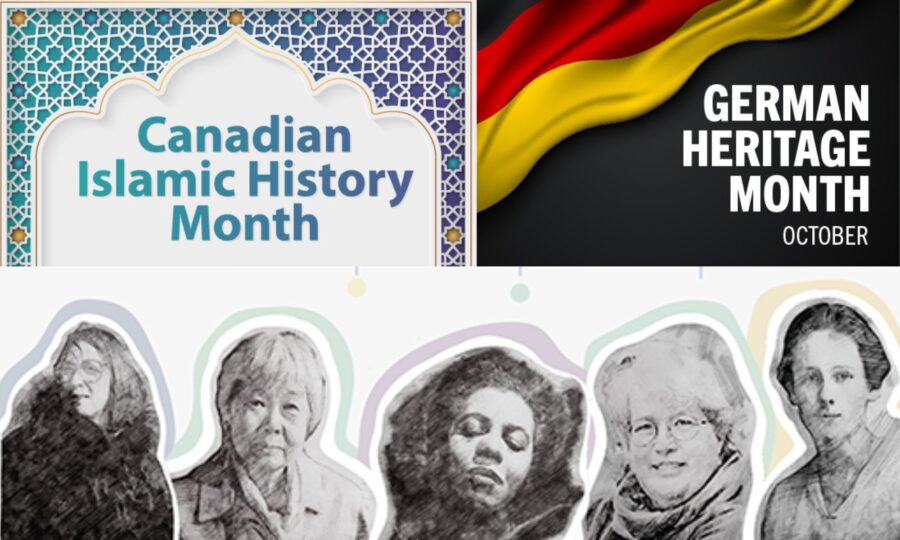
October hosts a number of months of significance: Islamic History Month Canada; Women’s History Month; Autism Awareness and Acceptance Month; Latin American and Hispanic Heritage Month; and German Heritage Month. Learn more about the acceptance, heritage, and history months acknowledged during this time below.
Islamic History Month Canada
“Celebrating Muslim Women in the Arts & Sciences” is the theme for Islamic History Month Canada (IHMC), one of several months of significance that is observed in Canada every October and recognized at Niagara College.
This year, IHMC will focus on honouring the historical contributions of Muslim women through the ages and their influence in Canada on the progress of the arts, sciences and society.
IHMC was first proclaimed in 2007 by the late Mauril Belanger, MP, Ottawa-Vanier. Since then, provinces and municipalities throughout the country have made their own proclamations.
Every year, IHMC is a month filled with events that bring communities together to learn from one another about the Muslim heritage and contributions to society.
As an Employer Partner with the Canadian Centre for Diversity and Inclusion (CCDI), Niagara College regularly provides free learning opportunities to staff interested in inclusivity. This month, an October 5 webinar provides an important opportunity to learn about the lived experience of the Muslim community in Canada.
Titled Islamophobia: Removing systemic barriers faced by Muslim communities, this one-hour webinar brings participants together with thought leaders to get a better understanding of Islamophobia in Canada, how it’s manifested, and what workplaces and communities can do to address bias and hate against Muslims.
The webinar will be hosted by Anne-Marie Pham, who’s worked with diverse communities and workplaces for more than 25 years and specializes in mobilizing, educating and sharing the latest research and promising practices on equity, diversity and inclusion in the workplace.
The webinar begins at 1p.m. on October 5. Register on the CCDI website by 4 p.m. on October 4. When prompted to “select the type of registration that is most appropriate for you” during the registration process, choose “Employer Partner.”
More learning resources are available on the Islamic History Month website.
Women’s History Month
On October 18, 1929, Canadian women were legally declared “persons,” and therefore eligible to join the Senate of Canada.
It’s for that reason the Government of Canada designated October as Women’s History Month in 1992, marking the start of an annual celebration that acknowledges the contributions women have made–past and present–to create a better, more inclusive Canada.
This year’s theme, “Through Her Lens: Celebrating the Diversity of Women,” emphasizes the importance of recognizing and celebrating the achievements and contributions of women from diverse backgrounds. In particular, it focuses on the experiences of Indigenous women, women who identify as part of the 2SLGBTQIA+ community, and newcomer, racialized and migrant women.
Among the countless Canadian women who’ve created change are:
• Jeanne Mance, who founded Canada’s first hospital in 1645
• Dr. Emily Stowe, the first female physician to practice in Canada (1867)
• Louise McKinney and Roberta MacAdams Price, who were the first women elected to a legislature in the British Empire (1917)
• Elsie Knott, the first woman elected chief of a First Nation community (1954)
• Jeanne Sauve, the first woman to serve as Governor General of Canada (1983)
• Jean Augustine, the first Black Canadian woman elected to the House of Commons (1993)
• Josee Kurtz, the first woman to command a major Canadian warship (2009)
Learn more about Women’s History Month and the women who have historically and are currently impacting the fields of arts, science, politics and more in Canada from the Women of Impact Gallery.
Autism Awareness and Acceptance Month
Although about one in 66 children and youth in Canada have been diagnosed with Autism Spectrum Disorder (ASD) according to the Public Health Agency of Canada, this developmental disability is still widely misunderstood.
During October–Autism Awareness and Acceptance Month–Canadians can learn more about ASD, and how to support those living with ASD, their families and their caregivers.
 With the right support and resources, including early intervention, education and community support, people with ASD can lead a fulfilling life. At Niagara College, the Autism and Behavioural Sciences program delivers a comprehensive and dynamic educational experience for those interested in making a meaningful impact in the lives of individuals with ASD.
Key highlights of the program include:
Applied Behaviour Analysis (ABA) Principles: The program places a strong emphasis on supporting individuals with ASD through the principles of Applied Behaviour Analysis. Students are equipped with the knowledge and skills necessary to apply evidence-based ABA techniques effectively.
Skill Building Programs & Behaviour Intervention Plans: Students in the program learn to develop skill-building programs and behaviour intervention plans that are both practical and person-centered. These plans are designed to support individuals with ASD in reaching their fullest potential.
Extensive Placement Hours: To ensure hands-on experience and practical application of knowledge, the program includes 350 placement hours in schools and therapeutic settings. This valuable experience allows students to refine their skills and build confidence in working with individuals with ASD.
Special Initiatives: In addition to the core curriculum, NC has strong relationships with various community partners which allow students to be involved in specialized initiatives, such as a dental care program for children with ASD and a PEERS program (Social Skill Group for Teens).
Autism Canada offers many free resources as well as information about support and programs for those living with ASD. The organization is also active on its social media channels.
Latin American & Hispanic Heritage Month
During Latin American & Hispanic Heritage Month, the many contributions of the Latin American & Hispanic community in Canada are celebrated. This is a large and growing community in Canada, with representation from the 20 Latin American countries (and one territory) where Spanish is the official language.
 The Government of Ontario designated October Hispanic Heritage month in 2015; the Government of Canada designated October Latin American Heritage Month in 2018 to celebrate, share and promote the unique culture and traditions of Latin American & Hispanic communities with all Canadians.
To learn more about Latin American & Hispanic Canadians and the significant contributions made by this community, visit the Hispanic Canadian Arts & Cultural Association website or the Canadian Encyclopedia. The Sur Gallery in Toronto, a project of Latin American-Canadian Art Projects is also dedicated to the implementation of art projects that showcase and promote contemporary Latin American and Latinx artistic practices.
A number of local organizations are dedicated to supporting Latin American & Hispanic Canadians, too, including:
Iglesia Cristiana de Port Colborne
Niagara Folk Arts
TOES Niagara
NC International will be hosting a Fiesta Latina event on Nov. 10. Stay tuned for more information.
Happy Latin American & Hispanic Heritage Month!
German Heritage Month
More than three million people make up Canada’s German community. It’s one of the largest cultural communities in the country, and it’s celebrated annually in October.
German Heritage Month is an opportunity to recognize, celebrate and learn more about the significant contributions of the German community to the Canadian society and economy.
October is also the month communities across Canada host their own Oktoberfest celebrations. In Germany, the well-known Bavarian festival lasts for nine days prior to Thanksgiving and features traditional outfits, food, song, dance and beer–all of which celebrate German culture and heritage.
The largest Oktoberfest outside of Germany takes place in Kitchener-Waterloo, attracting more than 700,000 people, according to tour operator Canadian Affair.
Locally, the Niagara German-Canadian Club serves as a focal point for the German-Canadian community to promote the understanding of German-Canadian culture and history. Visit the club’s website for more resources and to learn more. Additional information can be found in the Canadian Encyclopedia.
Happy German Heritage Month!
