
When Business and Management Studies professor Brian Law started a new academic year at NC at the beginning of September, he was looking forward to implementing the learning strategies he acquired recently during the first phase of the College Educator Development Program (CEDP).
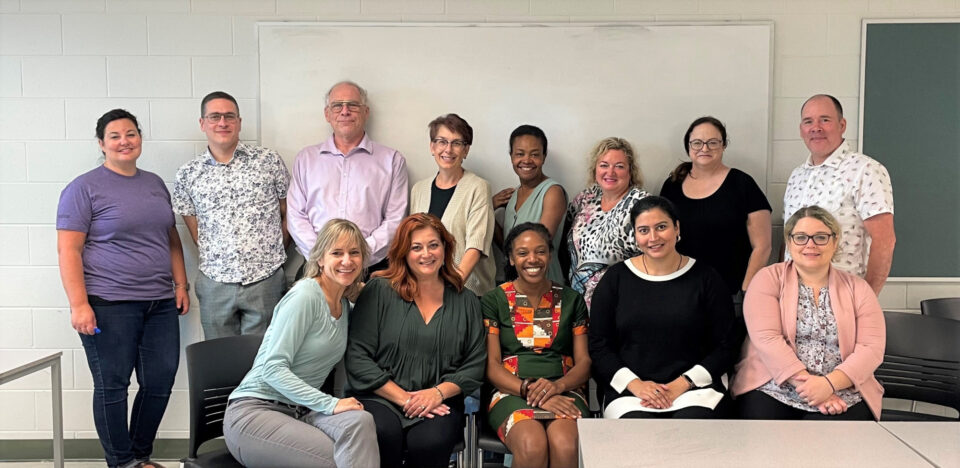
Law was one of 24 NC faculty members taking part in CEDP at Fanshawe College, Aug. 15-17, where about 180 college educators and facilitators from Fanshawe, Lambton, Mohawk, Niagara College and St. Clair came together for the professional development event.
“I found CEDP Phase 1 to be a highly enjoyable experience,” Law said. “The three-day phase was packed with a wealth of informative presentations. These presentations were accompanied by practical workshops, engaging team discussions, and various learning activities.”
He said he especially liked the keynote address from Dr. Joseph Kim, an associate professor in Psychology, Neuroscience and Behaviour at McMaster University, who’s actively involved in the science of teaching and learning.
“He offered valuable insights into effective learning strategies like retrieval practice, interleaving and spacing,” Law said. “These strategies can significantly enhance students’ academic performance within the classroom environment. Consequently, I am enthusiastic about implementing these strategies in my upcoming teaching endeavors.”
For more than 25 years, all new Niagara College full-time faculty have participated in CEDP, said CEDP facilitator and NC School of Technology professor Sarah Rouillier. The program fosters a learning community among faculty with specific outcomes over three years.
The program is broken up into three residential phases: the first is delivered in August of Year 1, the second in May of Year 2 and the third in June of Year 3. Faculty members are placed in learning teams with a facilitator and other CEDP participants for the program’s duration.
“Each phase has a theme,” explained Rouillier, who also participated in the program when she was hired in 2011. “New hires in Year 1 need the required information to get started. Year 2 has a bit of reflection after 8 months of teaching and looks at the technology that can be used to enhance our teaching experience. In Year 3, participants continue their self-reflection through the presentation of their teaching portfolio, while exploring opportunities for further professional development and personal growth.”
Sherry Visser, a professor in the Child and Youth Care program, said even though she’s been teaching part time at NC for a number of years, the first phase of CEDP alone has taught her so much.
“All of the sessions that I participated in were meaningful and I had amazing takeaways that have already used in my teaching and will continue to do so throughout my career,” she said. “The immersive experience was incredible. I learned so many new things.”
The program, which is delivered entirely at Fanshawe, provides educators with a way to enhance their own learning on how to deliver material, and it’s constantly evolving to reflect the needs of the current participants.
It’s just as beneficial to the facilitators, too.
“Being surrounded by new hires, forward-thinking planning members and passionate facilitators keeps my teaching fresh and my spirit inspired,” Rouillier said. “I truly enjoy the program. Every phase I feel that not only can I add my own perspective by my contributions to productive discussions, but I learn something new each time.”
Whitney Ross, Associate Director, Educational Development, Centre for Academic Excellence (CAE), described CEDP as “one of the most unique professional development opportunities available to post-secondary faculty members in Ontario.
“Niagara College’s involvement in CEDP speaks to our institution’s commitment to teaching and learning and providing faculty opportunities to engage with new topics and best practices, while connecting with colleagues across the college sector. It was amazing to see our Niagara College cohort come together and deepen their commitment to student learning and success.”
Part-Time Teachers Development Program
New part-time faculty received their own special training in August through a development program that includes an orientation to teaching at NC and best practices for teaching in the college sector.
Ross said more than 50 faculty attended the Part-Time Teachers Development Program (PTTDP) this August.
“Every offering of the Part-Time Teachers Development Program reminds us of the amazing group of part-time faculty we have at NC who are committed to support student learning,” she said. “We are always amazed by the dedication of our part-time faculty who commit 10.5 hours to this program before term and are excited to engage with topics related to teaching and learning at NC.”
PTTDP is offered three times per year–before the start of every term, said Kate Wiley, educational developer in the Centre for Academic Excellence, who’s currently responsible for oversight and implementation of the program. A panel of veteran part-time teachers are also invited to answer attendees’ questions and share their experiences with their new colleagues.
Although the training isn’t mandatory, Wiley said it’s strongly recommended for any new part-time faculty or existing part-time faculty who’ve been invited to complete the program by their Associate Dean.
It’s also offered both virtually and in person so it’s more accessible.
“It’s such a nice way to welcome (educators) to NC,” she said.
For those interested in joining an upcoming PTTDP session, more information about it is available on CAE’s Frequently Asked Questions page.
