
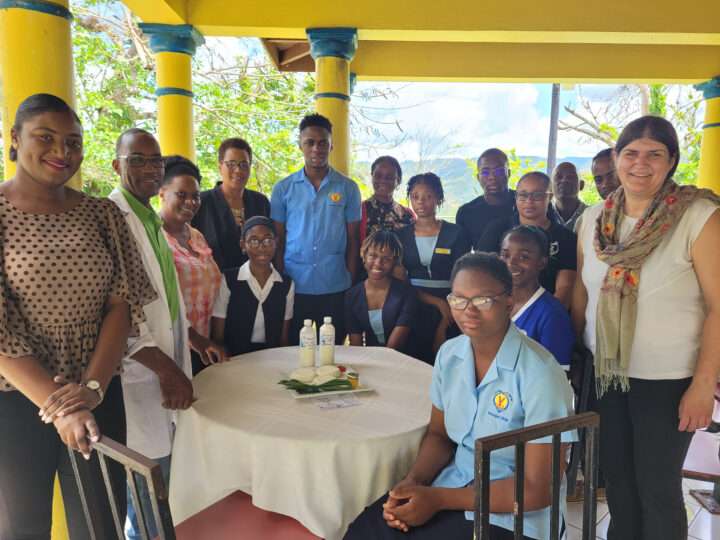
Goat dairy is being processed on Moneague College campus in Jamaica as a new milestone achieved within the project Skills to Access the Green Economy Program (SAGE), with the support of Niagara College.
The SAGE project aims to develop a globally recognized agro-food processing program for students to work in the agro-food sector, providing them with the environmental skills needed for the future industry. Through this multi-year project, Niagara College, in collaboration with College of the North Atlantic, supports its partners in Jamaica, Moneague College and HEART/NSTA Trust Ebony Park Academy, since 2020.
With NC’s support, Moneague College was able to implement a work-integrated learning model focused on hands-on learning and circular economy. This model allowed students in the agricultural production courses to produce inputs for the food processing students, who could create goat dairy products for the student cafeteria and the local tourism trade.
“Since Moneague College has a goat herd we made it a priority to process goat dairy on campus, and during this most recent visit we pushed for the opening of the food processing lab,” said Niagara College Program Coordinator and Professor of Culinary Innovation and Food Technology, Amy Proulx, Ph.D.
As one of the collaborators on the project, Proulx travelled to Jamaica last Spring to visit the Moneague College campus.
“Students had the chance to practice dairy pasteurization and basic quality control using the new equipment, helping produce our first batches of fresh goat cheese and goat yogurt,” said Proulx. “Goat milk was also processed into natural soap using a range of agricultural products from the campus farm. The goats provide recycling of crop materials while providing important fertilizer, the manure is processed in their bio-fermentation facility for biogas production, and the composted manure is applied back to the agriculture plots.”
Funded by the Government of Canada, the project is part of a program through Global Affairs Canada to share the expertise of Canada’s colleges and institutions with education institutions and employers in six Caribbean countries – Belize, Dominica, Guyana, Grenada, Jamaica, and Saint Lucia. Led by Colleges and Institutes Canada (CICan), the project’s overall objective is to strengthen demand-driven and competency-based training programs offered by Caribbean institutions and to attract and retain marginalized students for those programs.
“A key part of the project is to create and deliver a future-focused agriculture and food processing-centred curriculum, with a concentration on skills for sustainability,” said Proulx. “Agriculture and food processing contribute about 25% of all greenhouse gas emissions and food processing has a reputation for creating large amounts of packaging waste. With SAGE’s efforts to create a next generation of environmentally conscious leaders, there is a potential shift within the industry towards greater environmental sustainability.”
During Proulx’s trip to Jamaica, workshops were run on food safety leadership in Hazard Analysis and Critical Control Points (HACCP) Systems and Continuous Improvement (CI) Methodology, with a train-the-trainer mindset. Also, local teachers were exposed to new Open Education Resources (OER) and participated in global committees related to OER in agro-food innovation and sustainability.
One of the trip’s highlights was the St. Ann Agricultural, Industrial and Food Show at the Discovery Bay Sports Complex on April 28. Faculty and students from the Moneague College and Heart Trust Ebony Park were proud to demonstrate their youth engagement strategy for sustainable agriculture and food production.
During the show, Jamaica’s Minister of Agriculture, Pearnel Charles Jr., delivered the message that, “Agriculture is a viable and honourable career for youth,” emphasizing Jamaica’s dedication to sustainable economic growth in the sector, both to serve the domestic population and the growing tourism sector.
Through this initiative, NC continues to support the United Nations’ Sustainable Development Goals (SDGs). While developing skills training programs focused on SDG 13, climate action, this project will also target SDG 4, quality education, and SDG 8, decent work and economic growth. The project’s gender-sensitive skills training programs encourage the participation of women, youth and vulnerable populations and include a gender mainstreaming component, which also supports SDG 5, gender equality.
Over the past 20 years, Niagara College has successfully completed more than 100 capacity building and training projects in over 25 countries, including Barbados, Bhutan, Chile, Colombia, Grenada, Jamaica, Malawi, Mexico, Saint Lucia, Saudi Arabia, South Korea and Vietnam. For more information on Global Education and Partnerships and how to get involved, visit ncglobal.ca.
