
Does using virtual reality be a confidence booster for nursing students and improve their performance?
A NC Practical Nursing research study, led by faculty in the School of Nursing, found out that it does.
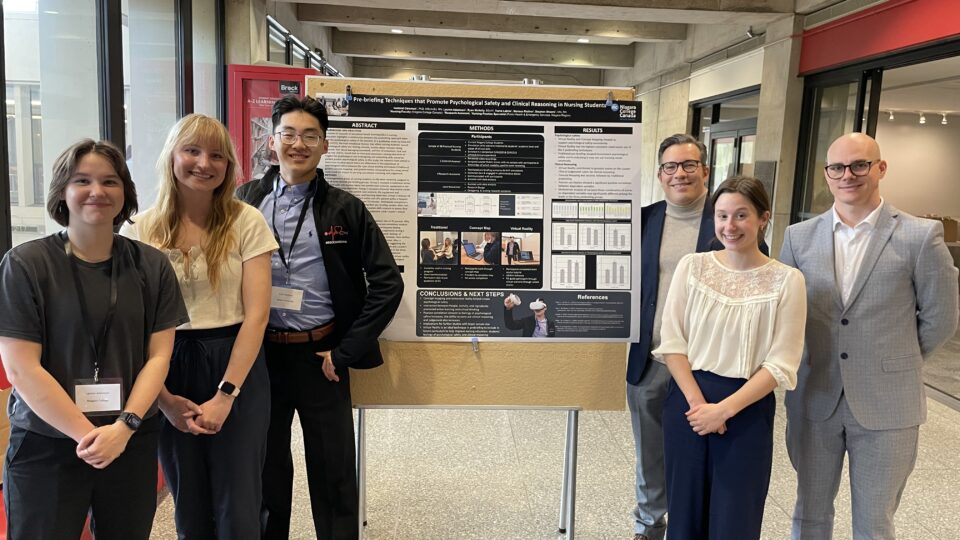
The study, “From Pre-briefing to Skills Performance: Approaches that support Psychological Safety and Clinical Reasoning in Nursing Students” explored how different methods of simulation impacted the performance and confidence of nursing students at the College.
Professor of Nursing Dr. Holldrid Odreman (PhD, MScN-Ed, RN, CCNE, CCSNE) who led the study, said the study’s objective was to promote psychological safety in nursing students so they may have an increased chance of performing better. Its goal was to identify which method of simulation instruction increases student performance and confidence as students make clinical decisions.
A small group of final term Practical Nursing students gained hands-on experience as research assistants in the study, as well as one university student who joined the NC study from Brock University.
“As a professor involved in research, it is always a great experience to mentor pre-graduate nursing students on the planning, process, and execution of nursing research,” said. Dr. Odreman. “The research assistants’ enthusiasm and commitment to this research study led to the discovery of useful results and sparked an interest in them to pursue future research endeavours in their nursing career.”
Working with Dr. Odreman, the research assistants began planning the study in January. They examined the use of three different types of pre-briefing strategies – traditional, concept-mapping, and virtual reality – to determine which method the student participants were most comfortable using, encouraged their feeling of psychological safety, and influenced their ability to make appropriate clinical decision-making.
The first week of March was ‘intervention week’ for the research assistants to collect data. Participants – 38 volunteers from the Practical Nursing program – were randomly assigned to one of the three types of pre-briefing strategies to receive a pre-briefing session before participating in a simulation skills scenario. Each pre-briefing session lasted 20 minutes. Following the session, participants completed a survey on Psychological Safety.
Once a pre-briefing session in their assigned group was completed, research assistants guided study participants through a simulation skills scenario where they were asked to use their nursing judgement to assess the patient.
Following ‘intervention week,’ research assistants began to analyze the data, dissect the research findings, and provide feedback to parties involved.
Stephen Shears, a Registered Nurse from Public Health Nurse and Emergency Services, Niagara Region, also contributed to the research study as an external assessor by conducting an extensive review of video recordings from the study participants. The video recordings showed participants in a simulation skills demonstration, right after they completed pre-briefing techniques (which were either traditional, concept mapping, or virtual reality).
After analyzing the data from the students regarding their psychological safety, clinical reasoning and decision making, the study concluded that:
- Concept mapping and immersive reality helped create psychological safety;
- Interaction between participants and research assistants during the pre-briefing techniques promoted active learning and critical thinking;
- Statistical analysis of the scored data showed that, as feelings of psychological safety increased, the ability to carry out clinical reasoning and judgement also increased; and
- Virtual reality is an ideal technique in pre-briefing to include in future curriculum to help improve nursing education, students’ feelings of psychological safety, and clinical reasoning.
“There was a significant positive correlation between participants feeling psychologically safe and their ability to make clinical judgements during a simulated skills scenario. This suggests that as participants’ feelings of psychological safety during their pre-briefing experience increase, their abilities to carry out clinical reasoning and judgement tend to increase,” said Dr. Odreman.
“Virtual Reality had the highest consistent rated scores out of the three pre-briefing techniques. In addition, Virtual Reality contributed to greatest scores on the Lasater Clinical Judgement rubric for clinical reasoning.
“The student results suggest that the use of virtual reality in pre-briefing was the ideal technique to support the feeling of psychological safety and to improve clinical reasoning in the group of nursing student participants.
The team had an opportunity to participate in a poster presentation for Niagara Health Research Day on May 4 – an annual showcase of findings and ideas from researchers across Niagara and the Greater Toronto Area. The event highlights research dedicated to improving overall health and well-being, patient outcomes and how care is delivered.
“The research assistants in the team had an amazing opportunity to speak to visitors of the event about our study and got also network with other researchers in the healthcare field,” said Dr. Odreman.
The study was supported by $20,000 from College’s Dream Big Fund, which covered the purchase of virtual reality equipment (Oculus headsets), to use with a nursing simulation program, as well as payment for student Research Assistants.
“We thank Fiona Allan (VP Academic), Angela Butt (Dean), and Courtney Evers (Associate Dean) for their support to meaningful and practical student experiences within our nursing program,” said Dr. Odreman.
