
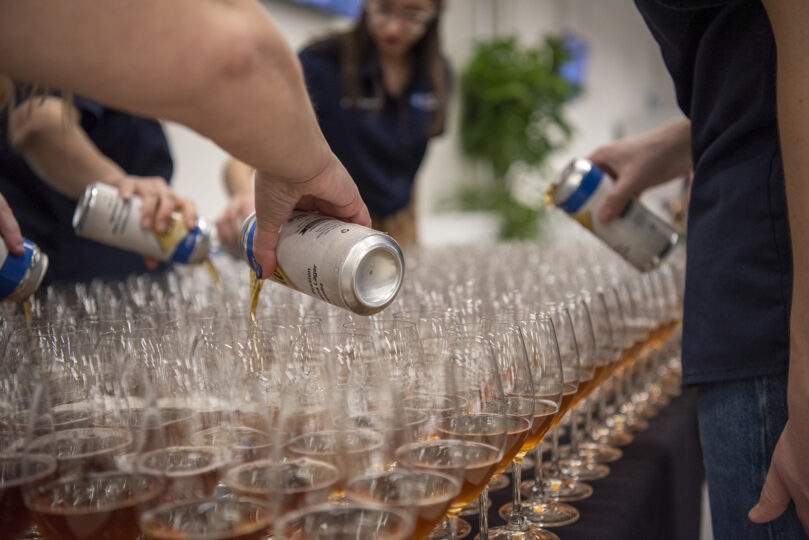
InsideNC caught up with Team Beer faculty lead Victor North and participating Brewmaaster student Nathaniel Perrault prior to Round 16 of Caps, Corks and Forks, to tap into plans for the event and its impact on the student experience.
Here is what they had to say.
Victor North, faculty lead
How many Brewmaster students are involved Team Beer ?
There are seven Brewmaster students on team Beer for Caps, corks and forks this year! They are in different terms, we have students from second, third, and fourth term on the team.
How did they get to be on Team Beer?
They check their student email regularly and, when they saw the opportunity, they volunteered quickly! Caps, Corks and Forks is always a highly anticipated opportunity and the students are quick to volunteer!
How does student participation in this event correspond with their learning experience in the Brewmaster program?
It is on av olunteer basis, but their participation corresponds with their learning experience in several ways. A primary example is how the students have prepared five different brews in the Teaching Brewery for potential use in this event!
But there is other crossover to curriculum content, of course, as a personal example – in BREW1294, they go over the art and science of pairing food with beverages in class with me. We do some tasting exercises, talk about the rules of pairing food and drink, and then we break the rules for scientific purposes.
How do you feel Caps, Corks and Forks benefits the Brewmaster students involved?
Caps, Corks, and Forks is one of the rare opportunities for our brew students to engage in cross-term collaboration and socialization – with much of their regular school activities being divided by term. It is also an even rarer opportunity to meet (and engage in some friendly competition!) with students of the Wine and Viticulture program. It is generally an excellent opportunity for all our beverage programs to cross-pollinate, as we always try to pull our friends in the spirits program into the fun in some way too! (this year with a pre-meal cocktail).
As a great example of the cross-discipline nature of the event; our brewing team this year has an alumni of the Artisan Distilling program, while the Wine team this year actually has an alumni of the Brewmaster program!
It will be interesting to see how that might play out at the event!
Of course, I would be remiss if I didn’t mention the student volunteers and faculty of culinary and hospitality programs who will actually make and serve the wonderful food.
There is no other Niagara College event where the Culinary, Tourism and Beverage Studies division so intimately involves all three of its schools: Culinary Arts, Hospitality and Tourism, and Wine, Beer and Spirits. This is part of what makes the event so special, and of such benefit to all the student participants and faculty!
What kind of valuable experience do students gain by participating?
Students gain experience in real world service and sales – presenting their pairings being something of an exercise in salesmanship and storytelling.
It is also a kind of public speaking exercise: they have to be able to take the kind of theory that they discuss in class, translate it into something compelling and comprehensible to a dinnertime audience, and then compress it into a brief “elevator pitch” that will be sticky and successful!\
Transforming beer theory, which can be kind of dry, into something exciting and interesting to a general audience is exactly the kind of thing required when selling a new beer! There are other opportunities for students at Niagara College, but none are quite like Caps, Corks and Forks.
What have the students done to prepare for the event?
To prepare, the students will do two tastings. At these tastings, the students put theory to practice by trying the beers that they selected with samples of the food that will be served at the event. There are always a few surprises during these exercises. Some beers that the students thought would complement or contrast the food nicely turn out to fall flat for some reason – which is always interesting to explore! By the end of the second tasting, the students will have to determine, and commit to, their best possible pairings.
Essentially, the first tasting is to try a couple of possible combinations that should theoretically work, and see what works best, while the second tasting is to narrow it down and land on the best possible pairing!
At the event itself, the students will pour and serve the beers, as well as introduce each pairing to the assembled diners.
Can you tell me if they are brewing a beer for each course or selecting an existing beer (from NC or Ontario or otherwise)?
The beers are going to be something of a surprise, but the rules are that all of the beers have to be made in Ontario – just as all of Team Wine‘s selections also have to be Ontario in origin.
I always encourage the students to use their own student-made brews as often as possible, because it’s because it’s great to highlight their work in the Teaching Brewery at this public event!
Still, it’s also fun, and important, to highlight the great products of the Ontario brewing industry, so we do tend to do a bit of both
It is ultimately up to the students which beers are poured and paired with each dish!
Nathaniel Perreault- student
Where are you from?
I currently live in Welland and commute to DJP Campus, but I am originally from Walter’s Falls, Ontario which is hallway between the Blue Mountains and Owen Sound.
What year of the Brewmaster program are you in?
I am currently in my last term in the Brewmaster program and I am set to graduate this spring.
How are you gaining valuable experience by participating on Team Beer?
Pairing food and wine is a relatively common concept that is frequently showcased in movies, culture, and dining. Beer has yet to have significant representation or consideration when food pairing is mentioned. Most people think of pizza, wings and pub grub as appropriate beer pairings; which they are, but we believe beer also has a place in fine dining.
The culinary program builds layers of flavours and textures with a multitude of ingredients. We can create a wide range of flavours and mouthfeel to complement the dishes with our array of malts, hops, and yeast strains. This event is allowing our team to explore an area of fine dining food pairing that is greatly underrepresented in the brewing industry.
What do you find particularly helpful or rewarding about the experience?
Wine has certain societal rules when it comes to food pairing which determines a consistent pattern in Team Wine’s pairing choices. For beer, no such rules exist, but knowing the general pattern can help guide us into unfamiliar territory. Discovering unique pairings between food and beer using drastically different styles has been very rewarding. It has also been a pleasure to collaborate and further connect with a wide demographic of beer students.
Is there something you are looking forward to about the event?
I am really looking forward to being immersed in the event and the energy surrounding it. It is unique for culinary, wine, distilling and beer to all come together to curate such an extravagant event. We will be presenting styles that are familiar to most, and styles that are known by few. I’m excited to see how people react and decipher them. I am also looking forward to the fact that we will be the first team to showcase exclusively Niagara College Teaching Brewery produced beers.
