

January 27 is International Holocaust Remembrance Day, a day that honours the six million Jewish victims of the Holocaust and millions of other non-Jewish people who were victims of Nazism. The date marks the anniversary of the 1945 liberation of Auschwitz-Birkenau, one of the main German Nazi concentration and extermination camps.
Officially declared in 2005 by the United Nations General Assembly, International Holocaust Remembrance Day promotes Holocaust education around the world to help prevent future genocides and raises awareness against all forms of “religious intolerance, incitement, harassment or violence against persons or communities based on ethnic origin or religious belief.”
International Holocaust Remembrance Day presents an opportunity for Niagara College students and employees to learn more about the history of antisemitism – the hatred of or prejudice against Jews – especially as we hear about the rise of antisemitism in contemporary society.
“In the context of a recent rise in anti-Semitic hate, it is especially important to take time to commemorate Holocaust Remembrance Day, which serves as a reminder of how systemic racism can negatively impact a community,” said Samah Sabra, NC’s Workplace Equity, Diversity, and Inclusion Manager.
“As work continues around our ongoing, collective commitment to advancing EDI at Niagara College, it’s important that we educate ourselves on all forms of discrimination, so that we can ensure our learning and work environments are inclusive and welcoming for all.”
Antisemitism and the Holocaust are among the topics being covered in a new course, History of Racism, developed by NC History Professor Michele Stairs and offered to students for the first time this winter term.
“Part of what I try to do through my history courses is to help students develop empathy and be able to do some perspective taking,” said Stairs, whose course examines different groups who have experienced systemic racism from a global context.
Stairs incorporates primary sources and documents into her classes, giving students a window into the lived experiences of the millions of victims of the Holocaust.
“One of the big challenges is taking history and making it relatable so that people understand it,” she said. “We look at people’s journeys and individual experiences, so students can start associating those numbers with real people.”
Using primary documents is also a way for Stairs to teach students how to read and think critically, while shedding light on the disinformation and denial that exists around the Holocaust.
NC Professor David Bright, who discusses the Holocaust in his Modern History course, echoes this thought.
“The role of education is not to deliver content per se, but to promote, nurture and refine critical thinking skills, skills that will serve our students a lifetime and help them to navigate a world awash in lies, fake truths and falsehoods, such as Holocaust denial,” said Bright.
“I’m not convinced that the ‘value’ of history is that it teaches us ‘lessons,’ but I am totally convinced that an absence of historical knowledge or awareness makes it easier, over time, for us to forget how one thing (casual bias, discrimination, racism etc.) can almost inevitably lead to tragic, avoidable consequences,” he added.
Stairs reminds us that history will always inform the present.
“If we skim over these kinds of huge, devastating events, it’s easy for us to lose sight of the cost that things like antisemitism, or racism, or discriminations of different kinds, have on people’s lives,” she said. “If we aren’t able to make good connections to these kinds of events, then we don’t take the lessons away from the events either…we don’t learn the things that we need to learn.”
Employee webinar on Feb. 16
The Centre for Organizational Excellence has partnered with the Canadian Centre for Diversity and Inclusion (CCDI) to offer NC employees free access to CCDI-led webinars that provide invaluable insight into the latest thinking about diversity and inclusion in Canada.
Staff and faculty are encouraged to register for an upcoming webinar on Antisemitism: How to recognize and prevent it in the workplace, to be held on February 16 from 1 to 2 p.m. The webinar will feature thought leaders in the Canadian Jewish community who will discuss what organizations can do to define and combat antisemitism in the workplace and beyond.
Resources
Resources on the Holocaust and antisemitism are available through ncLibraries, while a photo gallery from Holocaust survivor and author Max Eisen’s 2017 visit to the College can be viewed on the NC Digital Archive. Eisen, who dedicated his life to Holocaust education, passed away in 2022 at the age of 93.
Staff, faculty and students are also reminded that NC’s newly launched EDI website is a resource and learning tool for all of us at the College to uphold the values of respect and inclusivity.
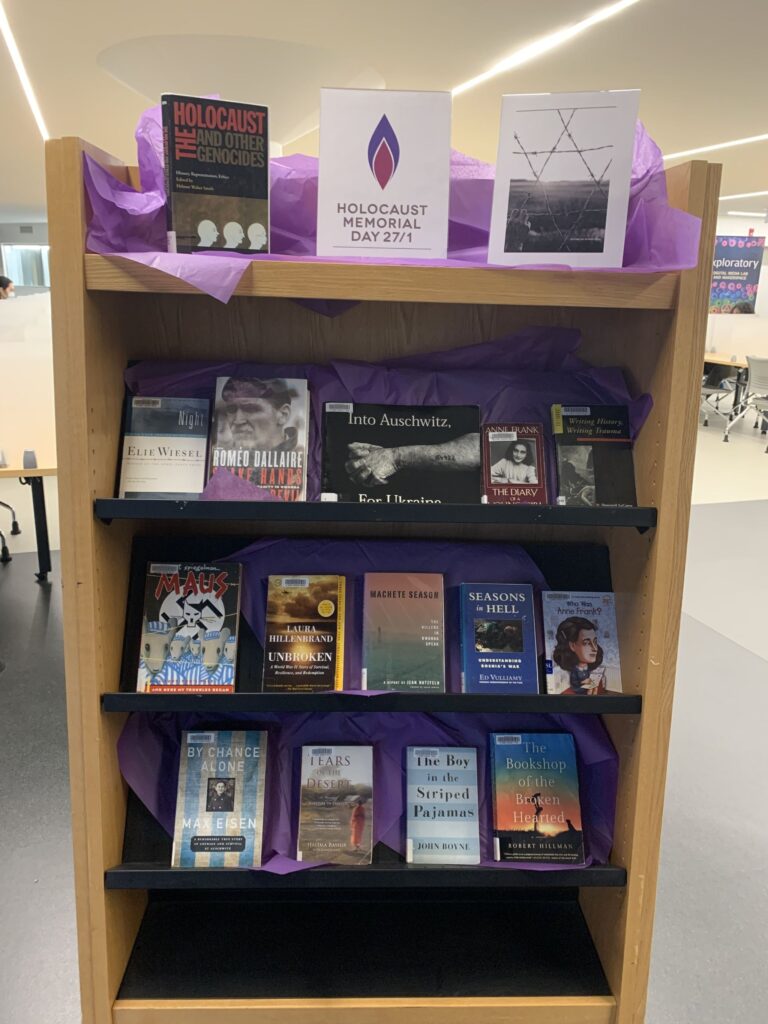
The library at the Welland Campus marks International Holocaust Remembrance Day with a book display.
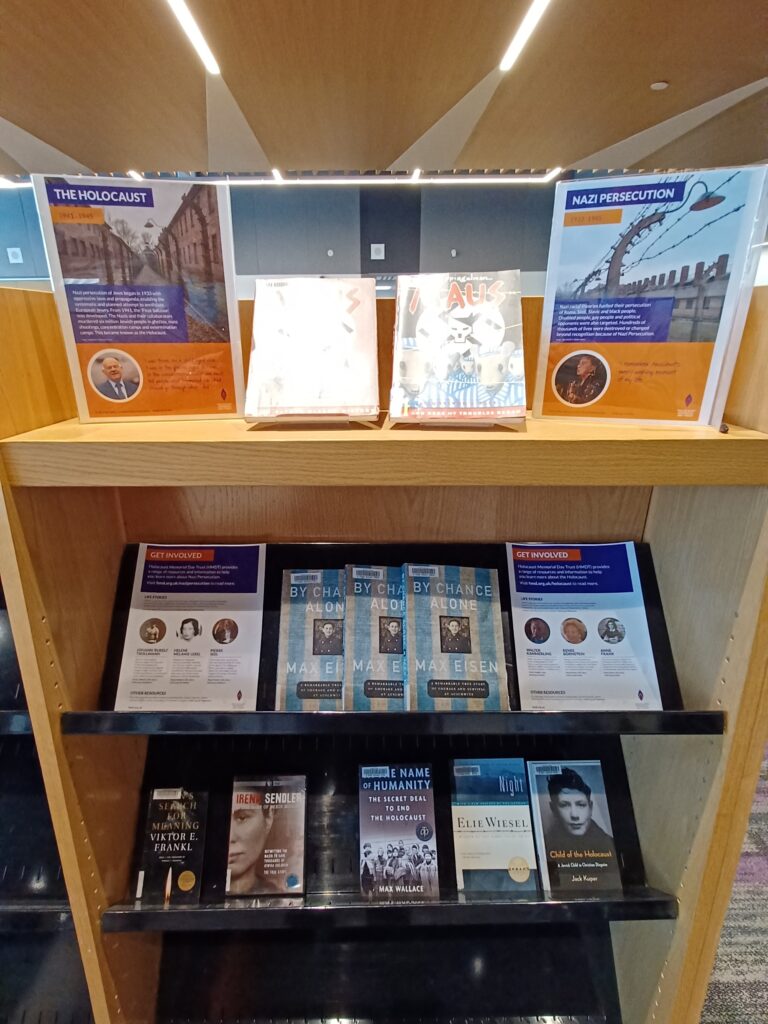
Resources for International Holocaust Remembrance Day on display in the library at the Daniel J. Patterson Campus in Niagara-on-the-Lake.
