
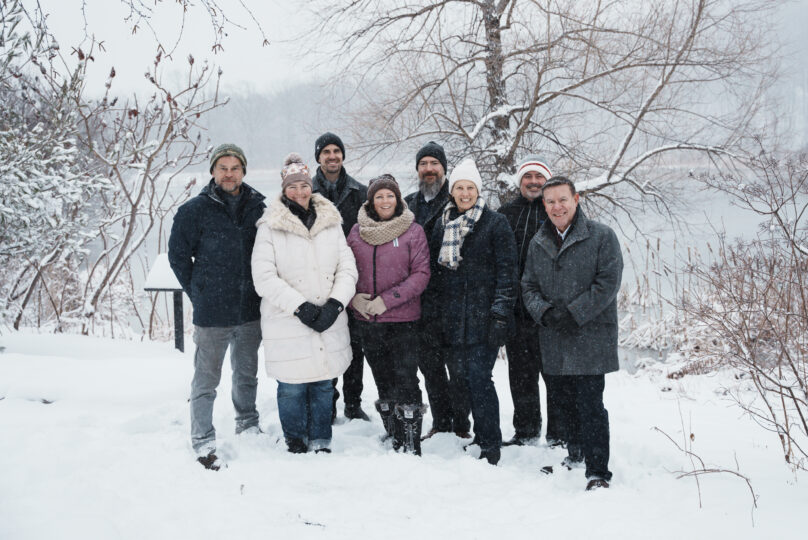
A donation from a local nature club is helping Niagara College Ecosystem Restoration students spread their wings when it comes to tracking bird migration.
The Niagara Falls Nature Club is the most recent supporter of the College’s Motus tower project, which tracks the flight patterns of migratory birds and works in conjunction with hundreds of others across North and South America. The tower was installed last year at NC’s Daniel J. Patterson Campus in Niagara-on-the-Lake, and has recently become operational and online, connected to Birds Canada’s server.
“Thank you to the Niagara Falls Nature Club for their generous donation to our Motus tower project. This device and financial donation will be used to support student learning in a real-world way by providing environmental students with an incredible tool that they will be able to use and access for years to come,” said Alan Unwin, NC dean, Business and Environment, who was recently part of a historic Canadian delegation at the United Nations’ Conference of Parties (COP15) in Montreal. “It also connects us into a larger more expansive database network that will benefit others, even outside of the College, as the data the Motus unit will produce will feed into the broader monitoring network.
“It fundamentally illustrates our institutional commitment to environmental education that will continue to focus on and elevate the importance of nature.”
NC’s Ecosystem Restoration students have been involved with creating and executing a plan as well as securing resources for the Motus Tower project since fall 2020. This year, students will begin using data collected from the tower in applied research projects.
“The Motus tower is a perfect example of why NC’s Ecosystem Restoration program is a go-to source for employers looking to hire skilled graduates,” said Evan DiValentino, associate dean, School of Environment and Horticulture. “The Motus tower is an excellent example of how experiential learning and strong community partnerships can benefit student skill development.”
Martin Smith, professor and program coordinator for Ecosystem Restoration, explained that NC’s Motus tower and hundreds of others are continuously collecting data. The ever-expanding dataset is summarized and interpreted by researchers from around the world. With the College now supporting the Motus network, students will soon have access to data collected across North and South America.
How it started
The first phase of the project began in spring 2022. The project received $1,000 from the World Wildlife Fund and a student-led Go Fund Me Campaign raised $2,800 to cover purchase and installation of the Motus tower.
The tower was installed on the roof of the student residence building on campus – chosen as the highest point that is easy to access for antenna installation, so that birds with electronic transmitters can be more readily detected up to 10 kilometers or more.
During 2021-2022, Ecosystem Restoration students also successfully applied for funding from the Royal Bank of Canada’s Tech for Nature Fund resulting in $4,000 earmarked for Phase 2 of the project: the purchase of radio tags as required during Phase 3 and beyond.
“Developing ideas into fundable projects that can be implemented by the next cohorts of students is a learning process we have been developing in Ecosystem Restoration for three years now, since this is the same funding cycle our grads must succeed at in order to advance their initiatives and careers,” said Smith.
What’s new and next
The NC antenna became functional in December 2022. Ecosystem Restoration students will learn how to access and interpret data in their Wild Species Management course starting Winter 2023 term.
The initiative has recently received a $2,531.69 donation from the Niagara Falls Nature Club. The funds will be earmarked to develop the third and final phase of the project: a trapping and tagging field training program for NC students to be designed with Birds Canada specialists. Next year, a group of Ecosystem Restoration students will gain hands-on training in designing and implementing a bird radio-tagging field campaign in the Niagara region.
Why it’s important
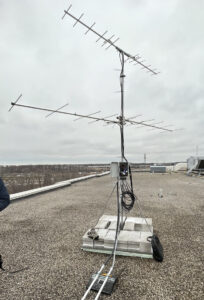
NC’s Motus tower is located on the roof of the student residence building at the Daniel J. Patterson Campus in NOTL. Birds with electronic transmitters can be readily detected by its antenna up to 10 kilometers away or more.
Smith noted the importance of the Motus network. Radio transmitters on tagged birds broadcast unique identifiers specific to each tagged bird. For example, a red-tailed hawk may be picked up on NC’s single antenna one day, then detected on another Motus antenna a few hours later – for example, at the University of Buffalo – and the next day – for example, at Ohio State University.
“The network traces the exact path of a specific bird as it travels south. Some red-tailed hawks migrate as far as Central America,” Smith said. “Our antenna is only one of hundreds. However, the data our antenna generates will indicate whether some migrating birds are specifically using the Niagara Peninsula to avoid the long, exhausting flight expanses over Lakes Erie or Lake Ontario as they migrate north or south.”
In time, the data will also indicate the impacts of climate change and may serve to assist at-risk species.
“The data can tell us when and where a species is dying – while in Canada, during migration, or while overwintering, providing direction where and when the species needs protection,” said Smith. “Actually, the applications of the data in helping migratory species of birds, bats and even insects (for example, the Monarch butterfly) goes on and on.”
He noted the significance of NC’s Ecosystem Restoration students having access to new data describing current behaviour of a species.
“With this info, they can ultimately identify when and where these species need protection and help over the course of their lives – for example, breeding habitat protection, prohibited hunting while migrating / protection critical overwintering habitat,” he said.
Project support
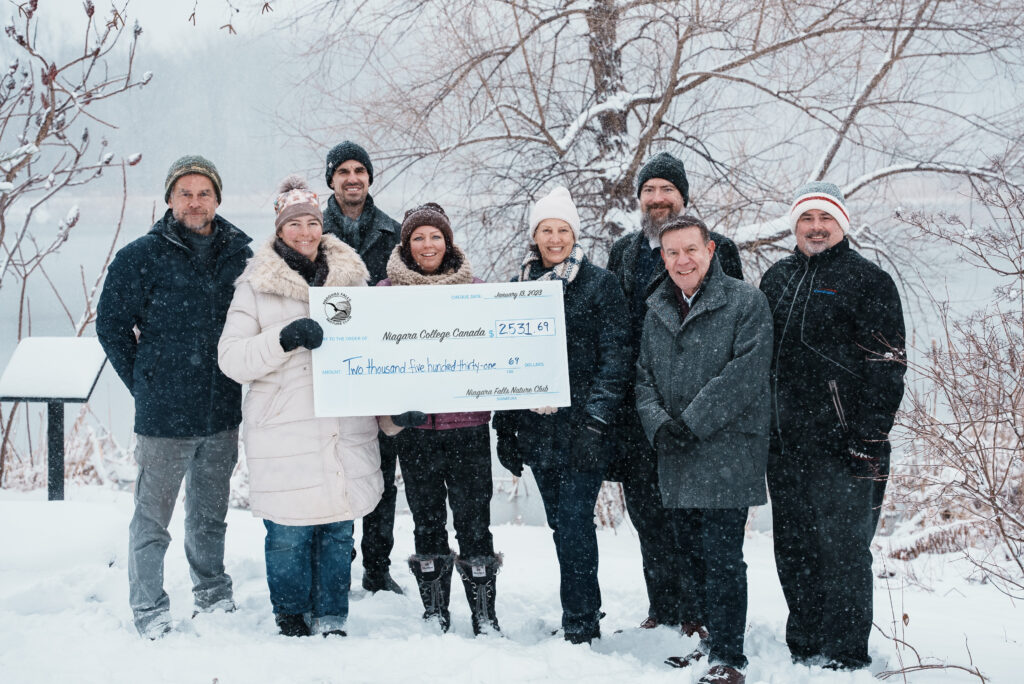
From left: Martin Smith (NC faculty), Christa Jackson (Ecosystem Restoration student), Evan DiValentino (associate dean, School of Environment and Horticulture), Lisa Bacon (Niagara Falls Nature Club, president), Jeff Schuts (NC residence services supervisor), Kerry Kennedy (Niagara Falls Nature Club, past president), Kevin Fochuk (NC residences, general manager), and Alan Unwin (NC dean, Business and Environment).
The project was applauded by its most recent community supporter.
“I am quite eager for the launch of the Motus project. As an avid birder, volunteering over the years as a counter in various bird counts across Niagara, and a principal atlasser for the Ontario Breeding Bird Atlas, I know just how beneficial the collected data will be,” said Lisa Bacon, president, Niagara Falls Nature Club. “It’s no secret just how valuable any and all data collected on bird migration is. I believe the Motus initiative at NC will give students and the community a deeper interest with local and global conservation efforts and research.”
The local Nature Club received a bequest from the estate of its long-time members Jim and Marjorie Chase and sought to honour their interests in birding and education. After learning that NC students were seeking funding to expand the Motus network, the Club felt it was a perfect fit to donate a portion of the funds.
“Enabling expanded data collection to track bird movement while also supporting student research and learning is certainly a winning combination and in line with the nature club’s core aim of promoting a better understanding of Niagara’s natural environment,” said Kerry Kennedy, past president of the Niagara Falls Nature Club, who is a graduate of NC’s Ecosystem Restoration program and the spouse of College President Sean Kennedy.
“Hopefully, students will be able to use this technology to support project work and research on bird movements and will be able to share their findings with the local naturalist community as well as the broader research community.”
Applied learning in action
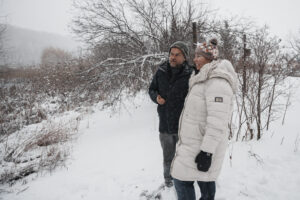
Ecosystem Restoration program coordinator Martin Smith and student Christa Jackson take in the natural surroundings near the lagoon at the wetlands on campus.
Ecosystem Restoration student Christa Jackson is gaining experience with the Motus tower as she monitors the prothonotary warbler in Wild Species Management class.
“The Motus system is an amazing opportunity to learn more about birds and their migration habits and possible routes,” she said. “Working with the Motus system has left me wanting to work with birds even more.”
Ecosystem Restoration is a one-year graduate certificate program within NC’s School of Environment and Horticulture, based at NC’s 125-acre Daniel J. Patterson Campus in Niagara-on-the-Lake.
