
‘Education is the most powerful weapon which you can use to change the world’
History is in the making and the stakes couldn’t be higher as world leaders meet in Montreal to grapple with declining biodiversity impacting all life on Earth, and a Niagara College Dean is a part of it all.
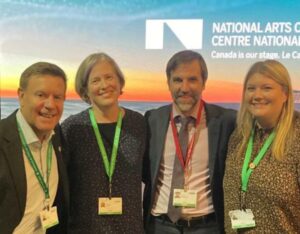
Unwin (left) stands at COP15 in Montreal with federal Environment Minister, The Honourable Steven Guilbeault, and lead negotiators for Canada on specific elements on the Global Biodiversity Framework: Kate Davis and Krista Locs.
Alan Unwin (St. Catharines/ Toronto), Dean of Business and Environment, is among members of a historic Canadian delegation taking part in the United Nations’ Conference of the Parties (COP) in Montreal, from December 7-19, focused on protecting nature and halting biodiversity loss around the world.
The 15th Conference of the Parties (COP15) to the United Nations Convention on Biological Diversity (CBD) brings together representatives from 196 countries to create targets on biodiversity for the next decade. It was one of three conventions created following the UN’s landmark Earth Summit in Rio in 1992.
The mission for the two-week convention: to finalize ongoing negotiations and agree to a post-2020 global biodiversity framework which is expected to include targets that range from pledges to crack down on invasive species, to rules on the use of synthetic biology.
Unwin is among a team of Canadian delegates supporting the Government of Canada’s priority to ensure that COP15 is a success for nature, given the urgent need for international partners to halt and reverse the alarming loss of biodiversity worldwide.
Countries collectively failed to meet targets laid out in the last global biodiversity agreement, which expired in 2020.
Getting all countries involved to agree to targets that will go far enough to make a difference is one of the biggest challenges delegates face, Unwin said.
Another challenge is to get the public to understand just how important their work is, how biodiversity is crucial to life on Earth.
While climate change often steals the media spotlight, Unwin pointed out how biodiversity is even more dire for humans. Unlike climate change, which can be potentially reversed if carbon dioxide is removed from the atmosphere, the loss of biodiversity can’t be replaced, he said.
“Once a species is lost, it’s gone forever,” said Unwin. “That should matter more to people.”
He noted that climate change is one of the principal reasons why species are becoming extinct.
“We don’t know which species will cause a cascading impact and effect that could lead to a global food security crisis,” he said.
While richer nations may be better positioned to afford to adapt to climate change, he pointed out that the loss of biodiversity has a global impact affecting all nations around the world.
“If something gets so fundamentally lost that it’s so integral to a system that we barely understand, if we can’t feed ourselves, that could very well lead to the collapse of civilization quicker than climate change in many ways,” said Unwin. “This particular convention seems to not get the traction and attention it needs … and yet lovable animals are at risk of becoming extinct.”
Unwin noted that some studies by partnering UN organizations have predicted that as many as a million species may be at risk of extinction over the next two decades.
Being a part of COP-15 is deeply meaningful for Unwin. While he is not typically an emotional person, he said he fought back tears when he received a message welcoming him to join the Canadian delegation at COP-15 Montreal.
While an agreement is not a certainty, there would be no more satisfying moment for Unwin at COP15 than when the gavel comes down – when there are no further edits or comments – and the document is agreed to by each country. This is the goal for during the two-weeks conference as they work on negotiations for an agreement. If it happens – this would be the moment that Unwin is ultimately looking forward to and hoping to witness firsthand. He can envision the crescendo of energy in the room and everyone erupting into cheering and clapping once the framework is completed and agreed to.
“To be there, and to think that I contributed in some small way to this historic agreement… I don’t know how I could ever come close to beating that in my career again,” he said.

Al Unwin presents as part of a panel discussion on forest landscapes and ecosystem restoration at the UN COP meeting in Cancun in 2016.
Lifelong passion for nature
Unwin has been passionate about the environment ever since he can remember. He recalled how his love for nature stemmed from his childhood summers spent on Georgian Bay, when he enjoyed fishing and catching bullfrogs. He recalled using dip nets to catch minnows, took pains to identify various species, and built mini ecosystems in an aquarium to see how they lived. One summer, he helped his mother tag monarch butterflies that she had hatched from caterpillars she would gather with hopes that they’d be able to track their flight to Mexico.
“Nature is ‘my church.’ It’s where I go for solitude and connection,” he said.
During his twenties, he worked with the mining industry on Quark Lake, north of Elliot Lake in Northern Ontario, and witnessed the environmental impacts of mining operations. He began as an undergrad university co-op student, and moved on to conduct field work, analysis, and sampling with a research company that was his first job after graduation.
The experience opened his eyes to how contaminated the lake was because of mining and how the human activity was causing destruction in the water. It proved to be a game-changer that would impact the course of his career.
“In that moment, I realized that I have to do something,” he said.
Unwin became involved in researching nature-based solutions with the mining sector across different sites from Saskatchewan Cape Breton that examined the use of natural systems to address their ongoing impact. He saw that nature had the solutions that were needed and this interest and realization lead him to the field of ecological restoration.
“I knew I was in the right field. I knew that I had a passion for nature, but it was sort of the first time that I was introduced to this whole concept of restoring ecosystems and ecological restoration,” he said. “Nature knows what it needs to do. We just have to allow it to restore itself, assist it in its recovery.”
“We have to protect the best, restore the rest … If we have any chance of a future for our kids and our grandkids.”
With a Bachelor of Environmental Studies and Master of Education, Unwin has brought his passion for the environmental field to the College almost 30 years. Driven by a passion to change the world through education, he was instrumental to developing the College’s environmental programs.
NC and global involvement
Unwin as a Professor and Program Coordinator in 1994 and became an Associate Dean for the School of Environment and Horticultural Studies in 2011, then Dean for the Environmental division in early 2020.
His work at NC led him to branch out to working with international organizations more than 20 years ago, when he was researching to develop content for the Ecosystem Restoration program. For research purposes, he reached out to the Society for Ecological Restoration (SER) and its Ontario chapter.
It proved to be a fateful connection for Unwin. He felt an immediate bond with the group of scientists, practitioners and policymakers associated with this international organization which promotes ecological restoration as a means of sustaining the diversity of life on Earth.
“I felt like, these are my people.”
Unwin’s international involvement took root. He chaired the 2001 International Conference for SER and was later asked to sit on its international board. He became Chair of SER’s International Board of Directors (2015 to 2018) which connected him with the United Nations, through restoration policy work.
More invitations sprung up through his involvement with SER, as Chair and then as its appointed Global Restoration Ambassador.
In October 2013, Unwin had a leading role as Conference Chair of the Fifth World Conference on Ecological Restoration held in Madison, Wisconsin. He was also part of panel discussion on forest landscapes and ecosystem restoration at the UN COP meeting in Cancun, Mexico in 2016.
In Sept. 2019, Unwin participated in the Global Landscapes Forum held at UN headquarters in New York city. The forum was a global consultation in the run-up to the official launch of the UN’s Decade on Ecosystem Restoration.
In March 2022, Unwin was part of a Canadian delegation at the UN Convention on Biological Diversity in Geneva, Switzerland to assist in some of the earlier negotiations on the Global Biodiversity Framework that is hoped to be finalized at COP15 in Montreal.
While he was heading SER and attending worldwide conventions, Unwin had a life-changing encounter when he met the executive secretary of the UN Convention on Biodiversity (CBD) the first time he attended a SBSTTA meeting (a subsidiary body of all the parties that sit at the convention). He asked Unwin, as head of SER, what he was going to propose on restoration. Unwin’s modifications to a proposed Canadian position received a positive response and were implemented – and he was asked to formally read an item in support of Canada’s position at the conference.
Unwin will never forget how he felt when it was time to press the mic and speak after all the other nations made their comments.
“My light comes on, so I’ve got the mic and the only thing I was told is, ‘you speak slowly, clearly because it’s being simultaneously translated into the six official languages’ … somebody swooped down and I copied our statement onto a flash drive. And somewhere it’s in a permanent record of the United Nations as a statement made by Alan Unwin SER, at the SBSTTA meeting,” recalled Unwin. “I was immediately hooked!”
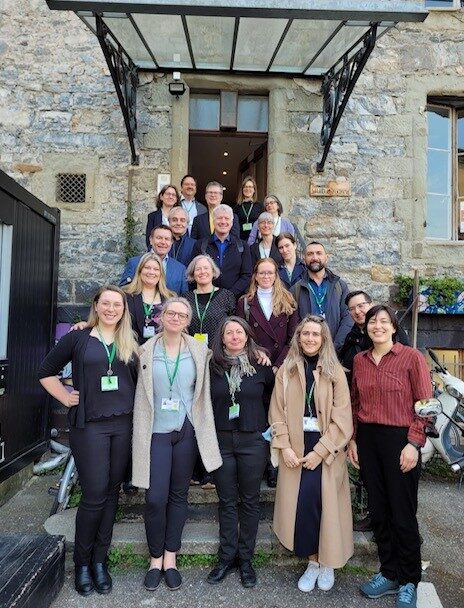
Unwin stands with the full Canadian delegation at the UN Convention on Biological Diversity in Geneva, Switzerland in March 2022. The earlier negotiations on the Global Biodiversity Framework are hoped to be finalized at COP15 in Montreal.
Influencing the future
Unwin was inspired by his new connection at the UN and, from then on, he set his sights on more opportunities to influence policy and make a difference that can help the environment.
“It was really cool because I got a chance to influence the Canadian delegation’s actual position,” he said. “The work I was a small part of became a part of recorded history.”
In addition to his passion for the environment and his own career path, Unwin is driven by the impacts the work and its outcomes will have on today’s students – especially students in NC’s environmental programs.
He believes his experience will create opportunities for the more than 40 current Ecosystem Restoration students at NC, and will lead to promising job opportunities for them.
“This work we’re doing at COP15 will guarantee the need for grads of this program for well into the future, and I think it will probably attract more and more students, knowing that that is a career path they can consider,” he said.
Unwin pointed out that he is proud of the many grads who are already making a difference in the field, including Kelsey Worboys (Ecosystem Restoration, 2016) who is working as a junior policy analyst, biodiversity policy and Partnership Directorate of the Canadian Wildlife Service Environment and Climate Change Canada.
Quoting Nelson Mandela, Unwin said, “Education is the most powerful weapon which you can use to change the world.”
Video
Unwin has recorded video from COP15 to share with the NC community.
The 10-minute video was intended to provide an introduction to COP15 and the Convention on Biodiversity.
“I am here because NC supported my presence and I know there may be those interested in what is all about,” he said.
Related:
March 2022: Al Unwin joins the Canadian delegation at the UN Convention on Biological Diversity in Geneva
Sept. 2019: NC’s Al Unwin helps shape next 10 years of UN action on climate change
Jan. 2017: Al Unwin speaks at UN convention on biological diversity in Mexico
Sept. 2015: NC’s Al Unwin appointed chair of Society for Ecological Restoration
Oct. 2013: Unwin chairs international environmental conference
