

As part of Black History Month, three Ontario artists opened up about how their cultural ties and lived experiences have shaped their creative work in a panel discussion for NC students and employees.
“Art can be a bridge to create understanding of the lived experiences of Black folks,” said Randell Adjei.
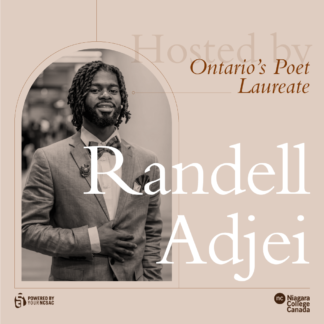
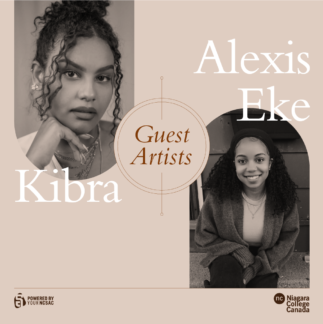
Adjei, Ontario’s first Poet Laureate and spoken word artist, moderated a panel discussion – held in collaboration with Niagara College and NCSAC – with fellow Toronto-based artists Kibra and Alexis Eke. Kibra, an Eritrean Canadian R&B musician, and Alexis Eke, an illustrator and designer with Caribbean roots, joined Adjei to discuss the intersection between identity, culture, belonging and artistic expression.
The panel, entitled “The power of the arts to express identity and unite afro-diasporic communities” was attended by NC students and employees. NC President Sean Kennedy and NCSAC President Sam Jemison introduced the trio of artists who shared their creative work, including poetry, music, and visual art, as well as their personal stories of self-acceptance through art.
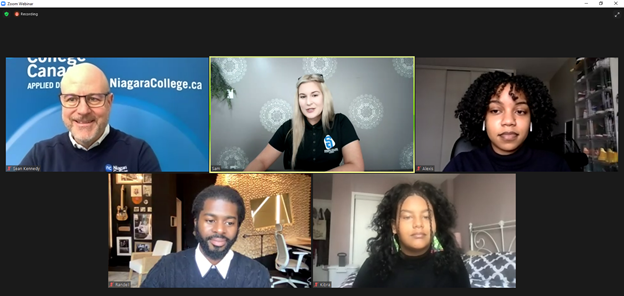
NC President Sean Kennedy and NCSAC President Sam Jemison introduced the panel of artists.
“There are many shades and hues of Blackness … Race itself is social construct that we all participate in every day,” said Adjei, who explained that his artistic practice is a process of “digging deep” into the meaning of identity.
Adjei – who delivered two inspiring poems including “I am an artist” – shared his experience as a Canadian born to immigrant parents from Ghana, and the challenges he faced growing up as an English-speaker with an accent.
Kibra shared her music video for ‘Live Your Life‘ which she wrote and recorded in Ghana and which represents a marrying of Eritrean beats and instruments with her own unique sound.
Kibra (pronounced “ki-bra”) was candid about her own process of self-discovery, choosing to adopt the authentically Eritrean pronunciation of her name to stay true to her roots and not compromise her identity.
“It’s a huge signifier of my culture and the closest thing I have to my grandmother,” said Kibra who explained that her name is a way to “hold space” for her culture and racial identity, and “to inspire people to be proud of what their name may represent.”
Eke shared her stunning portraits of Black women which draw upon her upbringing in the Christian faith by strong and resilient Caribbean women. Her work – commissioned by big names like Adidas, Nike Jordan, Raptors and the CBC – invites audiences to question how Black women are represented in the art world.
Adjei, Kibra and Eke addressed the purpose of Black History Month, asserting that it should not be performative, but rather intent on listening, collaborating, and being inspired to take action against injustice to create true equality.
“I truly can’t thank our panelists enough for being so authentic and powerful in sharing their experiences, ideas, and art with us. This panel demonstrated the power of the arts and diverse perspectives in building bridges, opening our minds and enriching our lives,” said Niagara College President Sean Kennedy.
A link to a recording of the panel discussion will be shared with NC students and employees via email. Out of respect for the artists who shared original content, you are asked to refrain from sharing the video.
For more on the artists, visit the links below:
Randell Adjei
Alexis Eke
Kibra Music
