
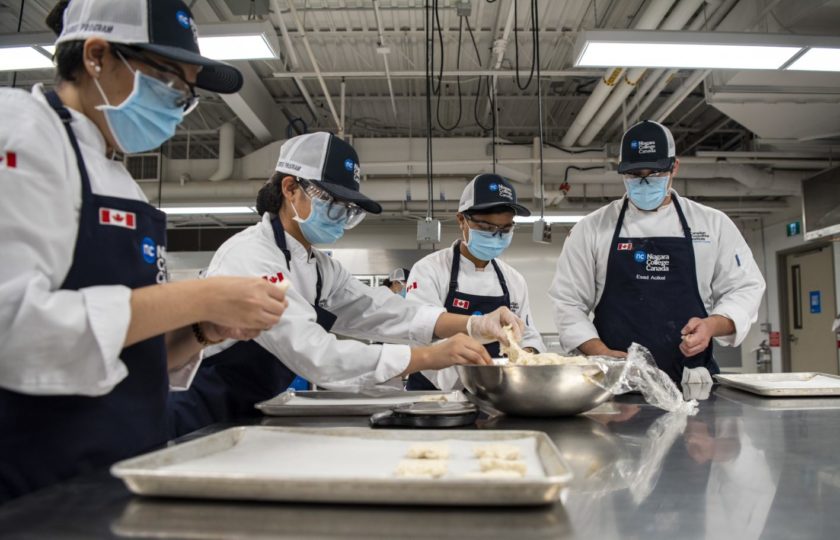
Industry experience was on the menu for a class of Hospitality students who were behind an Indigenous recipe event on November 23.
The event was part of a larger class initiative for second-year Honours Bachelor of Business Administration Hospitality (BBAH) students in their Introduction to Culinary Operations Management course. They have been been working on the project since September, conducting extensive research on Indigenous menu items, costing recipes, learning about the traditional Indigenous fare and its history, and planning for the event. It was all in preparation for November 23, when they gathered in a lab within the Canadian Food and Wine Institute to prepare the menu of Mushroom, Spinach and Cranberry Salad; Three Sister Soup; Wild Rice; Venison Stew; Strawberry Drink; and Bannock and Blueberry Jam.
After the food preparation was complete, they delivered the food across campus for the students in residence to enjoy just in time for lunch.

Food from the Indigenous recipe event was delivered to the residence for students to enjoy for lunch.
The Indigenous recipe event has been a part of the course since 2016. Hospitality Professor, Chef Osvaldo Avila, noted that the initiative is about much more than preparing food; it serves to showcase diversity, exposes students to Indigenous food and culture, and equips them with a broad range of skills in the Hospitality industry.
Students wear their caps and aprons literally and figuratively on the day of the event. While Avila noted that most students in the program move into managerial and supervisory roles – with many focusing on the financial side of hospitality – and a minority move into food and beverage. The hands-on experience they gain in the program prepares them to hit the ground running in all aspects of the industry.
“Their blue aprons and baseball caps mean that even if they take on white-collar positions, our students are very versatile,” said Avila. “They’re able to jump into any aspect of the operations and they’re ready to work.”
The Indigenous recipe event is about more than food preparation. Students work on time management, costing items, preventing waste and much more.
Working on the Indigenous recipe event gives students experience in various areas of hospitality operations – from costing ingredients, to preventing food waste, to serving and preparing food. The learning outcomes they gain from preparing the variety of menu Indigenous menu items can also be transferred to any type of restaurant, Avila said.
Through the initiative, students work on their time management skills and there is a focus on the prevention of food waste – Avila noted that the latter is consistent with Indigenous culture and sustainability goals.
Student Madison Vine said it was a valuable learning experience.
“I learned and was able to demonstrate some very important life skills such as leadership, time management, and organizational skills. We also have to all work together to ensure that everything gets done and properly,” said Vine. “This helps to build out teamwork skills and being able to work with others is a huge part of the hospitality industry.”
Vine also noted that while creating a plan for the event and researching the recipes, she found that recipes that she thought were Indigenous, proved not to be. The experience led her to do more research about Indigenous ingredients and look into why certain foods were Indigenous.
“I found that this event helped me realize the importance of Indigenous foods. I also took away many skills that are valued in the hospitality industry,” she said. “I have never done something like this before, so this was a very fun experience that taught me a lot.”
For student Renee Ramlal, who is originally from Trinidad, the experience opened her eyes to the benefits of all-natural products, which will be helpful in her future in the industry as health and wellness are becoming more important.
“This was very different since most foods nowadays are processed or contain additives … it was quite refreshing to enjoy various items made from all-natural, Indigenous products and it reminded me that they can be great tasting even without artificial ingredients,” she said. “By incorporating foods as well as other all-natural products, persons will be able to enjoy the best of both worlds. For example, when I open my café, I can incorporate desserts that are healthy, Indigenous and great tasting.”
As an international student, she said the project also enhanced her understanding of Indigenous culture in Canada. “I was able to learn quite a bit about the history of Canada in addition to the foods consumed,” she said.
Donating the food made the experience even more rewarding. “It really made me happy to be able to perform an act of kindness and know that it would be enjoyed and appreciated,” she said.
Evan DiValentino, Associate Dean of the School of Hospitality, Tourism and Sport, applauded the initiative.
“I think it’s fantastic that Chef Oz continues to collaborate with our Indigenous Education office to integrate Indigenous elements into the curriculum,” said DiValentino. “We’re incredibly fortunate to be able to live off the land as a result of our partnership with Indigenous communities.”
DiValentino noted that the students have fully committed to the learning activity and the upside of donating the food to students in residence.
“Chef Oz and our students are providing incredible leadership within our campus community,” he said. “The group is engaging our Indigenous partners, implementing sustainable practices by donating food to students in residence, and creating top-notch culinary experiences while doing so.”
Hospitality students and Indigenous Student Success Leader Ashley Buck offer the donated food to students in residence on November 23.
