
The cold weather and pandemic restrictions of last Winter Term were no match for students in NC’s Horticultural Technician program, who were hard at work cultivating new connections with agriculture industry researchers.

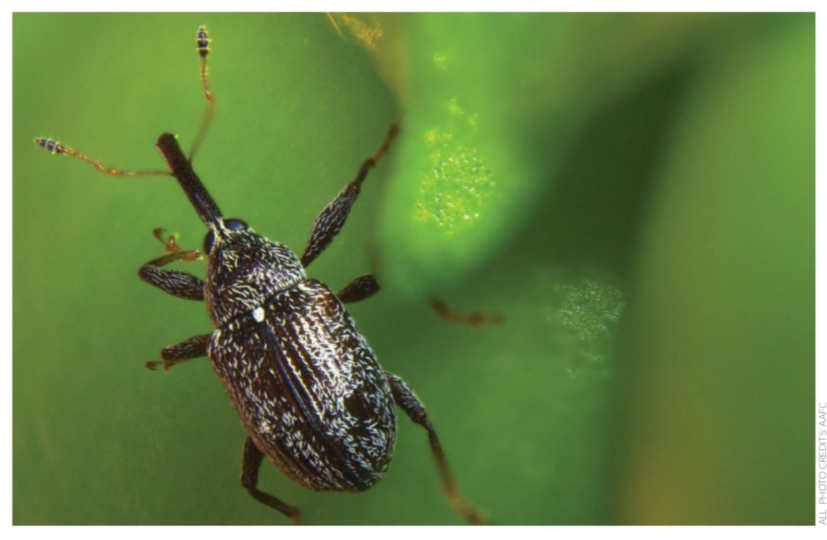
Student Matthew Brazil’s research essay in Greenhouse Canada’s Oct. 2021 issue
To make up for cancelled in-person labs due to pandemic restrictions, professor Sebastien Jacob sought new ways for his students to gain industry exposure. A class of students enrolled in the Greenhouse Production II course (Hort 1346) had the unique opportunity to learn about cutting-edge greenhouse research and collaborate with industry experts. Students then vied for the chance to have their final articles published in the Fall 2021 editions of Greenhouse Canada magazine, a national business publication for commercial greenhouse growers.
“While COVID sadly impacted some students’ hands-on learning, I organized this other assignment for those who could not come to in-person practical sessions. Students appreciated the variant from traditional essay writing,” said Jacob. “More importantly, it provided a great experiential learning opportunity for students to deepen their knowledge on cutting-edge research and new discoveries, all of which bridged really well into their course content. Some students got really excited and competitive about getting their name and work published in Greenhouse Canada magazine too.”
Jacob matched his students with experts in the industry who were studying real-world research with a practical application in the field of agriculture. Over the course of the Winter Term, students met virtually with researchers to learn and collaborate, culminating in an essay assignment summarizing the new research findings and their impact on the commercial greenhouse industry.
“The project took some management on my part, but students love the competitive aspect of standing a chance to be published in an industry magazine,” said Jacob. “I was pleased to facilitate, and I’m proud of what the students accomplished.”
The top five essays – chosen by Jacob and each industry researchers – were submitted to Greenhouse Canada magazine. Students Matthew Brazil, Dante Cacciotti, Destin Lamondin, Patricia Bitaxi and Julie Miller had their research update article published in the print and digital editions in September, October and November, respectively.

Students Dante Cacciotti and Destin Lamondin’s research paper in Greenhouse Canada’s Sept. 2021 issue
Dr. Roselyne Labbé, Research Scientist and Entomologist at Agriculture and Agri-Food Canada, was invited by Jacob to provide an overview of her research on pepper weevil management to our students. She then reviewed student research summaries and selected the one which would best serve as the basis for an article in Greenhouse Canada.
Brazil, in collaboration with Dr. Labbé and Cara McCreary, wrote an essay entitled “Pepper weevil studies bring new products to light,” in which they outline new pest management solutions against pepper imports where weevils – which are easily resistant to conventional pesticide products – are common. Among the most effective, Labbé et. al’s research suggests that kaolin clay and mineral oil led to a significant reduction of this North American pest on pepper imports.
Dr. Labbé commended all the students on their efforts. She shortlisted Brazil’s piece to adapt for the magazine, with the help of study collaborators.
“Matthew was very responsible, both immediately after I first delivered my talk on the research subject, as well as after the talk,” said Dr. Labbé. “He took the time to reach out to me by email to seek further information and clarification. I think this was important as it meant that he had a good understanding of the research when he wrote the article.”
Dante Cacciotti and Destin Lamondin worked with Dr. Geneviève Marchand on a piece entitled “Disinfectant hopefuls against rugose” about new disinfectants to mitigate the rugose virus. Rugose can infect tomatoes and peppers and make them unsuitable for export, resulting in food waste and financial losses for growers. Marchand et. al’s piece encompassed recent studies of disinfectants and processes which had a high success rate eradicating the virus, including implementing handwashing and/or frequent glove replacement during handling, surface disinfection, and seed disinfection.
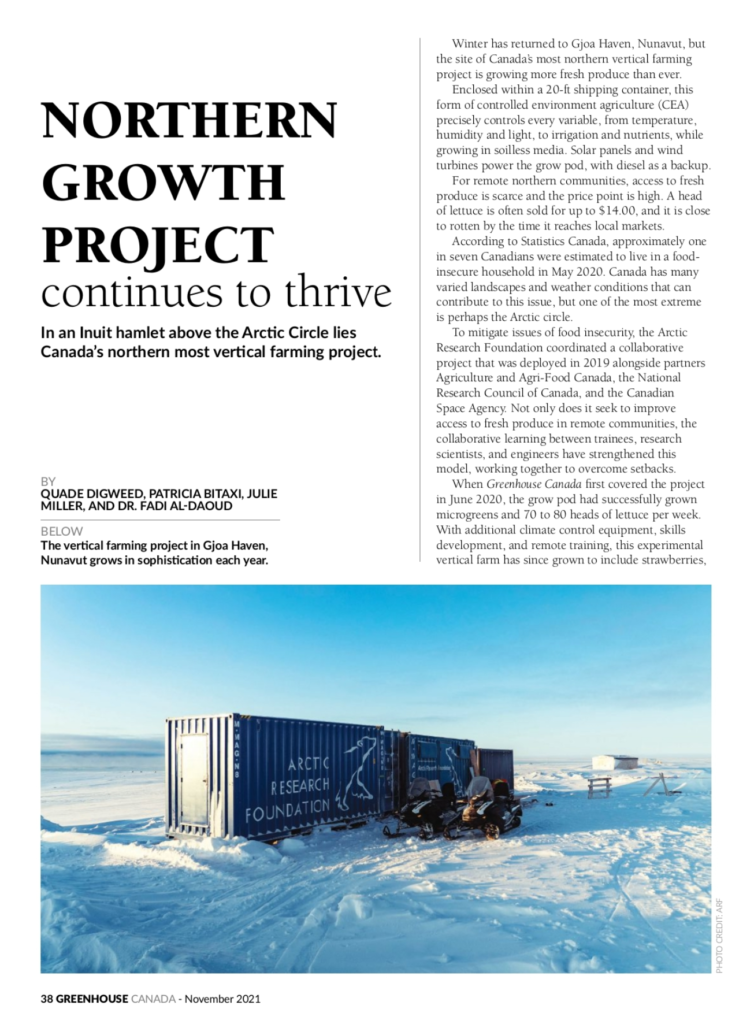
Students Patricia Bitaxi and Julie Miller’s research essay in Greenhouse Canada’s Nov. 2021 issue
NC students Patricia Bitaxi and Julie Miller worked with industry researchers to tell the story of a unique vertical farming initiative in northern Canada. Their article was published in the November issue of Greenhouse Canada magazine, and Bitaxi explained how the project gave her a window into other positions in the industry.
“Horticulture journalism [is] something I had never thought of… I really enjoy writing, and I appreciate professor Sebastien Jacob always thinking outside the box and pushing for alternative learning experiences,” said Bitaxi.
Digweed et. al’s piece entitled “Northern Growth Project continues to thrive” shines a spotlight on a unique and thriving vertical farming project in Gjoa Haven, Nunavut. The project, now in its third winter, is growing, allowing this remote northern community to access fresh produce where imports are both scare and unaffordable. In a 20-foot, climate-controlled shipping container called a “grow pod” – powered by solar energy, wind turbines, and a diesel backup – microgreens, lettuce, strawberries, tomatoes, and herbs can grow year-round. The research piece touches on the sustainability of the initiative, both from an ecological and community perspective, in which community members in Gjoa Haven trained to run the pod themselves.
On working with industry researchers, Bitaxi said: “It was interesting and inspiring to hear, first-hand, from people who are on the ground running with investors and government funding and support.”
Read the research in Greenhouse Canada magazine:
Pepper weevil students bring new products to light by Matthew Brazil
Disinfectant hopefuls against rugose by Dante Cacciotti and Destin Lamondin
Northern Growth Project continues to thrive by Patricia Bitaxi and Julie Miller
