
It wasn’t the typical end-of-year Game Development showcase, but 12 teams of students took their games to the next level with a virtual event connecting their works with industry professionals.
About 120 students from NC’s Game Development program as well as its joint Programming programs with Brock University — including Bachelor of Arts (Honours) Game Design and Bachelor of Science (Honours) Game Programming – participated in the Virtual Game Development Showcase on April 15.
It was an opportunity for upper-level game students to showcase games they created for their third-year capstone project which had them working in teams to develop their very own game from scratch – from conception to design, planning and development, to completion.
The virtual initiative was held in place of the annual on-campus GD Showcase.Program coordinator Rick Goertz noted that while the vibe of an in-person event could not be replicated remotely, it was important to give students an opportunity to unveil their games and gain industry exposure, network, and feedback on their work.
“There’s no greater reward than showing off your creative efforts to others in game development. Games are produced to be played by others; it’s a very rewarding experience for the students as this is their first game produced from scratch,” said Goertz. “It also connects our programs/students directly with industry which can lead to employment leads.”
The virtual format was designed similar to a gaming convention show – where visitors attend to view demos of games and learn what they’re all about. Each team presented their games through a teaser video, conducted a game walk-through, and answered questions about their projects.
The event was held on the Discord platform, which has been used by the College’s game programs throughout the year as students completed their programs remotely. Guests were scheduled times to pop into different breakout rooms where students would present their games, and walk them through their work.
A screenshot of a student presentation by Team 7Gnomes on their new game, Space Chefs From Space.
Burlington resident Jenni Rivers was the team lead, creative director, 2D artist and Ui Design behind the game Space Chefs from Space from team 7Gnomes. In this third-person tower defence game with farming elements, players are ‘G-Ma’, a retired human chef, who must protect a secret recipe book from waves of alien chefs by growing crops and building vegetable themed defence turrets. Rivers noted that having professionals view the game was helpful in showing students what they might consider doing when designing and creating games in the future.
“My own passions lie in both game design and digital art, and Space Chefs allowed me to show that to the public through my role as creative director,” said Rivers. “I was the one who decided the game’s mechanics and its overall aesthetic, so when we started getting feedback during the launch event that praised us for our game’s design and art, I was ecstatic.
“The positive comments tell me that I’m on the right track; to keep doing what I’m doing and have confidence in my future.”
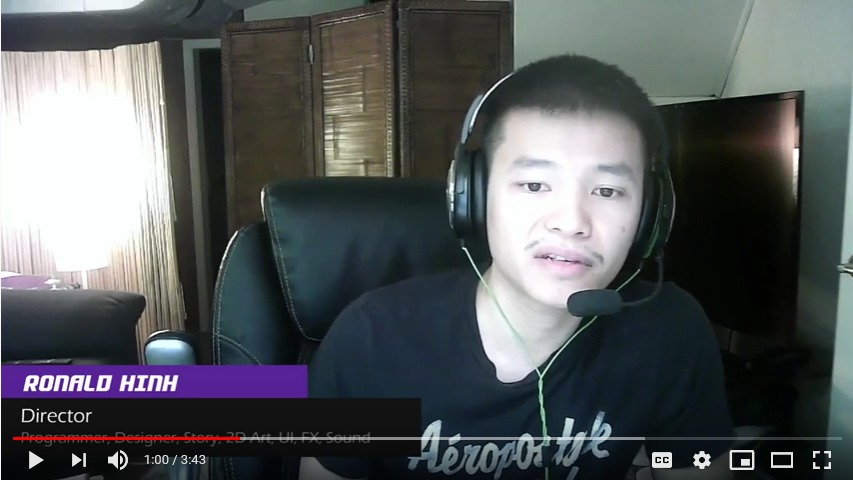
Ronald Hinh was among students from team Firefly Studios to present Transmechia – a turn-based tactical role-playing video game where robots and engineers wage battle in a world inspired by a Second World War futuristic perspective. A powerful magic called Transmechia, wielded by engineers, transforms them and allows them to cast powerful abilities such as calling meteors from the sky or creating hurricanes.
Hinh enjoyed the experience to be able to play other student games, chat with peers about the experience of game creation and see the variety of games created across the programs; as well as the opportunity to demonstrate Transmechia on the fly and gather comments.
“The feedback from the industry game devs was amazing. It’s always rewarding when someone notices the little details that you added to the game to improve the player experience,” said Hinh, who was the director for the team. “We were very welcoming to criticism on how to improve our game. It’s surprising when you hear a comment about a mechanic in your game that you haven’t even thought of.”
For Hinh and the Firefly Studios team, the biggest highlight was being told that their game looked and played like one that could potentially be sold on the market.
“Our team is very proud of the quality of the work we put out and it’s a rewarding feeling when your efforts are noticed,” said Hinh.
No awards were given out as part of the event, true to its focus as a showcase only.
“Making games is tough,” said Goertz. “They’re all standouts in their own right.”
