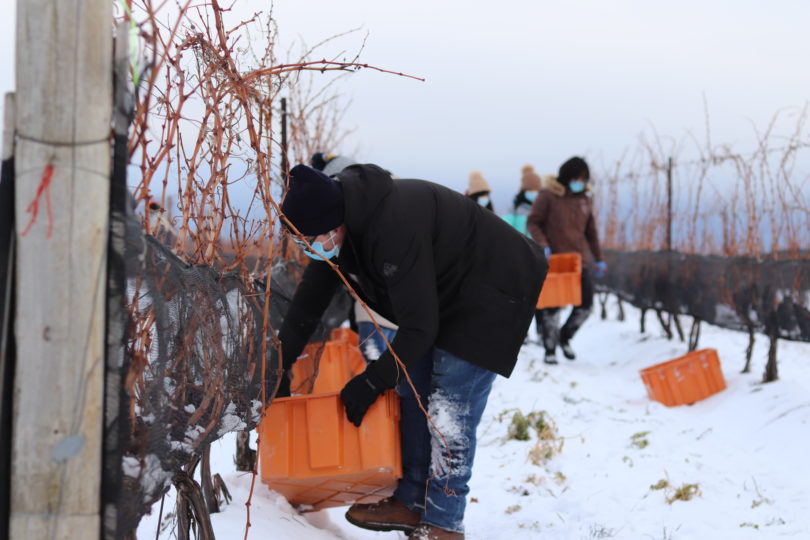
A temperature drop on the early morning of January 28 caused a flurry of activity for NC wine students who set out in frigid temperatures to participate in the College’s 2021 Icewine harvest.
It was minus 9.5 degrees at 6:30 a.m. when 35 students from the Winery and Viticulture Technician and Wine Business Management programs joined winemaker Gavin Robertson and NC Teaching Winery staff at the Concession 5 Vineyard in Niagara-on-the-Lake where they spent three-and-a-half hours picking frozen Cabernet Sauvignon grapes.
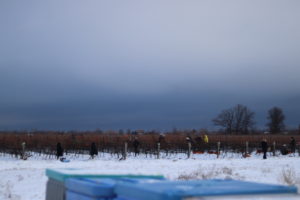
Groups set out at 6:30 a.m. and began picking under a dark sky. – NCLEC photo by Justin Niece
While the Icewine harvest is an annual rite of passage for NC wine students, this was the first time it took place at the Concession 5 vineyards, operated by the NC Teaching Winery since February 2020, following a partnership with Canopy Growth [View Feb. 10, 2020 article here.]
It was also the first Icewine harvest during the COVID-19 pandemic. Students participated in groups of 10 or fewer to comply with group limits, maintained two meters of physical distancing, and wore masks and safety glasses as added safety measures.
General manager of the College’s Learning Enterprises Steve Gill noted that he was proud that the tradition of the Icewine harvest has continued each year.
“Located in Niagara, we are very fortunate to have been able to harvest Icewine grapes every year since we opened the Teaching Winery almost 20 years ago, in and, in turn, offer this quintessential Canadian winemaking experience to our students,” said Gill.
Associate dean of the Canadian Food and Wine Institute Gary Torraville, who attended the harvest kickoff, echoed the sentiments of the College continuing the harvest tradition while, at the same time, experiencing new ‘firsts.’
“We were all pleased to be able to offer this experience again this year and to do it at Concession 5 for the first time,” said Canadian Food and Wine Institute associate dean Gary Torraville, who attended the Icewine harvest kickoff. “The students there were all thrilled to be outside, adhering to all PPE regulations, of course, and participating in the experience.”
Torraville noted that the Wine Business Management students who recently began their first term on campus, after studying remotely during Fall term, were excited to participate. For many, it was their first time experiencing snow.
“I remarked to them that they are the only students in the world who get to do this and they were all smiling and happy to know that they were doing something so unique. It truly represents hands-on learning at its finest,” said Torraville. “This continues to be such a unique learning experience and I know it meant a great deal to the students to be able to participate and share this experience despite the challenges we have faced around COVID over the past several terms.”
While spirits were high during the harvest, so are expectations for this year’s Icewine.
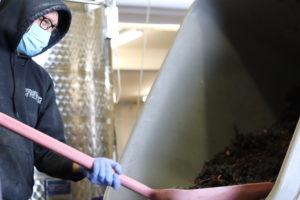
Two metric tonnes of Cabernet Sauvignon grapes were brought in from the Concession 5 Vineyard after three-and-a-half hours of picking.
– NCLEC photo by Justin Niece
Robertson noted that the harvest brought in two metric tonnes of grapes, which pressed at 38.5 degrees brix and produced quality juice. This year’s later harvest – compared to previous years when the weather is cold enough in December or even November – kept the berries intact even after the long hang time, with great colour on the skins and a good depth of flavour.
“With this late harvest, the fruit went through a series of freeze-thaw cycles which tends to produce wines with more complex spicy, nutty and sometimes earthy flavours that can really complement the primary red berry and plum qualities of Cabernet Sauvignon Icewines,” he said.
Some of the juice from the Icewine harvest will be used by the students for their second-year winemaking projects, where they are able to target a specific style of Icewine they wish to achieve and strive for their desired taste profile.
“The project pushes them to apply their lecture material in innovative ways, and helps prepare them for their future careers in the Canadian wine industry,” said Robertson.
In addition to being used for student projects, juice from the harvest will go into making the Teaching Winery’s Icewine, likely to be bottled in August and expected to be available on the shelves next winter.
One student, Christopher Anderson, shared his sentiments by posting a photo of the frozen vineyards in the early morning light to his Instagram account: “What if the real treasure wasn’t the Icewine grapes, but the friends we made along the way.”