
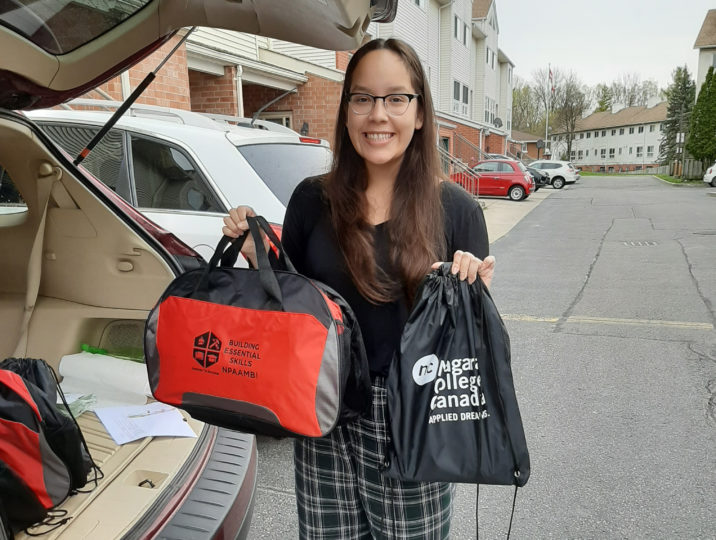
Twelve students in the Niagara Peninsula Aboriginal Area Management Board’s (NPAAMB) Journey to Success program are learning like no other group of students in the program has learned before. The latest cohort, that started the program in May, was set up with resources to succeed in a virtual classroom after the program was adapted for online delivery.
The Journey to Success program consists of a 14-week course that provides Indigenous youth with employability skills to enable careers in a wide range of industries, with a focus on health care, hospitality and tourism. The program is jointly delivered by NPAAMB and faculty in Niagara College’s School of Workforce Development and Community Programs, drawing on the expertise of NC’s School of Hospitality and Tourism and the School of Allied Health.
Normally, courses are held at Niagara College’s Daniel J. Patterson and Welland campuses based on which program stream is being delivered. With campuses closed due to the novel coronavirus, the Journey to Success program team worked together to ensure the continuation of the program in an online format.
“To do this online we knew we couldn’t have anything change in terms of the curriculum,” Shanyn Porter, project manager and educator, Workforce Development and Community Programs at NC. “This meant looking at our content and figuring out how to best deliver the course online while keeping students engaged.”
With the shift to online course delivery, NPAAMB worked with incoming students to ensure they had the necessary resources, including laptops and access to Wi-Fi, to be successful in a learn-from-home situation. Students were also provided with tips on how to best set up their at-home learning spaces, advice on how to deal with screen fatigue, and welcome kits that were hand-delivered by NC’s NPAAMB partners.
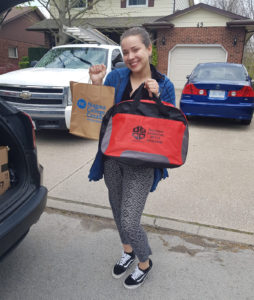
Journey to Success student Starla receives her welcome kit in preparation for the 14-week course.
“The welcome kits provided a way for the program team to connect with students right from the start, as the one-on-one connection is important to the cultural way of Indigenous people,” said Porter.
To accomplish a sense of connection throughout the course, the program is set up with opportunities for interaction each day. Students start the day with an opening circle and end the day with a closing circle, which is a tradition the team made sure to continue virtually for students via Blackboard Collaborate, the online platform of choice for course delivery.
Through the platform, students and instructors meet online for live instruction during the first half of a class, while students work on their assignments during the second half. Instructors remain online the entire time to respond to questions as they come up.
To further enhance the social interaction piece between students, NC’s Indigenous Education department created a virtual lounge as an alternative to the physical lounges that students socialize in on-campus.
“Since we thrive in a community setting that we feel safe in, a goal of the Journey to Success program has always been to create a supportive learning space for students,” said Porter. “We want students to feel like they are part of a family as they experience the course.”
Current student Jacob Bell has had a positive experience embarking on his journey to success so far.
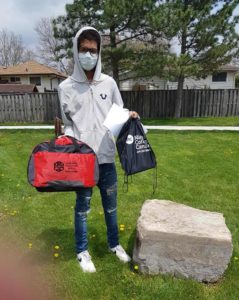
Current student Jacob Bell is pictured receiving his welcome kit prior to starting the Journey to Success program.
“I always thought about going to school but really needed that push – I wasn’t scared to start school it’s just that I wasn’t sure what I wanted to do,” said Bell. “We have very kind teachers and students, and everyone is so friendly and helpful. At first, I didn’t know how it would be, but getting more into it and getting to know my classmates, it kind of feels like a real family.”
The Journey to Success program has been running since May 2018. The latest cohort is the third to focus on the healthcare stream of the program, designed to prepare graduates for entry-level positions in the healthcare industry.
Students experience applied learning, through the expertise of NC’s School of Applied Health, and unique cultural education from NPAAMB instructors through a blend of courses that have proved to be enriching for current students.
“I chose this program to grow as person, to learn more about my Indigenous background and to get involved with the healthcare industry which is very vital right now,” said student Alayah Robinson.
Healthcare student Jessica Duke stated she chose the program because: “It gave me a unique opportunity to learn about traditional teachings while linking these teachings to various careers in health care. I am most excited about the opportunity for a placement to build my network and learn skills that will help me in my future career as a Nurse.”
Other motivations for choosing the program include one from Kelsey Swayze: “The Journey to Success program seemed to be a very educational and positive program for me. I find that it gives me some purpose in the day and a routine, and it can bring me forward on my path to becoming a certified PSW. I have thoroughly enjoyed the knowledge that I learn each day and every new teaching that has come my way.”
Porter credits the success of the program and its recent shift to an online format to the strong partnership between NC and NPAAMB. She noted that the team’s in-sync delivery of the program and focus on the student experience speaks to a joint effort in “Guiding our Youth Together.”
“We couldn’t have gotten this off the ground so soon without the strength of the partnership,” said Porter. “I was reminded by my NPAAMB team members that it’s in our DNA – both our cultural DNA as Indigenous people and our NC DNA – to adapt, progress, and make things happen for the benefit of others.”
