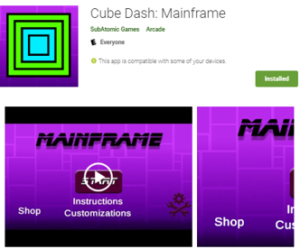

Andrew Bradshaw capped off his first year of the Game Development program by creating a new game now available on Google Play.
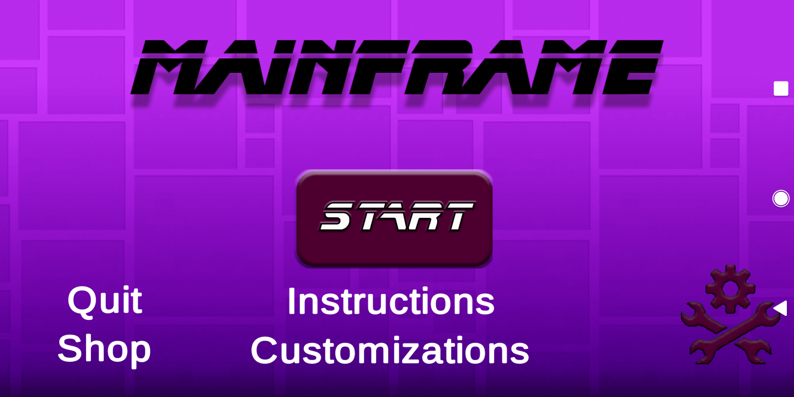
You are a cube trying to getting away as far as you can while avoiding enemy cubes at different heights. Power-up cubes give you different stats like money, invincibility and health.
Welcome to the world of ‘Cube Dash: Mainframe’ a newly released video game now available on the Google Play Store for Android. Its creator is Niagara College Game Development student Andrew Bradshaw. It’s not only his first game but one that he completed by himself – the programming, art, music, user interface and more. It all began as a first-year assignment for one of his classes in early April, which focused on using DirectX – a collection of application programming interfaces for handling multimedia tasks like game programming and video on Microsoft platforms.
“When I first began my studies, I had no previous knowledge about game development, let alone programming, so I wouldn’t have imagined making a game or even my DirectX game project,” said the Mississauga resident, who enrolled at the College after high school to pursue his lifelong interest in games and how they work. “The great teaching job of the profs and their enthusiasm gave me the drive to push myself and test my skills. And so I felt what better way to test my skills than to make a playable game.”
Game Development professor Rich Barnes applauded Bradshaw’s accomplishment. He noted that it’s the first time that a first-year programming assignment has turned into a released game.
“It’s very impressive, not a trivial thing to do,” noted Barnes.
Barnes noted that this is the toughest assignment of the year for students in the Game 1111 course in Object Oriented Programming. Students are tasked with making a Direct X point-and-click game. While it is intended to be a very simple game – a start screen, 30-second game and end screen – Bradshaw didn’t simply complete the assignment, he went beyond it.
“He basically did a complete game – menus, setting, sound, endless gameplay, power-ups etc.,” said Barnes. “He took the class assignment done on a PC and only running in our tools, and converted it into a Unity Program – no small task – polished and fixed many bugs, and figured out how to get it working on mobile, then released it for free on Google’s commercial store.”
Barnes continued to discuss the game with Bradshaw even since classes ended.
“He basically poured his heart into this. It was great to see,” said Barnes.
What inspired the first-year student to continue his work even after classes ended on April 17?
“I felt, after completing the DirectX assignment, that what I made was a more than a little project and felt it deserved to be finished,” he said. “After learning a bit C# and how to use the game engine, I started working on it.”
At first, he aimed to create a game to be playable on a desktop without needing the source code. As he got closer to completing it however, he set his sights on creating a mobile game.
Getting his project into an available game on Google Play in just over a month took a lot of work and a great deal of research. His assignment needed to be converted or rewritten altogether in another language for the game engine to understand. He also had to come up with new concepts on how to accomplish the things happening in the game. Getting the game approved was also a stringent process that involved painstaking game testing and source checking.
“The challenges were learning how to use the engine and its features, as we were only taught a little bit on how to code for it. But this was enough for me to self-teach myself on how to use it, trial and error,” said Bradshaw.
Bradshaw was surprised by what he was able to accomplish during his first year of the program.
“I feel proud of myself for my success in making the game in general,” he said. “Teachers taught me well but also with hard work and being able to pick up the material quickly, I was able to take the concepts learned and apply it to make a mobile game.”
He noted that creating the game was a rewarding experience. It taught him new concepts and increased his knowledge and understanding of how the programming language works, and of the engine itself.
With increased confidence as he moves into his second year of the Game Development program, Bradshaw is currently working on completing his third mobile game and hopes to publish his games on the IOS Play store (for iPhone) in the future.
“I’m trying even harder and try to grow my knowledge as much as possible and really try to push my limits in skill.”