
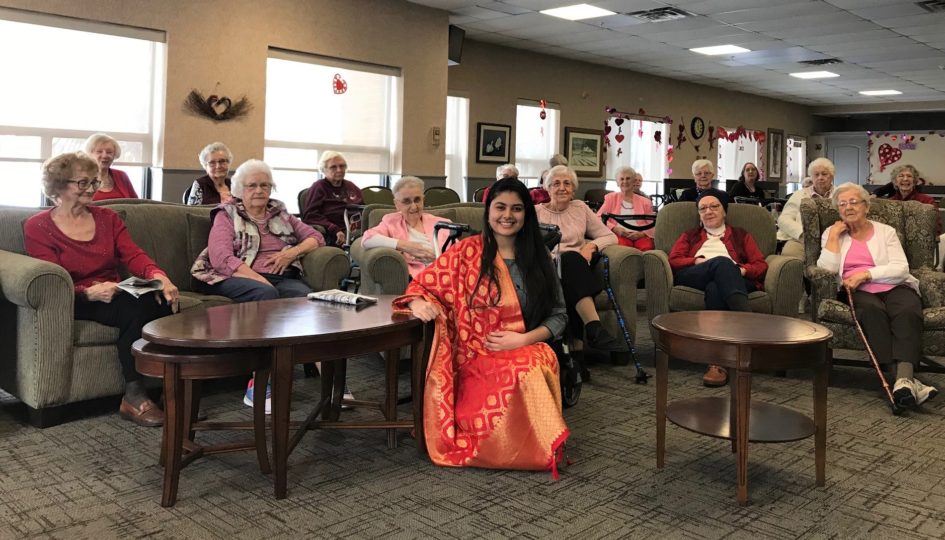
Residents at St. Charles Village in Welland had one request of Pankti Chaudhari, second year student in Niagara College’s Recreation Therapy program, before she completed her practicum: to teach them about her Hindu culture.
“I’ve really got to know the residents here and I was happy to share my culture with them,” said Chaudhari.
Chaudhari, who hails from the Gujarat region in western India, donned an ornately woven, red dupatta (a traditional shawl-like scarf) on February 14 – Valentine’s Day – and shed light on her life back home in India to a group of over 20 residents. The interactive presentation capped off her practicum placement at St. Charles Village as part of her NC program.

Pankti Chaudhari teaches residents about her Hindu culture and life in India.
A red dupatta, Chaudhari explains, is one of the three colours of scarves owned by every young woman in India. “Red is perfect for Valentine’s Day!” she said.
Standing barefoot, she explains to the residents, “Being barefoot is a sign of respect in my culture… and respect for our elders is the foundation of our beliefs.”
From daily life in a busy household of 36 family members, to wedding customs and the highest of Hindu holidays – residents were offered a window into Chaudhari’s life in India through videos and personal photos.
Residents were impressed by Chaudhari’s ability to speak seven languages from across India, and amazed by the many symbolic elements of Hindu culture.
“Placement is a great opportunity for the retirement home, the residents, and our students to learn from each other,” said Wendy Palermo, placement officer in NC’s School of Community Services. “Students in the Recreation Therapy program must complete 430 hours of field work experience in the community where they complete a number of competencies to build the essential skills necessary.
Chaudhari credits her practicum supervisor at St. Charles Village, Francine Hardy, for giving her the opportunity to do something special for her last day of practicum.
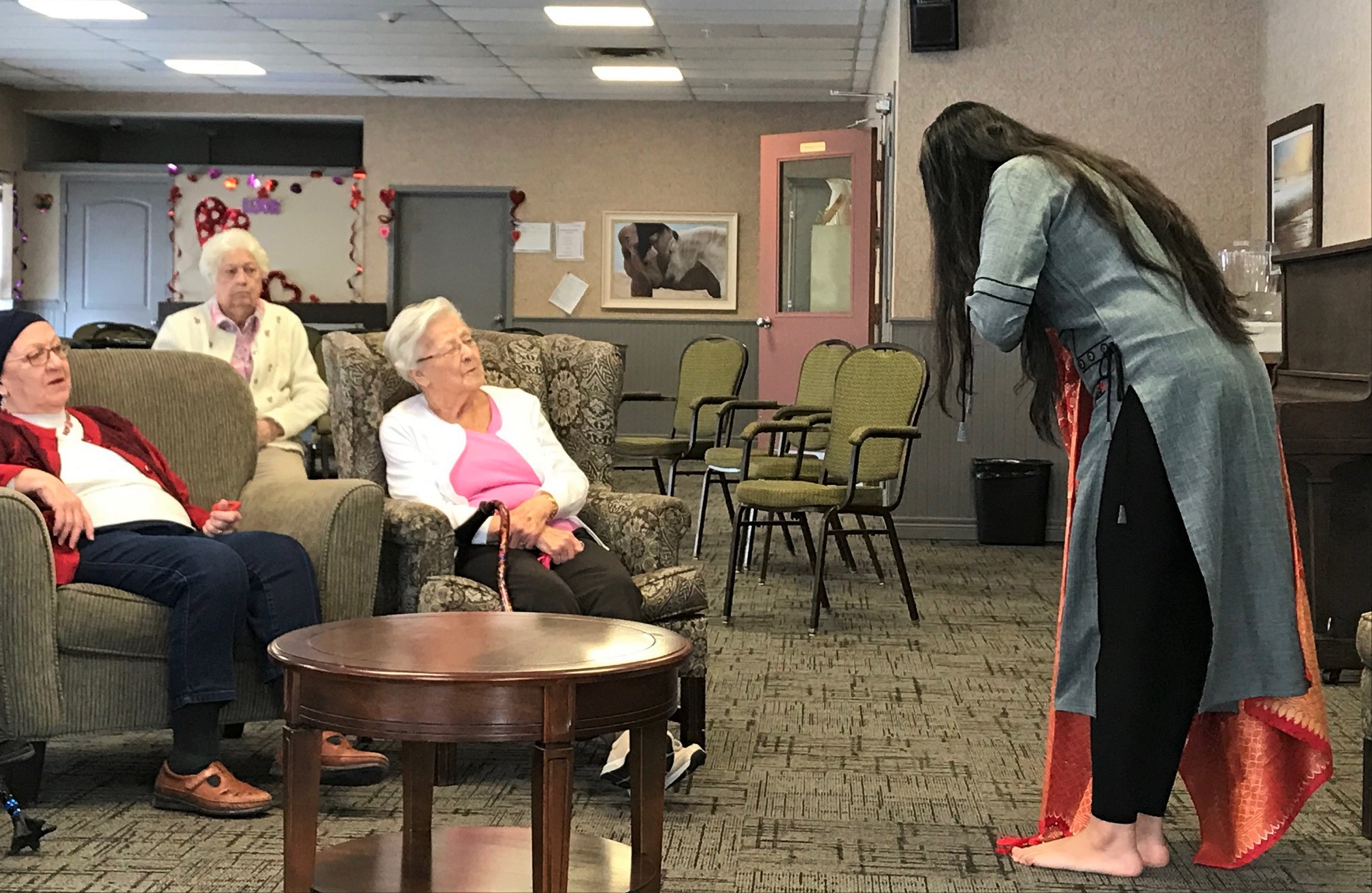
Chaudhari bows and says “namaste,” which she explains is a greeting in her culture.
“Students are encouraged to implement programs that meet the resident’s physical, intellectual, spiritual, social and emotional needs,” said Palermo. In the case of Chaudhari, Palermo says, “It’s always nice to hear how well our students infuse their own experiences into the programs they develop.”
To close the session, residents took part in an activity designed by Chaudhari that combined music with movement and a chance to share stories and memories about their own culture and heritage, passing a therapy ball until the music stopped and answering questions. Many of them noted the similarities between their own cultures and Chaudhari’s, like their love of music and dancing.
