
-

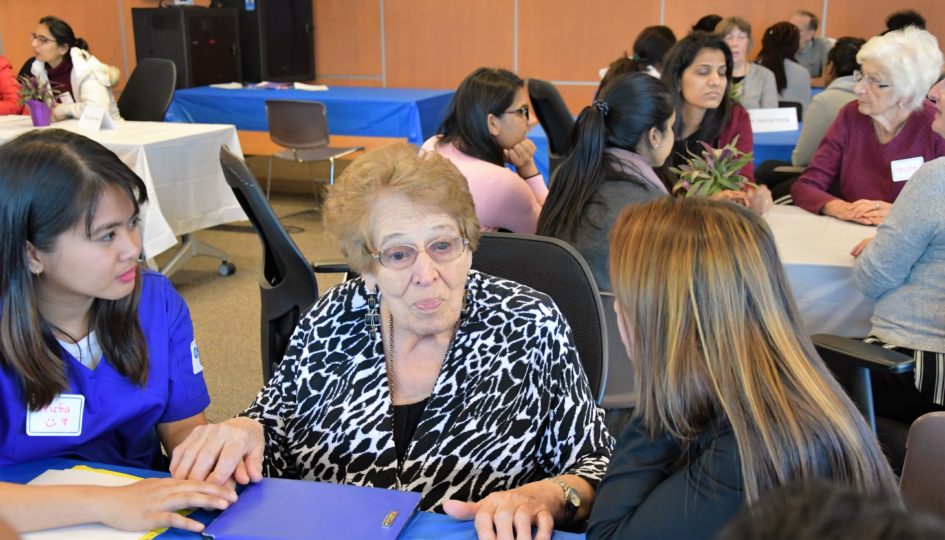
- Students and visitors pose for a group shot.
-
- Professor Lorrie Hudd welcomes visitors and addresses her class.
-

- Students have an opportunity to connect with older adults from the community and learn about healthy aging in Canada.
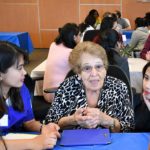
Marcella Peshko arrived at the Healthy Aging Café a local senior eager to share her experiences about aging in Canada with international Gerontology students. By the time she left however, many of the students were calling her, ‘baba’ – meaning grandmother in Ukrainian.
“I gave them permission because many of them are missing their families, their grandmothers and their mothers,” said Peshko, who has been participating in this event for the past three years.
Daisy Corbuz, from the Philippines, was one of them.
“I love this so much. I don’t have my grandmothers anymore and when I see them it touches my heart,” said Corbuz.
Corbuz was among a class of 40 students who got an up-close-and-personal lesson about healthy aging in Canada directly from a group of community seniors at the Healthy Aging Café. The event, held at the Welland Campus on October 18, was part of a Healthy Aging in the Community course, giving students an opportunity to cross cultures and generations to connect with local seniors.
Each older adult was paired with a group of students. For the first half hour, the groups shared their experiences of aging in Canada. Students asked questions that they prepared in advance to ask the seniors, and seniors gave students a snapshot of their lives. By the end of the experience, each student had the opportunity to speak to at least two older adults. The group work was followed by a potluck prepared by the students.
Lorrie Hudd, professor in the School of Nursing and Personal Support Worker programs, noted that the event has been held each term since the program began in 2015 and is a wonderful opportunity for cross-cultural and inter-generational learning and engagement.
“The café is one of the many experiential learning opportunities within the Healthy Aging in the Community course, in which our international students are introduced to the concepts of health promotion for older adults and healthy aging within Canadian communities,” said Hudd, noting that the students enrolled in the program are all nurses. “The goal for students is to learn about how older adults stay healthy, live independently and age gracefully in Canada.”
Peshko, who is from St. Catharines, embraced the opportunity to advocate for the elderly population of Niagara and beyond. She feels it is valuable to share the perspective of an aging person in Canada with the students, to give them insight into her physical, emotional and mental well-being, and express how she would like to be treated as an older individual.
“I am able to share with them how an elderly person should be cared for. The discussions we have give me hope that elderly people will be treated with dignity and respect,” she said. “It is beneficial to me, as a senior, because it gives me an opportunity to share my experience with the next generation. It also gives me a social opportunity to engage with the students. It makes me feel young and included in a project that can help many.”
Students valued the opportunity to make connections with older adults from the community.
Corbuz noted that the main message she heard from seniors she spoke to was that they do not wish to live in a long-term care residence. “They want to stay in their home and have a PSW go to their house if they require extra care,” she said.
Christine Capin, who is also from the Philippines, noted that it was helpful to learn about the seniors and to help further develop her communication skills at the event.
“I think it’s very helpful for us that we’re learning this type of conversation with them. We learn how they live at this age and how they cope with stress,” said Capin.
She was surprised at how active the older adults were.
“One man we spoke to is almost 80 years old and he travels a lot. It’s different than in the Philippines,” she said. “Also, in the Philippines, we don’t have nursing homes or seniors’ homes. It’s very different than here in Canada.”
The event is one of several experiential learning activities in the course. The class will also visit the YMCA, participate in a hands-on physical literacy workshop for older adults, and have an opportunity to listen to a guest speaker – an older adult living with chronic illness from the community. Following the activities, students will have an opportunity to reflect on their experiences and the insights they have gained from them, as part of a class assignment.
This year’s Healthy Aging Café included participants from the Third Age Learning Niagara (TALN). TALN is a not-for-profit organization offering unique opportunities for older adults in Niagara to learn about topics of interest, in a socially engaging, small group setting.
In early 2019, Niagara College became the first college in Canada to be designated as a member of the Age-Friendly University (AFU) Global Network, which is dedicated to the role higher education can play in responding to challenges and opportunities associated with an aging population.
