
The House of Commons is a far cry from the offices, labs and farm fields where researchers from NC’s Agriculture and Environmental Technologies Innovation Centre typically do their work, away from the public eye.
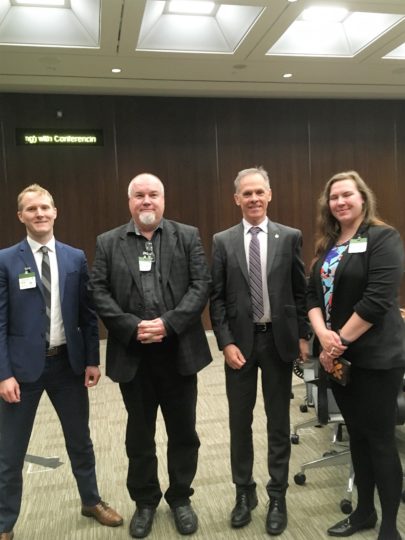
On September 18 however, three NC researchers were in the national spotlight, as they stood before the House of Commons Standing Committee on Agriculture and Agrifood in Ottawa, showcasing how the College is assisting the farming industry and farming exports.
Mike Duncan, PhD, industrial research chair in precision agriculture and environment technologies; Gregor MacLean, research project manager; and Sarah Lepp, senior research associate; appeared before the committee as part of its study of advancements of technology in the agriculture industry that can support Canadian exports.
The committee, which is looking at research, development and innovation with an eye to encouraging Canadian exports, is seeking to understand the challenges, problems and other factors that help or hinder the success of Canadian companies’ efforts to innovate. They invited the team from NC as an effort to gather comments from industry stakeholders about the federal government’s role in the face of these challenges, or problems with respect to agricultural innovation and technology.
MacLean addressed the committee in seven-minute opening statement which focused on NC research projects, funders, and industry partners, which was followed by a period where they responded to questions from committee members.
For MacLean, appearing before the committee was an excellent opportunity to showcase the NC team’s hard work, excellent progress, impacts, and the future potential to a national audience of ministers and teams who shape the country’s future and policy.
A pleasure to meet with representatives from @niagaracollege to discuss their participation in advancing technology in the agricultural industry that can support Canadian exports. pic.twitter.com/vTVRgV82ju
— Vance Badawey (@VBadawey) September 18, 2018
“We believe our work and this technology is a critical part of the future,” he said. “Farmer, agri-food and agriculture technology company collaborations in applied research will continue to play a role in supporting the farmers and Canadian exports, and we are fortunate to be part of that.”
MacLean highlighted projects done by the College’s staff, faculty and students, including Duncan’s work in precision agriculture and environmental technologies as industrial research chair for Colleges. “This session was a reminder of the unique and valuable offerings Dr. Duncan brings to Canadian agriculture,” said MacLean.
“As an NC graduate (Environment Management and Assessment) myself, and staff member now, I am always impressed at the level of passion, dedication and care that faculty, students, and graduates bring to their work,” MacLean said. “This session was a chance to showcase a few examples of what Niagara College does across both campuses.”
MacLean noted that he was pleased to represent the team’s partners, including Ferrero Canada, SoilOptix, and Yellow Gold Farms., as well as its funders. “Reflecting our appreciation for our funders Natural Sciences and Engineering Research Council, Ontario Centres of Excellence, and Colleges and Institutes Canada at this session was an important part of our visit,” MacLean said. “Without the team’s partners and our funders, this work would not be possible.”
Duncan noted that as part of his work for the College, he has an opportunity to meet people and work on ideas and dreams that help agriculture or Canada grow and prosper. For him, appearing before the standing committee allowed him speak about his team’s technology-focused work which can often be difficult for most people to understand, and to increase awareness about projects they are working on with industry partners. He spoke about projects with Ferrero which makes Nutella, for example – which he said were largely unknown to most of the ministers.
“This meeting was eye opening and the importance of gaining some visibility for the project and its general outcomes, which greatly affect both farming and exports, was very important. Opportunities like this one don’t come around that often,” he said. “The College gives me the platform and the help to assit these people and make a difference in the world. For that, I am grateful.”
NC’s Agriculture and Environmental Technologies Innovation Centre team works with private and public sector partners to develop innovative solutions to address today’s challenges in precision agriculture, GIS, computer programming, sustainable food production, plant growth, horticultural practices, greenhouse operations, aquaponics, environmental management and renewable energies. For info visit www.ncinnovation.ca/specializations/agriculture-environmental-technologies-innovation-centre
Gregor Maclean, Dr. Mike Duncan & Sarah Lepp of @niagaracollege with MP Pat Finnigan, (2nd from r), Chair of Standing Committee on AGRI, discussing advancements in research & technology in the agriculture industry re Canadian exports #ncinnovation pic.twitter.com/8Uw3dMwqM5
— Research & Innovation (@NCResearchInnov) September 18, 2018
