
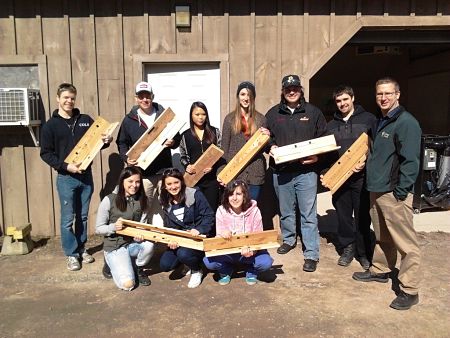
Pictured: Students hold up their salamander boards that they created during a habitat workshop on April 1.
It will be home sweet home for more blue birds, salamanders, pollinators, and mallard ducks, thanks to the efforts of the college’s first-year Environmental Technician students.
After assessing habitat availability and quality, as part of their Ecology course led by professor Andrea Sinclair, and learning about what animals need to sustain themselves and maintain their populations, students had an opportunity to participate in workshops to create habitats on April 1.
During a morning workshop, 24 students were joined by Michelle Martin from Land Care Niagara and Corey Burant from the Niagara Parks Commission. Martin led a workshop to construct blue bird boxes and salamander cover boards. Sinclair noted that well-maintained bluebird boxes with predator guards were promoted by the Ontario Bluebird Society after the Eastern Bluebird was declared rare during the late 1980s, and since that time the Eastern Bluebird populations have rebounded. She also noted that the Niagara Gorge is home to two species of endangered Dusky salamanders that require moist environments, and the cover boards help provide them with shelter from desiccation. Burant collected the habitat structures and will oversee their installation as part of the NPC’s ongoing efforts to enhance its natural areas.
Twenty-three students participated in the construction of pollinator structures and mallard nesting tubes for the Niagara Peninsula Conservation Authority during the afternoon session. Pollinators, such as bees, provide vital ecosystem services and, Sinclair noted that they are not only honeybees – which are not native to North America – but many hundreds of species of native bees, most of whom do not next communally but individually find cavities in plant material or sandy soil to lay their eggs. As natural areas are manicured and decaying material is removed, their habitats are lost. Students constructed three variations of pollinator habitats using pipe, twine, common reed grass, cedar and firewood logs.
Mallard ducks have also been experiencing nest predation, said Sinclair. Nesting tubes – constructed of straw stuffed wire coils, are supported and suspended above water, out of the reach of predators. Females can enter the tube, create her nest and raise her young safely until it is time to push them into the water below. Deanna Linblad, from the NPCA attended the afternoon sessions to answer questions and receive the habitats for installation.
“This is the first year that this habitat workshop was offered in this format. I designed it to allow the students the opportunity to curriculum in a very real way and to contribute to the important restoration projects that our partners are doing in the region,” said Andrea Sinclair. “It is also very important that as our first-year students head out on their co-op placement, they have an opportunity to interact with professionals in the field of conservation biology. Many thanks to our partners at Land Care Niagara, Niagara Parks Commission and Niagara Peninsula Conservation Authority for sharing their time, expertise and passion for the environment with our students.”
– Info submitted by Andrea Sinclair
