
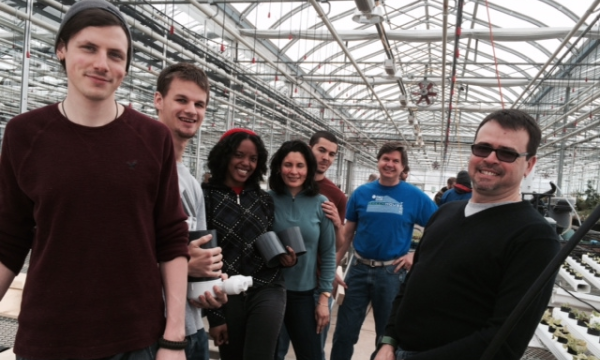
Students bound for the Dominican Republic on an International Field Studies trip during Reading Week have been working on building treadle pumps to bring with them to assist the community. Students from left: Brian Ellis, Craig Koornneef, Jheanelle Reynolds, Andrea Sanchez, Andrew Gonsalves, and Ramon Tovar, are pictured with professor Bill MacDonald (second from right).
When a group of 15 students signed up for an International Field Studies trip to the Dominican Republic for Reading Week, building foot-powered irrigation pumps to help boost the development of the greenhouse industry was not part of their itinerary. Fuelled by a desire to help others however, the group decided that they wanted to help make a difference.
Led by Environment and Horticulture professor Bill MacDonald, and lab technologist Linda MacDonald (his wife), 15 students from a variety of programs will depart for the Dominican Republic for an IFS trip from Feb. 22 to March 2. The one-week study program focuses on cultural exchange through engagement with daily life in the Dominican Republic. Students will tour the city of Santo Domingo and experience rural life in Los Cacaos, where NC works with a fair-trade coffee co-op. They will engage in activities related to fair trade coffee production and learn about the community’s interest in sustainable farming, greenhouse technology and agri-tourism.
MacDonald, who has worked in the greenhouse industry for 25 years and has been teaching for seven, said he embraced the opportunity to use the knowledge he has gained over the years to help others, and to give students the same opportunity. After reading a book called Out of Poverty by Paul Polak, he learned how treadle pumps are used in developing countries, and thought the simple foot-powered pumps could benefit the developing greenhouse industry aimed at growing produce in Los Cacaos region.
“In the Dominican Republic, the electrical power is sporadic and expensive and they need a way to irrigate the crops to get the greenhouse industry going there,” he said. “The treadle pump is a simple human-powered system. It’s a lot of labour but simple to make and people can there can see it and say, ‘OK, we can do this as well.’”
He was particularly impressed by how the students responded to the idea of building treadle pumps and how they have been dedicating their spare time between classes and on weekends, to put them together at the NC Greenhouse. While it has been labour intensive for the students, MacDonald noted that it has been great for team-building.
“It shocked me how much the students have grabbed onto this. I gave them the idea and they ran with in,” he said. “I have not cut a single board. I have not measured a single thing. It’s 100% the students”
In addition to the treadle pumps, the students also plan to help the Los Cacaos community improve their compost teas, used to help control disease on crops. The area has been impacted with coffee rust which is destroying crops and they believe an improved compost tea may be helpful. The students will bring a microscope with them — which has been donated for them to leave in the Dominican Republic — to assess compost teas used locally and compare them to aerated teas which are typically more effective. Two Greenhouse Technician students particularly interested in working on the compost teas during their stay are Andrea Sanchez and Jheanelle Reynolds.
“I’m so happy because I know I’m going to be helping communities in remote areas of a developing country. The idea of helping them with building a greenhouse and exchanging expertise is something I have a passion for,” said Sanchez. “It’s our social responsibility to help out developing countries.
Reynolds, who is originally from Jamaica, came to NC’s Greenhouse Technician program after the University of Guelph. She said she was interested in the opportunity because she loves to travelling and helping others.
“Because of my background, I saw what many communities in developing countries are like and a lot of them really need help,” she said. “I’m interested in helping the community.”
For more information about International Field Studies, click here.
