
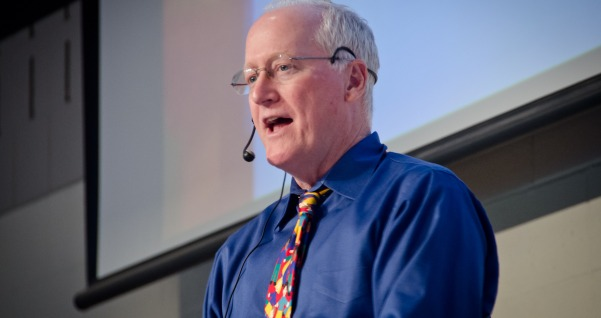
Mark Taylor, PhD, spoke about the differences between Generation Next and its predecessors at the 2013 Day of Reflection.
A very different cohort of learners has been streaming into the college system over the past few years bringing with them a dramatically different set of expectations than those before them.
That generation, Generation Next, was the focus of a keynote address at Niagara College’s 2013 Day of Reflection, on April 25.
Held at the Niagara-on-the-Lake Campus, staff and faculty had the opportunity to learn more about Generation Next, comprised of the segment of the population age 25 and younger – which makes up 80% of Niagara College’s student body.
Taylor is an educator, consultant and speaker who is on the forefront of transformations in educational practice and workplace management. He has recently written articles about Teaching Generation Next and has worked with more than 500 organizations, businesses and schools throughout the U.S. and Canada.
Taylor discussed the differences between Generation Next and its predecessors Generation X (born from 1965-1986) and, before that, the Baby Boomers. Generation Next was the first to be raised in child-centric households ushering in the era of “the trophy child,” when children were rewarded equally despite their varying levels of performance. Helicopter parents became common, hovering around their children ready to swoop in whenever a problem should arise. Consequently, this method of parenting is depriving children of developmental opportunities.
“Now there are snowplows and bulldozers (parents) going in front and pushing the obstacles out of the way,” he said. “If the same mode persists, we will get more of the same in perpituity.”
Taylor discussed reactionary parenting, the concept of parents raising their own children in response to how they were parented. Both Boomers – whose Traditionalist parents left them unsupervised and were highly critical of their children – and Generation Xers – the ‘latchkey generation’ who grew up with two working parents in the home – wanted to do things differently, becoming totally dedicated to their own children. This generation of parents also became friends to their children and facilitators. The goal with Generation Next was to make them happy.
Through no fault of their own, Taylor said their upbringing fostered dependence, helplessness, and self-importance. Their lack of authority figures, experts or bosses in their lives has also resulted in issues of compliance and persistence in the classroom.
Taylor noted that colleges have gone from serving the most compliant generation – the self-sufficient, independent Generation X – to the least. Generation Next, he said, needs a learning environment that facilitates persistence and keeps students engaged.
One of the most dramatic differences with Generation Next, he said, is that it was the first to grow up as digital natives, with videos, texting and social networking.
“Today’s students are no longer the people our educational system was designed to teach,” said Taylor. “Those who fail to meet them in their digital world will be viewed as obsolete and irrelevant.”
Taylor spoke about the importance for Generation Next students to be engaged digitally and for responsibility for learning to be shifted from teachers to learners in the classroom. He recommended that active learning strategies be implemented to get students involved, an increased use of online resources to deliver content, and more opportunities for students to teach one another in the classroom.
Schools that have been most successful, Taylor noted, have been those with a student satisfaction focus. Niagara College has been a leader in this area, having achieved a number one ranking in student satisfaction according to the Colleges Ontario’s KPI Indicators for several years.
Taylor pointed out several contributors to student satisfaction: time spent on campus, attractive programs, programs linked to industry and attractive environments, residential programs, transfer options, post-graduate programs and active learning pedagogies.
The single most important about a campus? The caring attitudes of faculty and staff, he said.
While Taylor noted that he usually speaks about what colleges are doing wrong, he applauded Niagara College for being far ahead of what he sees at U.S. colleges.
“I’m supposed to take people from where they are to where you all are now,” he said.
