
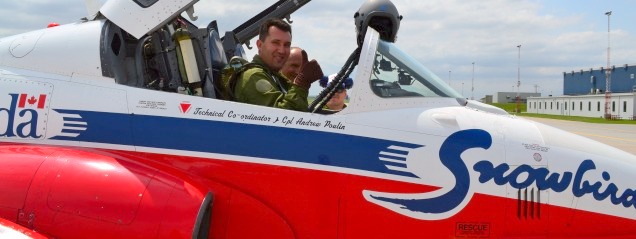
Pictured: NC’s Dean of Technology, Media and Technology Ben Cecil recently had a rare opportunity to fly with the Snowbirds.
Performing aerobatic maneuvers like Cuban Eights on a Snowbird jet is something few pilots ever have the privilege of experiencing – never mind civilians.
But this summer, NC’s dean of Environment, Media and Technology Ben Cecil seized the rare opportunity to not only fly with the Snowbirds, but to take turns at the controls as well – loops, upside down and sideways, weightless, minus G’s and all.
“This was such an amazing treat because it’s what I’ve wanted to do my entire life,” he said.
Growing up, Cecil had always wanted to be a fighter pilot. At age 16 however, he realized he was too tall to pursue his dream, due to height restrictions on fighter pilots.
While his career has ended up following a very different path, it somehow it led him to fulfill his childhood dream on June 6, 2012 – a day he will never forget.
Opportunity takes flight
The opportunity arose for Cecil as a result of being the chair of the National Councils of Deans of Technology – a position he has held for the past two years. Since the June 2012 conference was to be held in Moose Jaw, Saskatchewan, Cecil was interested in having the group visit sites that exemplify technology in the workplace. Because of the NCDOT’s relationship with the Canadian Forces, he pursued the idea of touring the 15th air wing where the Snowbirds reside. He wanted the group to have access to places the public rarely gets to see, such as the maintenance hangar, the real Snowbird lounge, and air traffic control. He contacted military personnel and the Association of Canadian Community Colleges in an effort to make it happen.
When the subject arose of possibly getting somebody to fly with the Snowbirds, Cecil jumped at the chance.
“I said, ‘It’s not going to be somebody, it’s going to be me!” he said.
Through the Canadian Forces and their recruiting arm, Cecil managed to arrange the visit as a promotional item for the deans. As for the fact that he would have the opportunity to fly with the Snowbirds, Cecil wanted to keep it a surprise until the big day.
Preparing for takeoff
Cecil had about eight weeks to prepare for his Snowbird adventure.
Due to his height at six-foot-two and the fact that the jets are designed for much shorter pilots, he opted for a smaller parachute to give him more space. To achieve the 204-pound weight restriction for the smaller chute however, Cecil had to lose weight.
With motivation in ample supply, he achieved his goal.
The preparation was far from over. The morning of the flight was jam-packed with training sessions. Cecil had to undergo ejection training, as well as a full medical examination.
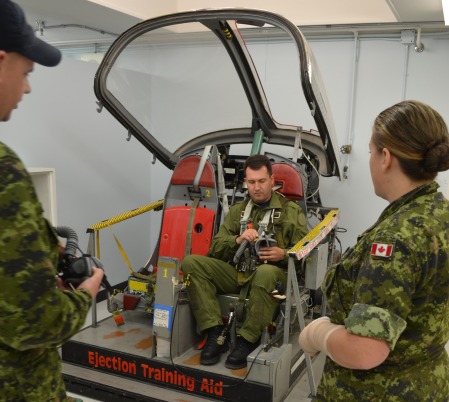
Above: Cecil undergoing his ejection training.
Standards Pilot Captain Derek Mosher took Cecil under his wing. Mosher gave him a rundown of what they were going to do, assessed Cecil’s experience and comfort level with flying and, after he had completed the full training, equipped him the full gear, including a custom suit and helmet.
That morning, Cecil also had the opportunity to meet Commanding Officer Lieutenant-Colonel Maryse Carmichael who, years ago, became the Snowbirds’ first female pilot.
“I had a fantastic meeting with her talking about the incredible opportunities the Canadian forces are providing for college graduates,” said Cecil. “What an incredible woman, very dynamic, hyper-intelligent, with nerves of steel.”
Carmichael even saw him off as he was about to enter the aircraft.
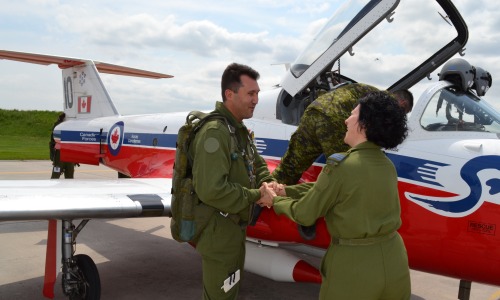
Above: Lt.-Col. Maryse Carmichael greets Cecil as he prepares to board the jet.
Flying Snowbird style
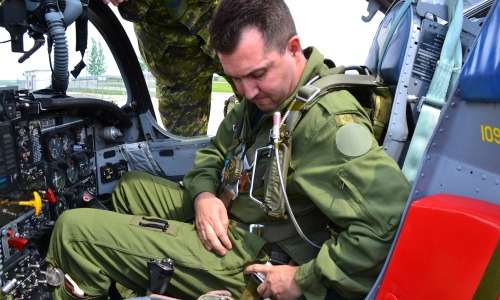
After the morning training session, Cecil recalls entering the air craft, getting buckled in and strapped down in the Tutor jet, side by side with pilot Mosher.
Once they left the runway, Mosher instructed him to follow along, left hand on the throttle, right hand on the stick and feet by the pedals, so he could feel what he was doing with the aircraft.
During every aerobatic maneuver he made, Cecil followed along. After each one was over and Cecil had his chance at the controls to repeat the maneuver.
Cecil said he wasn’t nervous taking over the controls, even after only seeing the maneuvers performed once.
“It was remarkably calm,” he said. “Most people don’t like inverted flight being upside down – that’s where most people get sick – but for me it was really calming and felt natural,” he said.
They were in flight for about one hour and Cecil had plenty of time at the controls. He began with a two-G turn around Mossbank airport south of Moose Jaw where he dropped the jet into a two-G turn at about 20 degrees and held it for about a minute as they circled the airport, flying on its side. They did a nosedive followed by a yank on the stick and a 3G loop. They did what turned out to be his favourite – Cuban Eights.
“Take any roller coaster that you’re on, and instead of having to follow the track, you get to drive the rollercoaster anywhere you want at 400 miles an hour – that’s what it’s like,” he said. “All of those loops and flips and rolls and turns – that’s what it feels like but there’s no track so you can’t see it coming. You have to make the track as you’re doing it.”
While he assumed the controls with ease, the experience wasn’t completely without incident.
During one of the maneuvers, the pilot began cranking the stick left and right at full speed at about 450 feet above a river that snakes its way through the prairies. Without a G suit which would compress the legs to keep blood up to the body and head, Cecil had to do it manually, by compressing his abdomen and core.
After a five-and-a-half G turn, Cecil began to tunnel and called “blackout.” Because he called it so quickly, he didn’t black out and was quickly ready for more.
The pilot took him to about 6,000 feet to a valley north of Moose Jaw with some simple turns over the lake to see the cottages before flying back to the airport. Instead of a typical gradual descent onto the runway from 4,000 feet, their landing was much more abrupt – after all, as Cecil pointed out, it was a Snowbird jet.
“It was so much fun,” Cecil said.
“It was amazing and quite an honour as a civilian without a pilot’s license or a military background, besides the air cadets, to actually have the opportunity to fly the snowbird, not just be a passenger and do acrobatics,” he said. “Only about eight to 10 people a year ever get to do this and most of them are former military or dignitaries and it’s level flight. I got to do the whole enchilada.”
Once-in-a-lifetime experience
Cecil was greeted with a round of applause when he entered the Snowbird lounge after his flight.
“The whole base knew I was up there. Everyone knew – except the deans,” he said.
When the deans eventually filed into the lounge to meet the pilots after their tour of air traffic control, they were surprised to see Cecil standing among the pilots and air crew. Cecil became the envy of the group once they found out where he had been.
Now, months later and back at NC, the scene inside his office may be world away from flying above the 15th air wing with the Snowbirds, but Cecil keeps the memory close by. A photograph of Cecil inside the Snowbird jet is displayed just above his desk, and other photos emailed to him by the Canadian Forces are just clicks away on his computer screen.
He continues to be grateful to the Canadian forces, the ACCC and the Snowbirds for the opportunity.
“The whole experience was incredible and just so much fun,” said Cecil. “It was one of those experiences that you know will never happen again.”
