

On the heels of the launch of Niagara College’s new five-year Strategic Plan, the Health, Wellness and Accessibility Services (HWAS) division is collaborating with key stakeholders from across the College to create a Student Mental Health and Well-Being Framework.
“Student mental health is at a critical point,” said Lianne Gagnon, Director, Student Services. “We know how important it is for our services to be informed by research and best-practices so we can best support our students on their post-secondary journey.”
The Framework will align NC with the National Standard for Mental Health and Well-Being for Post-Secondary Students and link to the ‘wholistic student experience’ focus area in NC’s Strategic Plan. This important area of focus addresses the wellbeing of the whole student; pursuing services and experiences that support mental, physical, emotional and spiritual health for all students.
Leveraging $25,000 in grant funding from Bell Let’s Talk to kick-start the project, HWAS hired external consultants to draw feedback from stakeholders and lay the groundwork for the Framework. They held consultations with staff, faculty, deans, associate deans, and a range of students, including international students, students with mental health lived experience, and those with disabilities.
“Health, Wellness, and Accessibility Services at NC are huge proponents of the student voice, and we received immensely valuable feedback on what our students are experiencing so we can best support them,” said Gagnon.
The results of the consultations revealed that many elements of the National Standard were already implemented or underway at NC, reinforcing the path forward.
Addressing how mental health has changed
Mental health has changed considerably in recent years – especially during the pandemic. Practitioners are focused on reducing stigma, amplifying conversations around mental health in public, and shifting to a more proactive approach to mental health. In many ways, mental health and well-being has assumed a similar approach that medical practitioners use to promote disease prevention. Consistent messages and actions to raise awareness are key.
A new service delivery model at NC: Stepped care
In November 2021, HWAS piloted a new-to-NC service delivery model called ‘stepped care,’ enabled by new funding from the Ministry of Colleges and Universities.
Stepped care ensures greater efficiency and appropriateness of service and is widely considered the preferred model for mental health service delivery at post-secondary. One of the benefits is that program intensity can be either “stepped up” or “stepped down” depending on what students need.
The first step for students seeking support from HWAS is an intake assessment by a Triage Coordinator. The Triage Coordinator decides which supports and resources would best suit the students’ needs. In addition to one-on-one counselling sessions, HWAS is offering more single-session workshops and making more community service referrals in cases when they are better-suited to a students’ need.
While the system has meant a new model of care, it has not changed how staff and faculty can refer students to HWAS. Referrals to HWAS can continue to be made in-person, by phone, or via the Student Wellness Check online form.
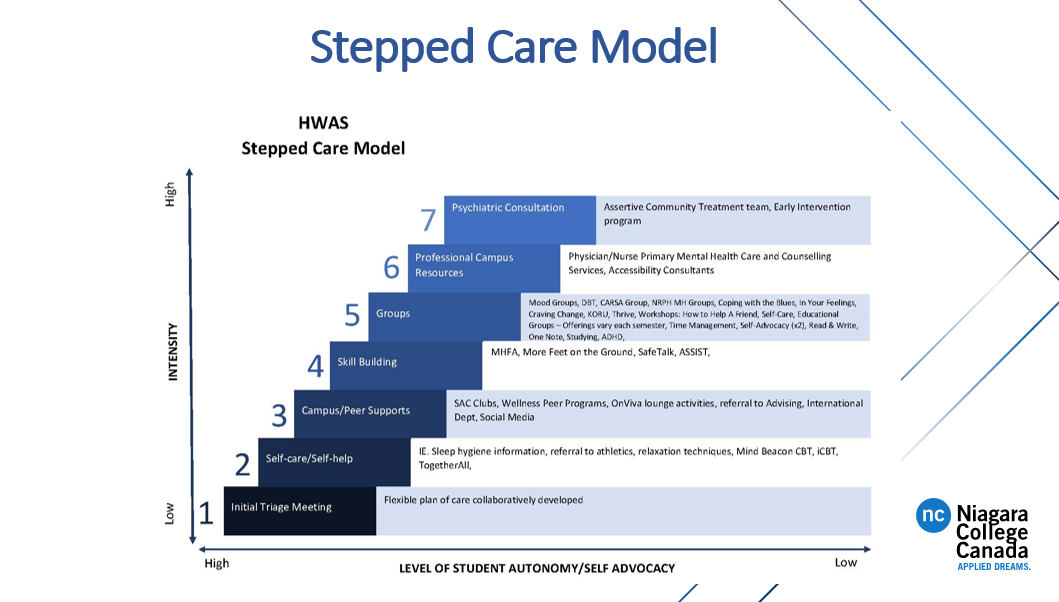
This graphic depicts the stepped care model at Niagara College. Long description/alternate text is available at the end of the article.
Peer Wellness Program
The Peer Wellness Program launched just three weeks before the pandemic shut-down, pivoting online like many NC classes and services. Today, the program operates by hybrid delivery in NCSAC’s Wellness Lounges at both campuses. These spaces are designed to create a relaxed and welcoming atmosphere for students. In recent months, the Peer Wellness Program has seen quite a large uptake in use. Students can have supportive conversations – in-person or virtually – with trained peers for help navigating campus resources, support from budgeting to nutrition and academic challenges, and more.
A boost in workshop offerings
Recognizing that students benefit from the format and variety of group workshops, HWAS has bolstered the sessions available. Examples of workshops offered in 2021-2022 included:
- Thrive @ NC – a 10-week resiliency-based program combining coping skills with learning strategies;
- Beating Homesickness – a transitional workshop to help students adjust to college life;
- Coping with the Blues – a 4 week cognitive-behavioural approach to dealing with depression;
- Feelings – a four-week program where participants learn emotional regulation skills;
- Invest in Rest – a workshop aimed at improving quality of sleep;
- KORU – a four-week mindfulness-based program.
Niagara Region Public Health collaboration
With suicide being the second leading cause of death among youth and young adults aged 15 to 34, prevention is an urgent priority.
HWAS has adopted the NRPH’s Zero Suicide Approach, designed to enhance suicide prevention in organizations that are not a formal part of the health care sector. HWAS will continue to implement the principles and best practices in this approach with the hope of expanding across the college
How to help a student in need
Staff and faculty who have concerns about the well-being of a particular student may Request a Student Wellness Check via the HWAS website. You can assure students that our services are free, confidential and voluntary.
Reasons for requesting a Wellness check include:
- Concern that a student is showing signs of deteriorating mental or physical health.
- Observing some type of unique circumstance that has caused a rapid deterioration in the student’s academic performance.
If a student is in imminent risk of danger to themselves or another person, or if they are experiencing an emergency/crisis that requires immediate intervention, please call 911 and then Campus Security at 905-735-2211 ext. 6999. HWAS is not an emergency crisis service.
Every Niagara College team member can make a positive difference in a student’s life, especially when it comes to their mental health. Thank you for your ongoing commitment to supporting all facets of student success.
Stepped Care Model graphic, alternate text:
This graphic depicts the progression of the stepped care model from lowest to highest intensity, and from a high-level of student autonomy and self-advocacy to the lowest.
- Initial triage meeting: flexible plan of care collaboratively developed.
- Self-care/self-help: i.e. sleep hygiene information, referral to athletics, relaxation techniques, mind beacon CBT, iCBT, Together/All.
- Campus/peer supports: SAC clubs, wellness peer programs, OnViva lounge activities, referral to advising, International department social media.
- Skill Building: MHFA, More Feet on the Ground, SafeTalk, ASSIST.
- Groups: Mood groups, DBT, CARSA group, NRPH MH groups, Coping with the Blues, In Your Feelings, Craving Change, KORU, Thrive, Workshops: How to Help a Friend, Self-Care, Educational Groups – Offerings vary each semester, Time Management, Self-Advocacy (x2), Read & Write, One Note, Studying, ADHD.
- Professional Campus Resources: Physician/Nurse Primary Mental Health Care and Counselling Services, Accessibility Consultants.
- Psychiatric consultation: Assertive Community Treatment team, Early Intervention program.
