
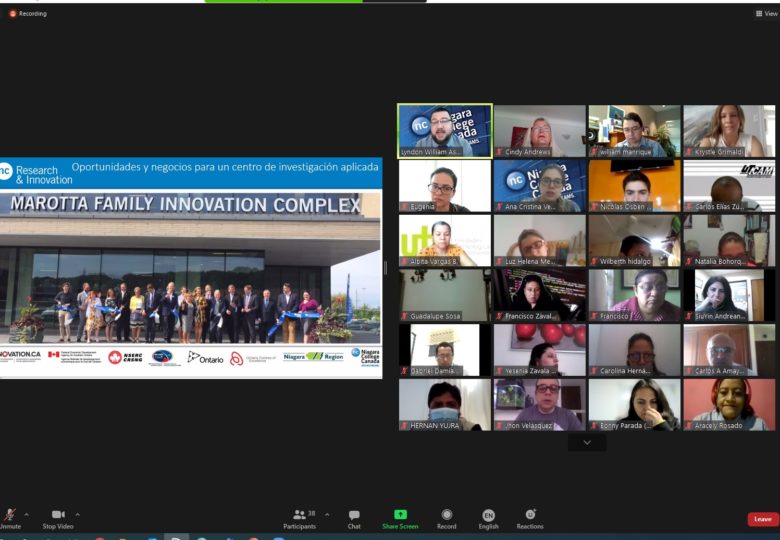
Sharing Niagara College’s unique approach to applied research and support of the Pacific Alliance (PA) program, NC’s Scientific Manager of the Canadian Food and Wine Institute (CFWI) Innovation Centre, Ana Cristina Vega-Lugo, PhD, virtually spoke at the seventh edition of the Conference of the Americas on International Education (CAIE). Inviting the global community in higher education, the theme of this year’s conference focused on international academic collaboration and was held from October 19 to 22.
“Niagara College has a unique approach to applied research focused on collaboration and high levels of client, learner and expert engagement,” said Vega-Lugo. “This adopts many private sector principles into public service delivery that I spoke to the group about. We have been successful in this way, and my hope is that our participants walked away better understanding the value of this approach and are motivated to find ways to incorporate learnings into their own institutional settings.”
After six years in a row of being ranked as a top 10 Canadian research college, earning the number one spot in 2019, NC is a recognized expert in the development and growth of Applied Research Centres in the post-secondary sector. In addition to showcasing the College’s model, Vega-Lugo highlighted what is possible through combined efforts from NC, Colleges and Institutes Canada (CiCan) and Global Affairs Canada to provide training and support for the creation and implementation of Applied Research Centres for Latin America partners as a means to advance their innovation agendas.
“The applied research model at Niagara College fosters and enables collaboration through strategic partnership in the ecosystem to stimulate sustainable growth of the economy,” explained Vega-Lugo. “Niagara College, in collaboration with CICan and Global Affairs Canada was able to provide training, equipment, and on-going support to Latin America countries to implement Centres of Applied Research for the first time. In this collaboration we supported five countries, seven institutes and 40 leaders that were actively involved.”
Through a collaborative partnership between NC’s Research and Innovation and Global Engagement divisions, the College has been delivering critical training for the development and execution of unique applied research models in other countries. The initiative is part of the Pacific Alliance (PA) program, a global development investment managed by Colleges and Institutes Canada (CICan) that focuses on sustainable development and skills for employment in Latin America. In 2018, NC was awarded three contracts for global development projects as part of the PA program. The contracts are for a three-year period and are funded by the Government of Canada through Global Affairs Canada.
“Being a Latin American- Canadian Scientist, it has been fulfilling to deliver training and support to implement centres of applied research following a collaborative business approach for the first time,” said Vega-Lugo. “As part of the team, I helped deliver some of the training particular to business development and industry engagement in collaboration with the other departments.”
Lyndon Ashton, NC’s Centre Manager for the CFWI Innovation Centre, also took part in guiding Pacific Alliance colleagues through methods and approaches to establish applied research and innovation programs and centres in their institute through a comprehensive set of interactive, online training workshops. In addition, he supported the strategic planning process and was responsible for recognizing the training participants with their successful completion of the program earlier this year.
“We are fortunate to live, work, and play in a country that has focused efforts for decades on building capacity in basic and applied research through our post-secondary educational frameworks,” said Ashton.
“Particularly in the last 10 to 15 years, there has been a significant push at federal and provincial levels to increase this capability in applied research supports aimed directly at boosting domestic and global competitiveness among our small- and medium sized businesses. We are now in a position, having learned from our mistakes and our successes, to be able to share our approach with the world. This training is significant because it has the potential to fast-track our international colleagues along the same continuum we are travelling, and assist in avoiding some of the pitfalls, while benefiting from proven concepts to employ customized research and innovation programs in their own communities and institutions.”
Ashton noted that knowledge exchange and capacity building are at the heart of NC’s approach to research and innovation, and that the College extends this belief to its work in the international arena.
“In our line of work, the target audiences for this support are industry partners, students, and staff – fulfilling our economic, workforce, and talent development mandates,” he said. “In this case, our audience is more akin to a ‘train-the-trainer’ approach where we are helping build knowledge capacity with our institutional colleagues from across the globe.”
As a professional economic developer, the initiative spoke to Ashton on a very deep level.
“I’m always looking for ways that my ongoing learning and leadership experiences can be leveraged to assist others, benefitting our communities in the pursuit of opportunity and accessibility to improve socio-economic and workforce development tools and success,” he said. “With respect to research and innovation, this can be seen through the sharing of best practices and learnings, which focus on increasing capabilities and capacities for post-secondary applied research centres to collaborate effectively with local industries in need of commercialization and training supports.”
As Canada’s leading global college, Niagara College has successfully completed more than 100 capacity building and training projects over the past 20 years in more than 25 countries, including Barbados, Bhutan, Chile, Colombia, Grenada, Jamaica, Malawi, Mexico, Saint Lucia, Saudi Arabia, South Korea and Vietnam. For more information on Global Education and Partnerships and how to get involved, visit ncglobal.ca.
