
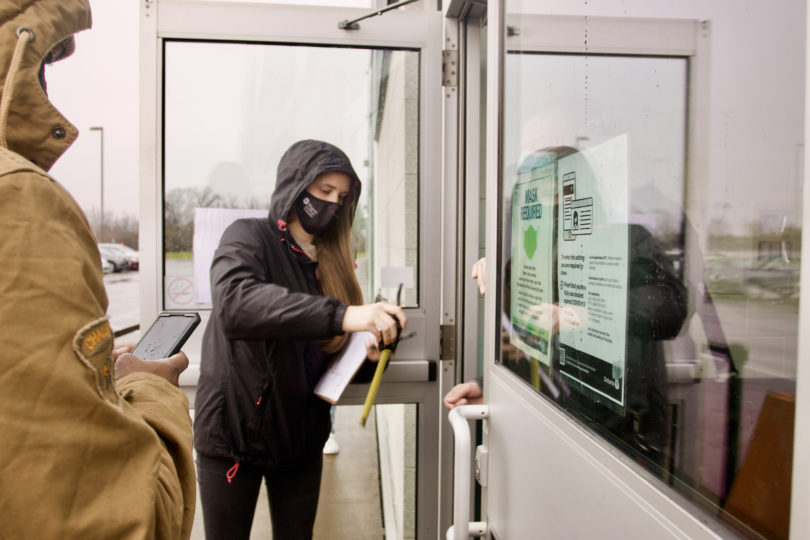
When Riko Miller and a handful of his Recreation Therapy classmates stepped into the washroom at Youngs Sportsplex in Welland last week, they noticed the paper towel dispenser was placed a little too high on the wall.
It wasn’t an issue for any of them to reach. But Miller knew it wouldn’t be easy for someone in a wheelchair.
Using a Facility Accessibility Design Standards (FADS) checklist and the cameras on their smart phones, Miller and crew documented the awkward height. They also pulled out tape measures to determine whether doorways at the sportsplex were wide enough for people using wheelchairs or walkers to pass through easily. And they scrutinized the proximity of accessible parking spaces to pedestrian pathways, the placement of signage to help people flow through the building, even the location of gravel near outdoor playing fields, which would be tough for someone with mobility issues to navigate.
All of it is part of an accessibility audit the students were conducting to determine what modifications the sportsplex needs to be fully accessible for next year’s Canada Summer Games in Niagara. Youngs Sportsplex, which will host soccer during the Games, is one of six Welland buildings that NC Recreation Therapy students are assessing as part of their third-term Community Practice and Partnerships class.
“We’ve noticed what needs to be corrected and we’ve seen some positives as well,” Miller said. “I’m not surprised. This is pretty typical.”
Other facilities audited by NC Recreation Therapy students include Welland Baseball Stadium, Welland Tennis Club, Welland International Flatwater Centre, Oakes Park (Baseball), and Legends on the Niagara Golf Course.
The audits are being done in partnership with the Canada Summer Games and Niagara Region to prepare for the onslaught of athletes, coaches, spectators and volunteers of all abilities who will be part of the two-week event next August.
“When looking at a venue, it’s what their experience is when they move through the building and are going through the flow of their visit,” said Prof. Christine Wilkinson, co-ordinator of the Recreation Therapy program. “This is a real-life opportunity to look at accessibility in action.”

NC Recreation Therapy students Sabrina Ioannoni, Abby Silver, Paige Phillips, Riko Miller, Lucas Steingart and Lindsey Taylor completed an accessibility audit of Youngs Sportsplex in Welland for the Canada Summer Games last week. It is one of six Welland buildings students will be auditing for accessibility for the Games.
Students will compile their findings and make recommendations to both organizations.
Applying their knowledge to a high-profile event is a unique opportunity, Wilkinson noted. Typically, students would visit a favourite venue on their own to do an audit, writing up their findings for a class assignment.
Either way, the exercise reinforces the lessons students learn about ensuring and assisting the community involvement of the people they’ll work with when they graduate.
“Everyone should have the ability to go places and do things,” said student Abby Silver, who was part of the Youngs Sportsplex audit group. “If I can go to these places, other people should have access to these facilities.”
The students were joined Thursday by Steve Murphy, the Region’s accessibility advisory co-ordinator and accessibility auditor/co-ordinator for the Canada Games.
Students were asking all the right questions during the audit, Murphy said.
“They understand why this is of value to the community,” he said. “Even if they’re not using this in their careers, you’re introducing someone to a new way of looking at stuff. People have the same needs, whether they’re able-bodied or in a wheelchair.”
