

Kulvir Singh Gill was in his late teens or early twenties when he started to become curious about his background.
Born into a Sikh family with a multi-generational connection to the faith, Gill said much of what he learned about Sikhism has come from his journey of being a “passive listener, observer and curious student.”
On May 27, Gill shared what he’s learned about living a more Sikh-inspired life during a hybrid event at the Daniel J. Patterson campus entitled “The Sikh Faith: Exploring Faith, Culture and Community.” The event was a follow-up to Sikh Heritage Month in April.
Starting with the creation of the Sikh Empire through to 1888 when the first Sikh – Prince Victor Albert Jay Duleep Singh – arrived in Halifax, and to 1897 when the first practicing Sikhs came to Canada, Gill provided an overview of the origins of Sikhism in Canada.
“It was the Diamond Jubilee of Queen Victoria,” Gill said. “The British army was invited from all over the world. Different regiments and Sikh regiments from India, Hong Kong, Singapore were all invited as well.
“The Sikhs have always been very enterprising people and (explorers), so the Sikhs (from) Hong Kong – rather than (return from Britain) through an Asian route – decided to check out this place called Canada. They landed in Halifax and they made their way across the country and saw a whole lot of nothing. It was pretty empty at the time, so they went back and told their friends and their cousins and family in Punjab, which was landlocked and running out of space.”
The first wave of Sikhs started coming to Canada in the early 20th century, Gill said. Today, Sikhs make up two percent of Canada’s population.
“There are Canadian politicians in all stripes now in all parties, represented at the highest levels. The head of a political party is now from a Sikh background, and we’ve had many (cabinet) ministers, mayors, premiers that have come from the Sikh community.
“We’re actively involved in the Canadian Forces at all levels – be it federal RCMP or the armed forces or, at a provincial level, (the) OPP. So we’re fairly embedded in the community.”
Beyond just the history of Sikhs in Canada, Gill, the Board Chair at the Sikh Research Institute, also spent time talking about the Sikh perspective on the Divine, the world surrounding us and the purpose of life.
Gill said that when he teaches children in Grade 6 or 7, he asks them to visualize God. Most tell him they imagine God as being anthropomorphic: an elderly, white male with a beard and dressed in a robe.
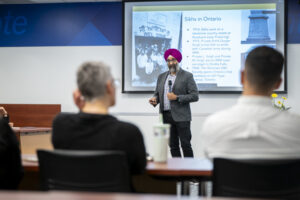 “But for Sikhs, it’s a very different construct of what we think of the Divine,” Gill said. “Our view of the Divine is that there is actually only one: one creator, one force, one energy. (It) was there at the beginning, is there now, and when everything is gone (it) will be there at the end.
“Our concept of the Divine is the Divine has no form,” he said, meaning the Divine has no markings, no distinction, no beginning and no end. “(It) is one energy of force that was not created.”
In Sikh culture, there isn’t a word for God. Instead, attributes of God are used, such as “the all-powerful,” “the all-knowing,” “the one that is destroyer of pains” or “the nourisher.”
The Divine is in everyone and everything that’s been created – the beautiful things and the not-so-beautiful things, Gill said.
“Some say the Divine is out there – far, far away – and some say that it’s very close to (them) and they’re both right. It is everywhere and nowhere at the same time.”
Gill spoke of the 10 principle beliefs of the Sikh religion, including recognizing the divine presence in all creation, facing challenges with a calm and fearless mind, and viewing others with love, compassion and understanding.
He also talked about the importance of the turban and the Five Ks, which are the five items that Sikh spiritual master Guru Gobind Singh commanded initiated Sikhs (those who have joined the Khasla or community of initiated Sikhs) to wear at all times: Kes (uncut hair), Kangha (comb), Kach (soldier-shorts), Kara (iron bracelet) and Kirpan (traditional sword).
“The turban was not part of the Five Ks, but it was… another gift that was given to us, and this is really a sign of serenity and royalty,” Gill explained. “This was a gift that was given in saying, in a crowd of thousands (or) millions by design, you’ll always be able to spot the Sikh and you can always hopefully know that they’ll answer the call of whatever is needed by their community, whatever is needed by society around them, regardless of the personal sacrifice and the cost that comes to them because they’ve committed to something bigger than themselves.”
Gill noted that the Khasla is accessible to all Sikhs who choose to join, not only men. He is initiated and carries the five articles of faith, as does his wife and his parents.
As he concluded his 60-minute presentation, Gill encapsulated the Sikh religion as one built around a single universal force that connects everyone and everything.
Everyone has the same spark in them, and it’s everyone’s responsibility to connect through a sense of grace and divine wisdom that can’t be learned in books, he said.
“It’s experienced through reflection, through service, and by connecting with and reflecting on the creator and serving the creation.”
