
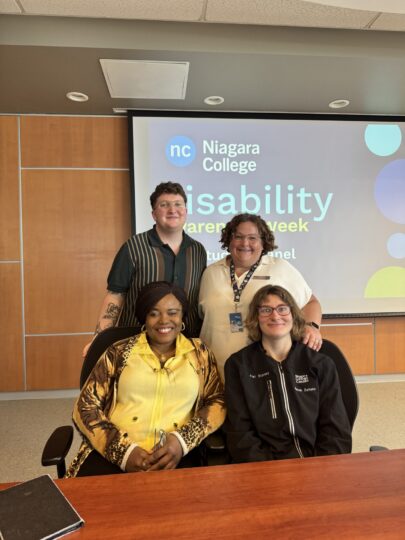
A student panel kicked off NC’s second annual Disability Awareness Week, highlighting two key messages: the importance of asking individuals what support they need and recognizing that while disability may be part of a person’s identity, it should not define them.
Students – Olivier, Alanah, and Sylvia – shared their lived experiences at the start of the week’s events, sharing personal stories and encouraging fellow students, faculty and staff to practice empathy and to consider the world from different perspectives.
NC students and employees gathered at the Welland Campus and online to listen, engage and ask questions.
With NC’s Kate Wiley, Educational Developer with the Centre for Academic Excellence, as panel moderator, student panelists opened the discussion by sharing insights into navigating college life with a disability.
Olivier – studying in the Social Service Worker program and originally from New Brunswick – spoke about Tourette Syndrome (TS), a neurological condition that can cause involuntary motor and vocal tics, chronic pain and other symptoms.
He said his experiences living with disabilities in the school system – compounded by being trans – were isolating as he was often excluded from the classroom environment. Those early experiences led him to believe that college might not be an option, underscoring how misunderstandings around disabilities can create barriers throughout education, even long before reaching college. Even now in post-secondary education, Olivier said he carries a lingering fear that even one uncontrollable tic can lead to consequences like being removed from school.
When asked about what meaningful support looks like at NC, Olivier shared that connecting with Health, Wellness and Accessibility Services (HWAS) at Open House, even before applying to his program, was crucial in helping him determine whether he could succeed and feel supported. Together, they worked for three months to prepare for Olivier’s first term.
“You show up at Niagara College and they say you’re fine, and at first you don’t believe it, until, over time, they prove it,” said Olivier.
Alanah, studying Business, shared her good humor on the panel. Born with cerebral palsy (CP), a spectrum disability which can impact people in a variety of ways, including speech and mobility, Alanah shared that she was originally drawn to NC by the range of program options and the accessible, welcoming campus. Joining the panel allowed Alanah to share her experience, while expressing her desire to advocate for others.
When asked about meaningful support at Niagara College, Alanah explained that Letters of Accommodation (LOA) provide formal opportunities for tailored support which can guide faculty support, helping students with disabilities have an equal opportunity to succeed. Olivier and Sylvia added that LOAs are essential to feeling supported in their education, especially given the barriers within education for those with disabilities.
Sylvia, a mother of three from Nigeria, left her career as an otolaryngologist to give her children a more prosperous life in Canada. Shortly after arriving, she became critically ill and spent months in a coma, which left her with a visual disability. However, her passion for healthcare remained strong, and she enrolled in NC’s Practical Nursing program. Sylvia also shared an experience in which her LOA was not applied during a practical assessment, making the situation both emotionally and academically challenging. With support from folks working in HWAS, she was able to retake the assessment with the appropriate accommodations in place, supporting the success she deserved.
The panelists discussed how living with disabilities amplifies test anxiety.
Sylvia praised adaptive technology, such as text-to-speech in the test centre, for removing barriers and reducing stress during exams.
“Nobody likes exams, but for students with disabilities, there is an extra layer of anxiety,” said Olivier, who shared an example of a faculty member who offered their office on the fly when the test centre was unable to accommodate.
Alanah asserted that LOA’s do not give students with disabilities an advantage. Instead, they level the playing field.
“We don’t want anyone to feel sorry for us. We have had obstacles… but we are not our disability, and we don’t want to be defined by our disability,” she said.
In addition to the panel, a Photovoice project was displayed at the event which included contributions from NC students living with visible and non-visible disabilities to share their perspectives on personal strengths, accessibility and ableism. Photovoice is a method where people use photography and written words to capture and share their lives experiences and thoughts on a topic or issue.
Disability Awareness Week continues through to March 13, with student trivia, learning workshops, adaptive sport, film screening, and more.
