
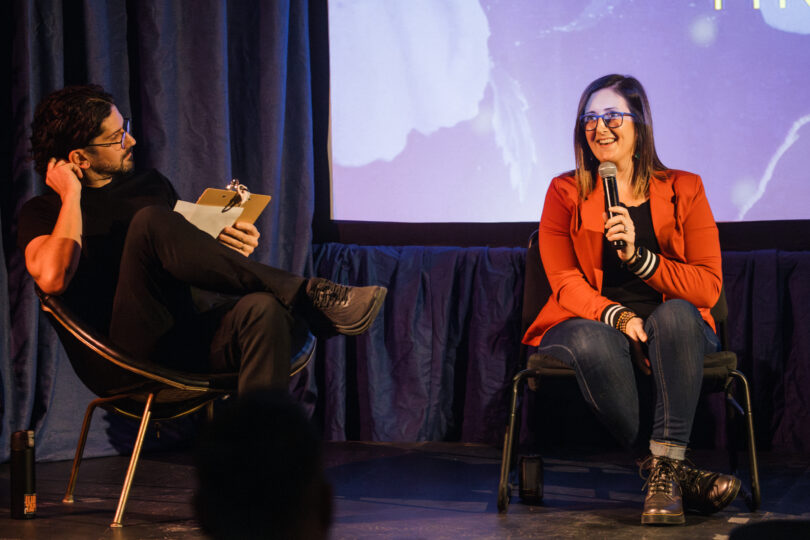
When NC alum Ren Kangas (Broadcasting – Radio, Television and Film, 2024) was planning the Mighty Niagara Film Festival, she knew exactly who to invite to speak about how artificial intelligence (AI) is reshaping storytelling: her former professor.
“I thought of Darcie instantly,” said Kangas, now working as an archivist at the Niagara Arts Centre. “Darcie’s classes were always my favourite.”
Darcie Hillier, a longtime professor in the School of Academic and Liberal Studies, teaches Writing for the Screen, a foundational course for students in the BRTF program.

NC professor Darcie Hillier (left) and alum Ren Kangas (BRTF 2024) at the Mighty Niagara Film Festival.
On November 15, Hillier was joined by fellow panelists and screenwriters, Jonathan Sobol (BRTF, 1999) and Andrea M. Scott, for a panel discussion chaired by Adrian Thiessen, filmmaker, media artist and creative head at Fourgrounds Media Inc., a local video production company.
Amid well-worn sofas and the smell of fresh popcorn, Hillier said the cozy microcinema on St. Paul St. in St. Catharines was the ideal place for local cinephiles to tease out the benefits, risks, and creative possibilities of AI.
Hillier called the panel a “thought-provoking experience,” noting a range of perspectives, from those that embraced and praised AI to skeptics who had ethical concerns about the technology diminishing or erasing their roles as creatives. Panelists weighed AI’s tendency towards tropes and clichés, but also acknowledged how, when prompted well, it had the ability to speed up workflows and streamline creative tasks.
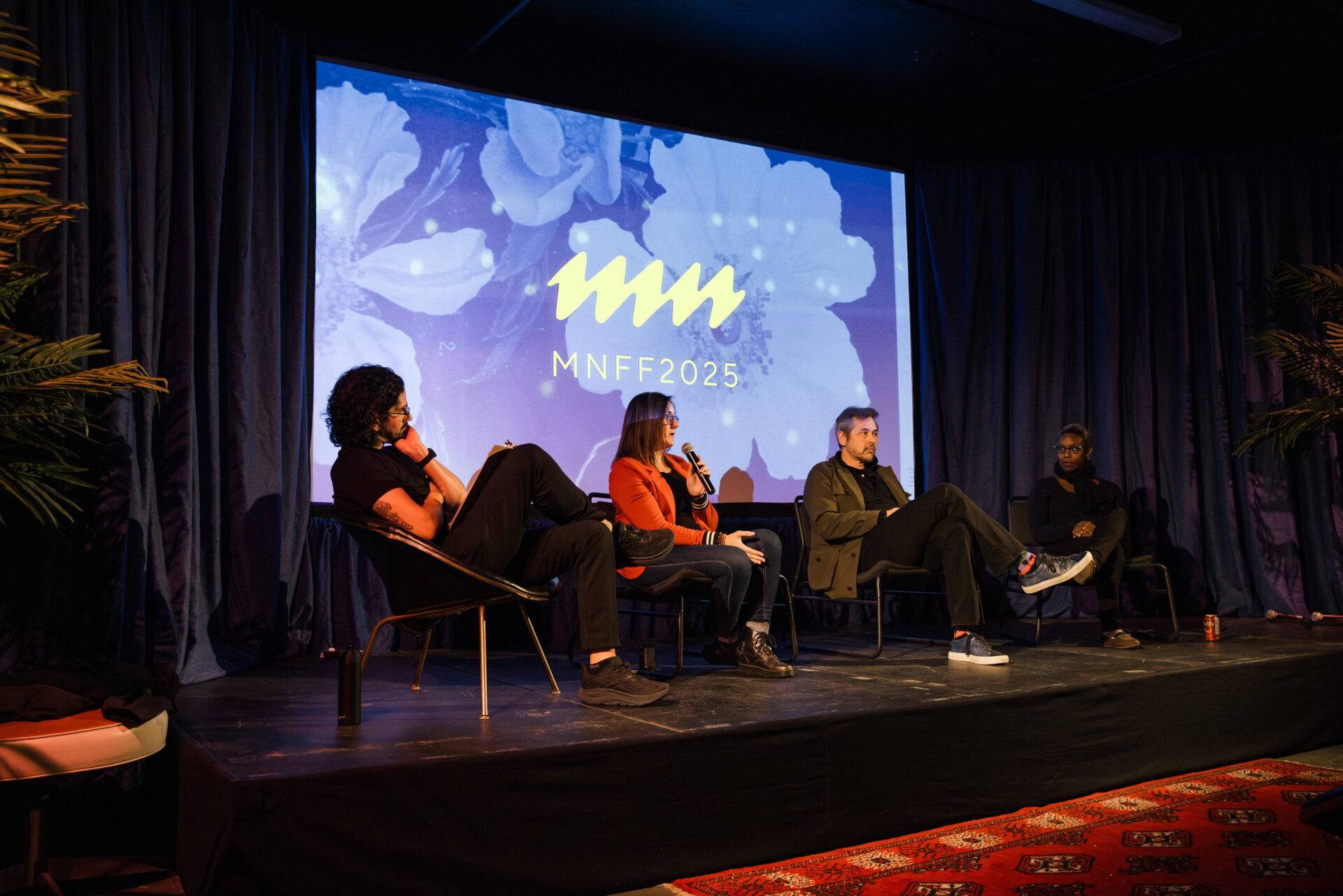
Drawing on her classroom experience, Hillier served as a bridge between differing opinions, noting that some students over-rely on AI at the expense of developing their own creativity.
“To correct this misconception, my students and I have explored the process of asking Chat GPT to come up with stories and scripts for us; students found that the results are not good,” said Hillier.
Hillier asserts that using AI effectively as a writer is a complex skill with a steep learning curve; hardly a time-saver if it produces shoddy work.
“However, it can help students who struggle with formatting, allowing them to worry less about the technicalities and focus more on the artistic creation of unique, deeply human stories.”
Hillier, who worked in Vancouver’s film industry in the early 2000’s, felt the panel provided valuable insight into what her students will encounter as the industry evolves.
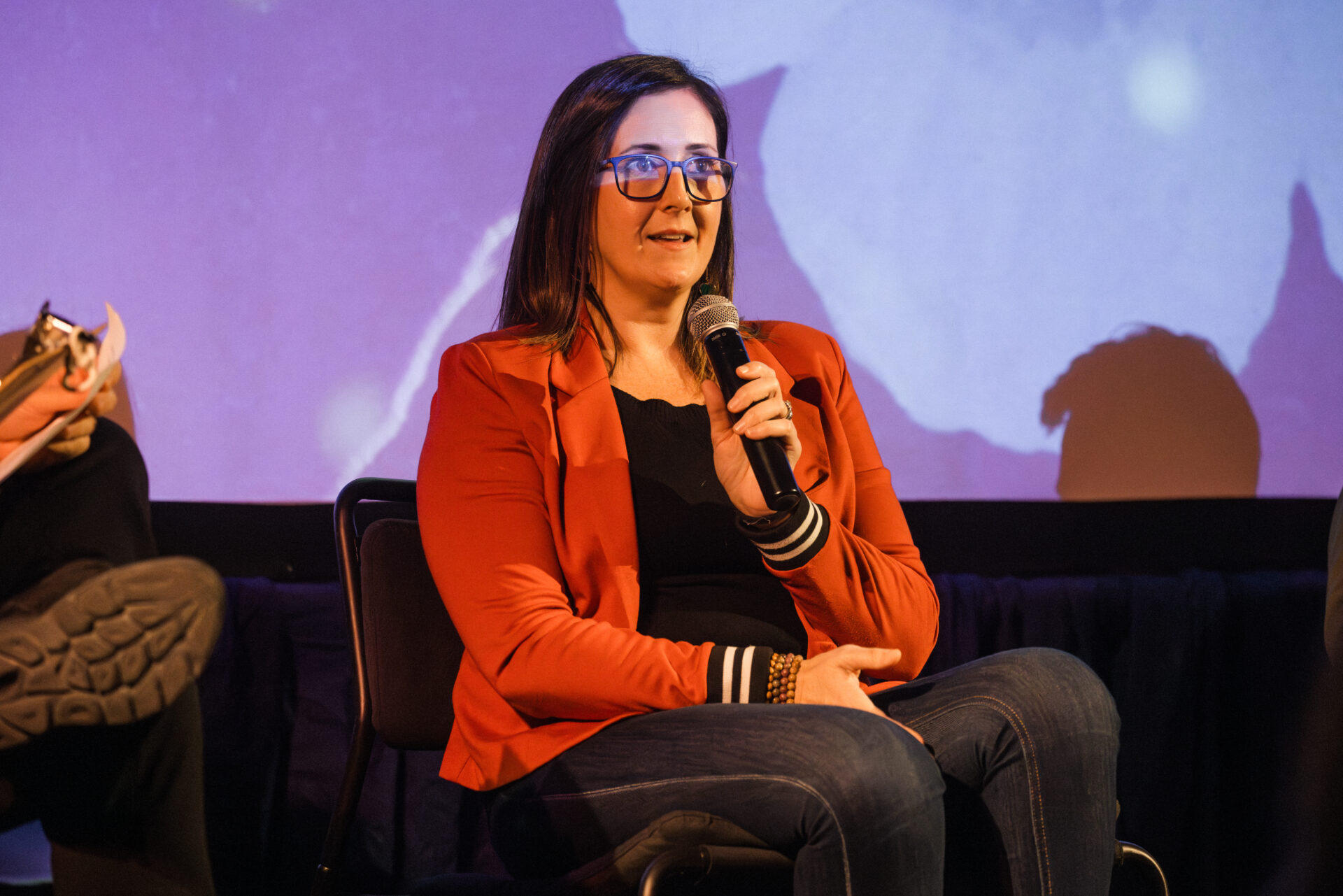
“Revisiting my personal connection, outside of academia, was both nostalgic and professionally stimulating,” she said.
Kangas brought a distinctly Niagara touch to the festival, leading a workshop on using wine to process film. She taught participants about 16mm cameras, eco processing, and developing cinematic film 100 feet at a time.
Her connection to the Niagara Artists Centre and the Mighty Niagara Film Festival began as a student.
“I have Niagara College to thank for that,” said Kangas, whose professor connected her with the Niagara Artists Centre to explore using her great grandfather’s old film equipment.
“Their archivist at the time taught me how to use the projector and screened my family videos, they happened to have a job opening at the time and the rest is history,” said Kangas. “Everything I learned at Niagara College has been transferable to my work at NAC: film techniques, video editing, writing, and most importantly the connections I made there.”
The experience brought Kangas and Hillier full circle, reconnecting them through their shared passion for storytelling.
“She is incredibly supportive, passionate, and does everything she can to help her students succeed,” said Kangas, underscoring the significance of having a female professor in a male-dominated industry.
As humans and machines co-write more and more, Hillier underscores the heart of storytelling:
“Storytelling is a deeply human ritual that we have been participating in almost since the dawn of language. The best told stories envelop us wholly into a relatable facet of the human condition, forcing us to grapple with questions about our very humanity. They are how we produce meaning and make sense of the world around us.”
The Mighty Niagara Film Fest is hosted each year by the Niagara Artists Centre, located at 354 St Paul St in St Catharines, showcasing local filmmakers and industry professionals.
