

A team of accessibility-minded educators at Niagara College have launched a self-reflection tool to help instructors spot hidden barriers to make their courses more inclusive for students.
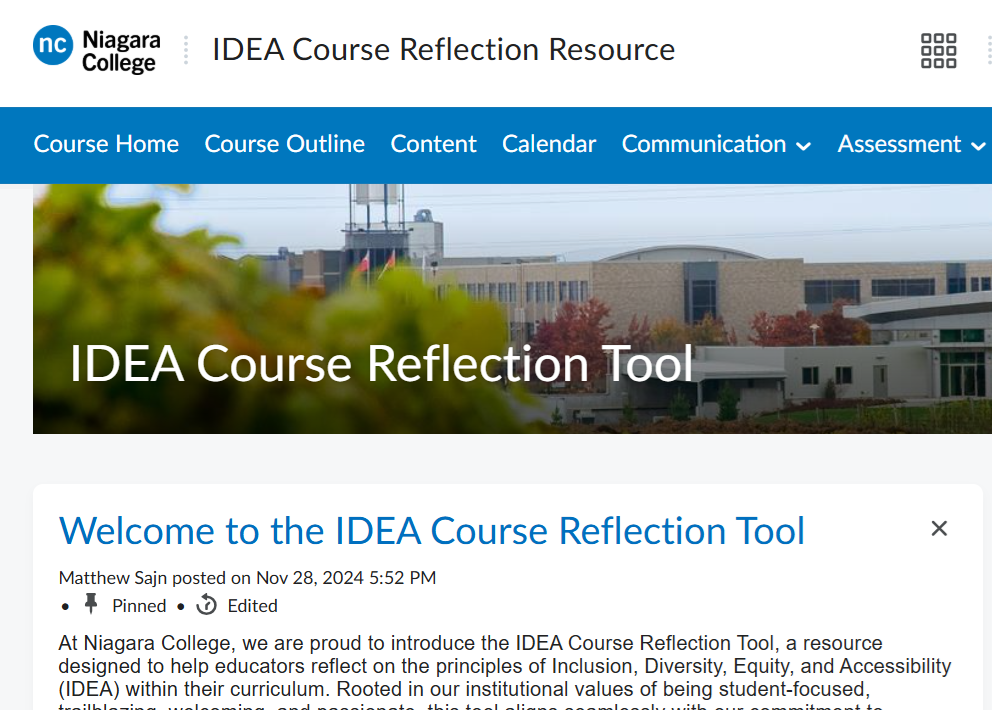
The IDEA Reflection Tool is a resource in Brightspace designed to help NC educators reflect on the principles of Inclusion, Diversity, Equity, and Accessibility (IDEA) within their curriculum.
The self-paced reflection tool was developed by Kate Wiley, Educational Developer, CAE, Matt Sajn, Instructor, Academic and Liberal Studies and EDI Catalyst, and Jaclyn Frail, Dean, Community Services Justice and Fitness, with material reflecting research and best-practices.
“It can be hard to improve our learning spaces and teaching practices when we don’t know what we don’t know,” said Wiley. “The tool was designed for reflection, to uncover unintended barriers, and to guide instructors toward opportunities for meaningful change.”
The IDEA Reflection Tool helps instructors identify strengths and improvement areas in their curricula. It offers strategies and resources for teaching plans, assessments, readings, lectures, and overall course design. It focuses on four key areas: Teaching and learning plans; reading lists and lectures; assessments; and learning environments.
Each section opens with explanatory content (text and video) followed by a 10-question quiz with yes or no responses with prompts rooted in best practices. The content was developed from an environmental scan of leading models and frameworks employed across higher education.
“The strength of the tool lies in that it provides instructors with a self-directed and differentiated way to step back and think about how well their courses might be meeting the needs of our students,” said Sajn. “Rooted in current research, it also provides actionable ways to enhance course features, from TLPs to the physical and digital space of the classroom.”
Wiley explains that a more accessible learning experience helps students feel that they belong, which can go a long way to their success.
“That feeling of being seen and respected makes way for students to be more motivated, engaged, and achieve greater academic success,” said Wiley.
The seed for the project was planted by faculty in Community Services, Justice, and Fitness, who began asking how they could make curriculum more inclusive, equitable, and accessible. Curious about what tools and best practices might already exist, Frail reached out to Wiley to explore the possibilities. That search led them to Matt, whose role as an EDI Catalyst helped transform those early conversations into a concrete initiative.
“In creating the tool, I don’t think that we assumed that instructors were or were not doing any of the things mentioned in the tool,” explained Sajn. “Rather, the goal is to provide opportunities to reflect on and build on the great work being done in our NC community.”
Sajn, Wiley and Frail spoke about creating and piloting the tool at a session during Inclusion Week last year. The IDEA Reflection Tool directly supports goal three, action one within the Employee Experience area of the EDI Blueprint. It also broadly supports the Student Experience area.
EDI Catalysts like Sajn have met monthly for a Community of Practice where they share project updates, ask questions, and identify support needed.
“Projects like this remind us of what’s possible when we bring together some of the best minds on campus,” said Samah Sabra, Director of EDI and Accessibility. “As we wrap up the third year of the Blueprint, we’re grateful to the EDI catalysts and all the departments that helped make NC a more inclusive and welcoming community.”
The IDEA Course Reflection Tool is now available in Brightspace.
