
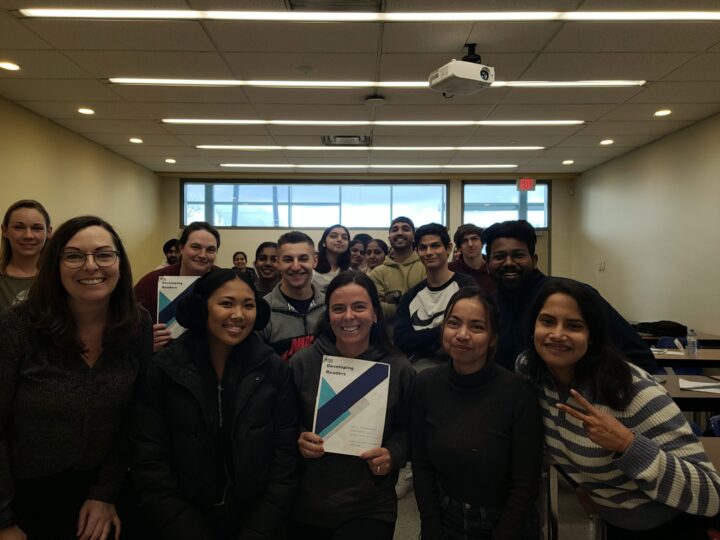
This semester, first-year students in Niagara College’s Educational Assistance and Adult Supports program have been gaining real-world experience supporting literacy development in children through a new initiative called Developing Readers.
Organized by School of Community Services Professor Barbara Morris, the Developing Readers program partnered with several DSBN schools in the area to create hands-on learning opportunities for NC students, as they learn to navigate the needs of elementary school children post-pandemic.
NC students traveled to the DSBN schools to meet one-on-one with their reading partners – spanning from kindergarten to grade two – over the course of four weeks.
“The Developing Readers program offers our students the opportunity to put the teaching tools and skills they learn in the classroom into practice,” said Morris. “Now, more than ever before, EA’s are thrown into many different situations that require them to be flexible in supporting the children in their classroom. This program encourages them to use reading as a tool to connect with students who may be struggling by building empathy, improving cooperation skills and building communication.”
The Developing Readers program is tied to the Literacy Supports and Strategies course, which teaches NC students the fundamentals in supporting early literacy, while reinforcing the underlying principle that all children have the right to read. This was the first time Developing Readers was part of the course-based curriculum in the Educational Assistance and Adult Supports program.
For first-year student Roxanne Kater, Developing Readers has played an important role in preparing her for her future career.
“The Developing Readers initiative has helped me prepare for my future as an Educational Assistant by providing me with the opportunity to work one-on-one with students who are at different levels of learning,” said Kater. “This program has given me the tools to feel confident using literacy and reading as a resource to support students with all levels of learning abilities.”
Chelsey Dewhirst, also a first year-student at NC, found that the program improved her ability to communicate with students at their level.
“Developing Readers has helped me learn how to speak to students and effectively communicate with them in a way that allows them to understand the goals of our reading session, while helping them develop their literacy skills.”
This was the first time that an in-person project was part of the first-year course and Morris plans on continuing the momentum.
“It is so important for our students to get out into the community to gain first-hand experience working with children,” she said. “Reading together is an essential interactive and communicative skill and Developing Readers has given our students the confidence to build these skills before they start their careers in such an in-demand field.”
